
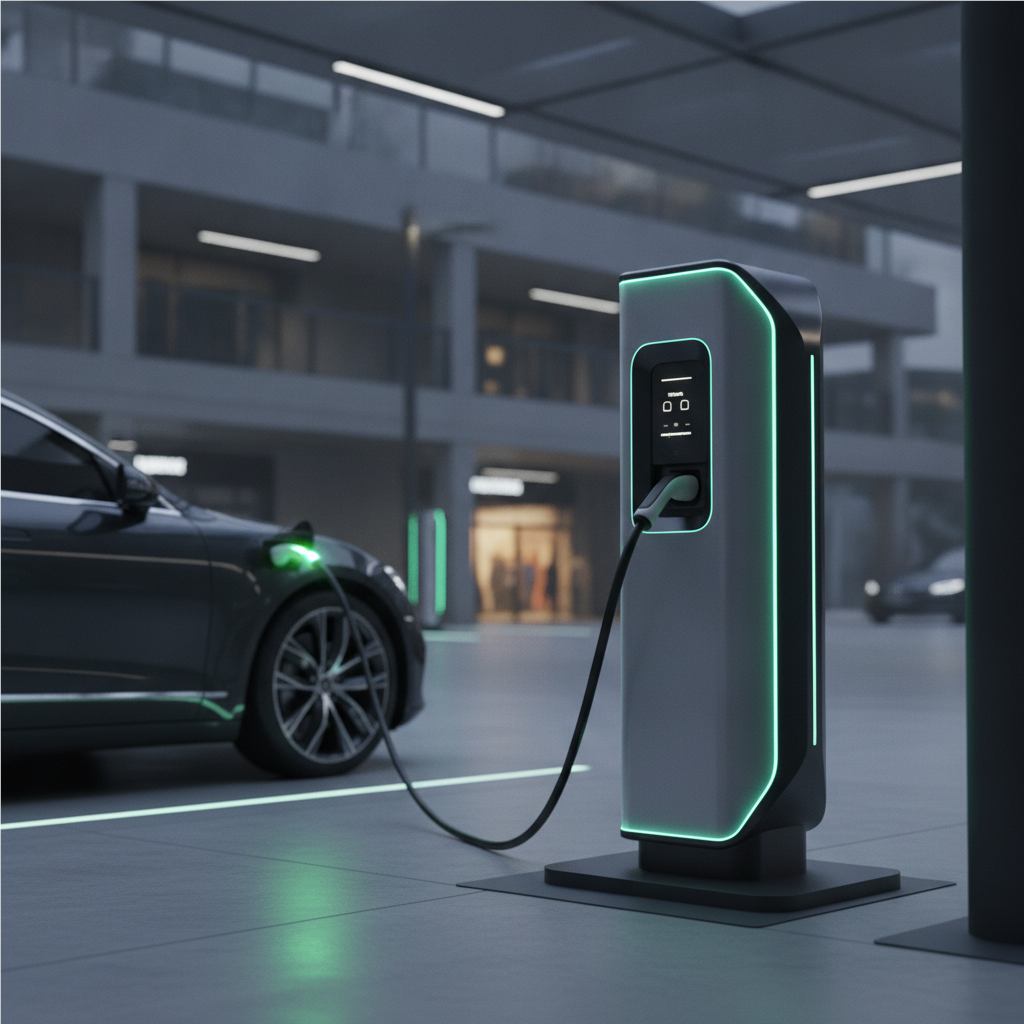
Types of EV charging stations: AC, DC, smart and managed – how to choose?
Anyone who starts looking for a charging station quickly discovers there are several types: a simple home charging station, a smart charging station, a managed charging station, Dual station, a DC fast charging station and a portable EV charger. In this guide, we explain in simple terms the difference between the types of EV charging stations, who each type suits and how much it costs.
In short: There are two types of current – AC (alternating current, 3.7-22kW) for homes, buildings and businesses, and DC (direct current, 20kW and above) for fast charging at businesses and charging sites. Within AC stations, there is a basic station, a smart charging station (app, scheduling, current limiting) and a managed charging station that works with a cloud management system via the OCPP protocol. For a private home, a 7-11kW AC station is usually enough; for an apartment building, parking facility or business – a managed charging station.
Want to see the models themselves? All EV charging stations from DSGCharge, with up-to-date prices, are gathered in the store.
What types of EV charging stations are there?
Charging station types can be divided along three axes: the type of current (AC or DC), the level of control (basic, smart or managed) and the number of sockets (single or dual). In addition, there are portable EV chargers, which are not a fixed station but meet some of the needs.
| Type | Typical power | Best for | DSGCharge models (store price) |
|---|---|---|---|
| Smart home AC charging station | 11-22kW | Private home, assigned parking space | DSG-1061 11kW (₪1,590), DSG-1062 22kW (₪1,790), DSG-1072 22kW (₪2,390) |
| Dual station | 2 × 11 or 2 × 22kW | Two cars at home or in a small business | DSG-3011 (₪5,990), DSG-3012 (₪6,490) |
| Managed station (OCPP) | 22kW | Apartment building, parking facility, business, vehicle fleet | DSG-6012 (₪3,290) |
| Managed public dual charging station | 2 × 22kW | Parking facilities, shopping centers, municipalities | DSG-6052 (₪6,990), DSG-6112 Free-standing (₪7,990) |
| DC fast charging station | 20-60kW in the store, up to 480kW to order | Businesses, vehicle fleets, charging sites, pickups | DSG-5120 20kW (₪9,428), DSG-5130 30kW (₪15,328), DSG-5240 40kW (₪24,900), DSG-5260 60kW (₪34,990) |
| Portable EV charger / granny cable | Up to 3.7kW (granny cable), 7.4-22kW (portable) | Backup, travel, those without a fixed station | DSG-350 (₪699), DSG-352 7.4kW (₪1,190), DSG-351 11kW (₪1,390) |
Prices from the store on the website, incl. VAT and excluding installation, as of November 2026.
What is the difference between an AC charging station and a DC station?
An EV has a built-in charger (On-Board Charger) that converts alternating current to the direct current that goes into the battery. In an AC the conversion takes place in the car, so the charging speed is limited to the power of the onboard charger – usually 7-11kW, and in some cars 22kW. In a DC the conversion takes place in the station itself and the direct current goes straight into the battery, so charging is much faster. Full details are in the guide AC or DC charging station.
DC stations are ordered with a choice of CCS2 connector (most cars in Europe and Israel) or CCS1 (American pickups). There is a dedicated guide for businesses: DC fast charging station for businesses, and for those considering DC at home – Home DC charging station.
What is the difference between a regular station, a smart charging station and a managed charging station?
- Basic station – charges when you plug in the cable, without remote control.
- Smart station – app (Wi-Fi/Bluetooth), scheduling charging for cheaper hours, current limiting, RFID card and consumption tracking. Suitable for a private home.
- Managed station – connected to a cloud management system via the OCPP protocol (an open language in which a station and a management system “talk”). What it means for you: load management between stations, user permissions, measurement and billing by consumption, remote fault monitoring and independence from a single software vendor. All DSGCharge public charging stations, including the DSG-6052, DSG-6112 and the DC stations, are managed with OCPP. More on this: Managed charging station and OCPP.
Which type of charging station suits my car?
Three simple checks will answer the question:
- Power of the vehicle's on-board charger – listed in the car's specifications. If the car accepts 11kW AC, a 22kW station won't charge it faster (but it will suit your next car).
- Home connection type – on a single-phase connection, the practical power is up to about 7.4kW; on three-phase, 11 or 22kW is possible. See Single-phase or three-phase and11kW or 22kW station.
- Connector type – almost all new cars in Israel use Type 2 for AC charging; older American cars use Type 1.
If you have two EVs at home, it's worth reading Dual charging station or 2 stations.
Which station suits an apartment building, parking facility or business?
Where several users share one electrical connection, a managed charging station is the right choice, because it enables load management and billing each user according to their consumption. In buildings, DSGCharge builds and operates the system, reads the meter and sends a billing report to the building committee – details on the page Managed charging stations in apartment buildings. The service fee for a managed charging station: ₪35 per month + 20 agorot per kWh. For parking facilities, shopping centers and hotels, see Setting up public charging stations, and for businesses – Charging stations for businesses.
How much does each type of station cost, including installation?
The station price is only part of the cost. Installation depends on the distance from the electrical panel, the connection type and whether the connection size needs to be increased. For a quick check, use theCharging station installation cost calculator, and to calculate the monthly charging cost – theCharging cost calculator. Detailed price list: How much does an EV charging station cost.
Why buy from DSGCharge?
DSGCharge is one of Israel's leading companies in EV charging solutions. DSGCharge is the importer of its charging stations– the brand is DSGCharge's own. The company has been active since 2021, about 20,000 chargers and charging stations have been sold and installed, and the products hold Standards Institution of Israel (SII) approvals. Areas of activity: managed charging systems for buildings, public charging networks and parking facilities, fleet management, EV charging stations and accessories (for example Charging station cabinet), andEV charging station installation nationwide.
Frequently asked questions about types of charging stations
What is the difference between a smart charging station and a managed charging station?
A smart charging station is controlled from the user's app (scheduling, current limiting, tracking). A managed charging station is connected to a cloud management system via OCPP, which manages several stations together – loads, permissions and billing – so it suits buildings, parking facilities and businesses.
Can a DC station be installed at home?
Yes, but only when there is a suitable three-phase connection and usually when there is a special need, for example a pickup with a large battery. For most homes, a 7-22kW AC station is enough with overnight charging.
What station power does a private home need?
On a single-phase connection – up to about 7.4kW. On a three-phase connection – 11kW is enough for most cars, and 22kW suits cars whose onboard charger supports it or as preparation for the future.
Can a portable EV charger replace a fixed station?
The DSG-350 granny cable plugs into a regular household outlet with adjustable amperage and power and is suitable for occasional charging. The 7.4/11/22kW portable EV chargers connect with an industrial CEE plug to a dedicated outlet on a separate infrastructure line. For everyday use, a fixed station is more convenient. Details: Portable charger and granny cable.
How long does it take to charge with each type of station?
With an 11kW AC station – about 5-6 hours for a 60 kWh battery (from 0 to 100%, approximately); with a 60kW DC station – about an hour, depending on the car's capability. Full table: How long does it take to charge an electric car.
Want help choosing the type of station? Leave your details in thethe contact page or call 077-9920350, and we'll recommend the station that suits your car and infrastructure.