
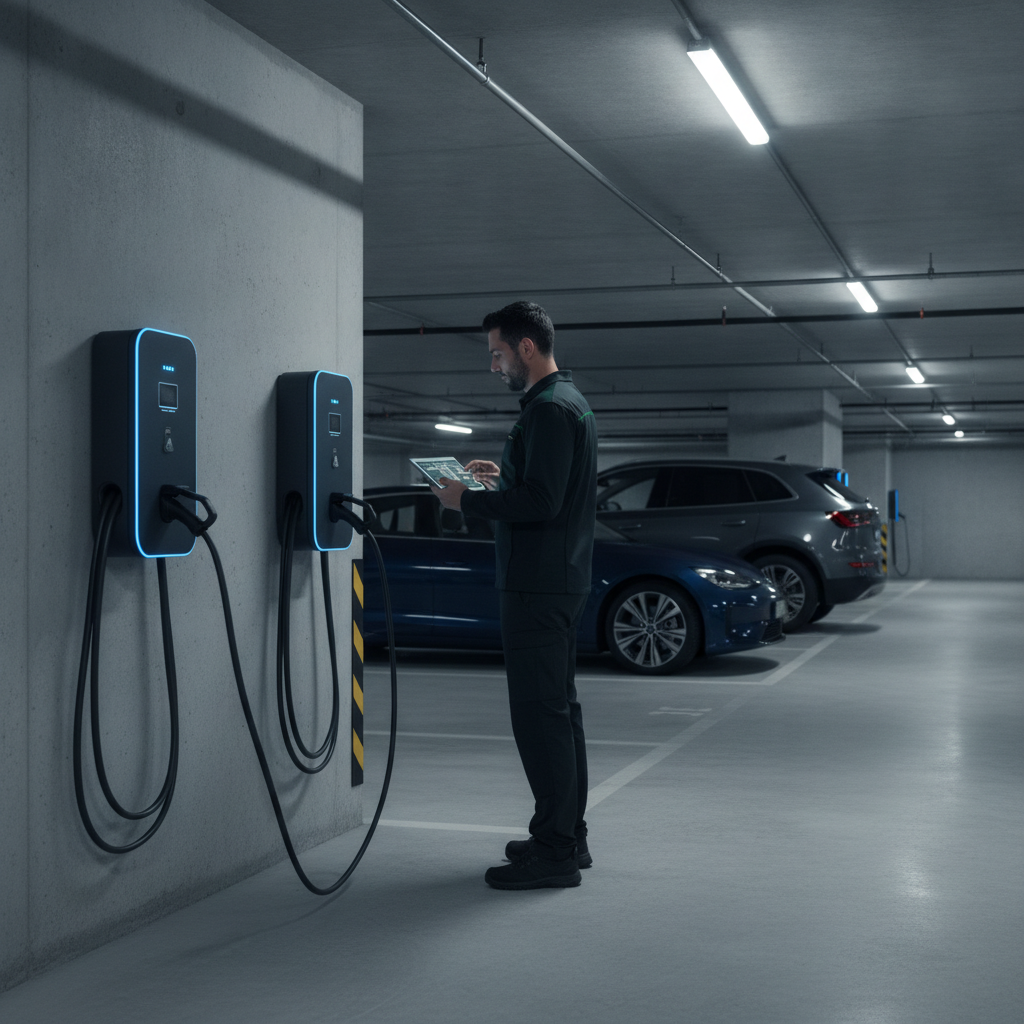
A managed charging station is a station that is connected to the internet and controlled from a cloud-based computer system, not just from a button or from the car owner's app. The language in which the station “talks” to the system is called OCPP, and it is what makes it possible to manage dozens of stations in a building, parking facility or business from one place: who charges, how much, when, and what it costs. On this page we explain in plain language what the OCPP protocol is, what you can actually do with it, and what to check before choosing a system.
In short: A managed charging station connects via Wi-Fi, 4G or a network cable to a cloud-based charging station management system (CSMS). The communication between them runs over the open OCPP protocol. This makes it possible to remotely identify users, grant permissions, measure every charging session, bill, manage loads, update software and handle faults – without physically going to the station and without being locked in to a single provider.
The models and prices of Public charging stations , including the managed models, are available in our store.
What is a managed charging station?
There are three main types of stations. Regular station Simply charges when you plug in a car. Smart station Connects to the manufacturer's app, and the station owner can schedule charging or view consumption. Managed station Is permanently connected to a central cloud-based management system, and whoever manages it (the building committee, the management company, the fleet manager or DSGCharge on their behalf) controls all the stations together: who is allowed to charge, at what power, at what time, and how much each user consumed.
The key difference: a smart charging station “belongs” to one driver. A managed charging station is part of a system, and the system can divide capacity among many users, bill each one separately and make sure the building's connection is not overloaded.
What is OCPP? A plain-language explanation
OCPP stands for Open Charge Point Protocol, an open communication protocol developed and maintained by an international non-profit organization called the Open Charge Alliance. It defines a “common language” in which a charging station and a management system talk: which messages the station sends (charging started, charging ended, so many kWh were consumed, there is a fault), and which commands the system can send to the station (start, stop, reduce power, update).
An analogy: Think of an ATM. The ATM itself is just a machine on the street. All the decisions (who you are, how much money you have, whether to approve a withdrawal, what to record in the account) are made in the bank's central computer, and the ATM talks to it in an agreed language. A managed charging station is the “ATM”, the cloud-based management system is the “bank's computer”, and OCPP is the agreed language between them. And because the language is open and doesn't belong to any one manufacturer, you can connect one manufacturer's station to another company's management system, just as a credit card works in ATMs of different banks.
How it works: the flow from the station to you
Charging station ↔ Internet (Wi-Fi / 4G / network cable) ↔ Cloud-based management system (CSMS) ↔ Driver app / building committee portal / manager dashboard
- The driver Taps a smart card or presses “Start charging” in the app.
- The charging station Sends an OCPP message over the internet to the cloud system: “User X requests to charge”.
- The management system Checks authorization, decides how much power to provide based on the load in the building, and sends back an approval.
- During charging The station reports consumption readings, and the system can change the power in real time.
- At the end The charging session is recorded under the user's name and appears in the report to the building committee or the fleet manager, or on the monthly bill.
What this means for the customer: the stations in the parking lot don't “act on their own”. Behind them is a cloud-based computer system that manages them 24 hours a day, and they can be controlled and fixed remotely.
What can you do remotely with a charging station management system?
- Starting and stopping charging remotely, for example when a driver forgot their card or when a station needs to be freed up.
- Permissions: Who is allowed to charge, at which stations and at what hours. A resident who moved out or an employee who left loses access with a click.
- User identification with a smart card (RFID) or the app, so that every charging session is linked to a person or a vehicle.
- Power limiting and load management: The system divides the available power among the vehicles and prevents exceeding the electrical connection.
- Prioritizing off-peak hours: Postponing charging to hours when electricity is cheaper under the TOU tariff.
- Metering for every charging session: How many kWh, when it started and when it ended.
- Billing and reports: Billing each user according to their own consumption, monthly reports for the building committee or the accounting department.
- Firmware (software) updates for the stations, remotely, without a technician on site.
- Remote fault diagnosis and repair: An alert when a station disconnects or reports an error, collection of fault logs, remote restart and release of a stuck connector. A large share of faults is resolved without a visit.
To see how all this translates into the bill in a building, read about Monthly charging report by TOU meter, and about the electrical side in the guide Load management for charging stations.
Regular station, smart station or managed charging station: what's the difference?
| Feature | Regular station | Smart station | Managed station (OCPP) |
|---|---|---|---|
| Internet connection | None | Wi-Fi / Bluetooth to the app | Wi-Fi, 4G or network cable, permanent connection |
| Who controls it | No one, it charges when plugged in | The station owner, via the app | Cloud-based management system (CSMS) and the system administrator |
| User identification | None | Usually a card or app for the owner | Smart card or app, many users |
| Metering and billing per user | None | Owner's total consumption | Metering for every charging session, billing and reports |
| Load management among several stations | None | Limited | Yes, dynamic |
| Remote update and repair | None | Partial, depending on the manufacturer | Yes, via the protocol |
| Vendor dependence | Not relevant | One manufacturer's app | Open protocol, you can switch systems |
| Suitable for | Private parking, basic use | Private house or an assigned parking space on the apartment's meter | Buildings, parking facilities, businesses, vehicle fleets |
| Example from DSGCharge | Portable charger | DSG-1072 | DSG-6012 |
OCPP versions 1.6J, 2.0.1 and 2.1: what's the practical difference?
According to the Open Charge Alliance, the organization that develops the protocol (as of 10/2026):
- OCPP 1.6 (2015), in its common JSON version called 1.6J: the most widely used version on the market. It includes remote start and stop, a local authorization list, metering, firmware updates and “smart charging” for load management and charging profiles. The organization also published a security extension for it (OCPP 1.6 Security Whitepaper) that applies the security improvements from version 2.0 to 1.6J.
- OCPP 2.0.1 (2020): Advanced device management (configuration and monitoring), improved handling of charging transactions, built-in security, support for ISO 15118 (vehicle-to-station communication, including Plug & Charge) and display messages. In 2024 it was approved as the international standard IEC 63584.
- OCPP 2.1 (2025): Builds on 2.0.1 and remains compatible with it. It adds bidirectional charging (V2X) according to ISO 15118-20, control of distributed energy resources, smart charging improvements, local cost calculation and new payment options such as secure dynamic QR.
What this means for you: For a building, parking facility or vehicle fleet, OCPP 1.6J provides everything you need today: identification, billing, load management and remote maintenance. The newer versions are relevant mainly for those planning Plug & Charge, bidirectional charging or deep integration with energy management. It's important to know that 1.6 and 2.0.1 are not directly compatible with each other, so the management system must support the version the station runs. Some management systems support several versions in parallel, and it's worth asking about this.
Why does an open protocol mean you're not locked in to a provider?
With a closed station, the hardware and software come from the same manufacturer. If the company raises prices, stops supporting the product or doesn't give you a feature you need (for example, a connection to a different payment processing company), the only option is to replace the stations, and that is the biggest expense in the project.
With a station that works over OCPP, the station and the management system are two separate components. You can:
- Switch the management system without dismantling stations, simply by setting a new server address in the station.
- Add stations from another manufacturer to the same system in the future.
- Connect the system to your invoicing, payment processing or fleet management system.
A question worth asking every provider: “Is the station open to OCPP, and can it be configured for a different management system if we want?” If the answer isn't clear, that's a warning sign.
Is a cloud-managed charging station secure?
A station connected to the internet is a network device in every sense, so security is part of the choice. The OCPP protocol defines three security levels (Security Profiles) for the connection between the station and the system:
- Level 1: The station is identified with a username and password, without encryption of the channel. Suitable only for a closed, protected network (for example, a VPN or private 4G).
- Level 2: An encrypted channel (TLS) in which the system identifies itself with a digital certificate, and the station with a username and password.
- Level 3: Encryption and mutual authentication with digital certificates, for both the station and the system.
The levels are built into OCPP 2.0.1 and are also available for 1.6J through the Open Charge Alliance security extension, which also includes secure firmware updates and security event logging. In a business project or a building, it's recommended to require at least level 2 and to make sure that access to the management portal is restricted by role (committee, manager, resident).
Who is a managed charging station right for?
- Apartment buildings and building committees: Several residents on one electrical connection, each resident billed according to consumption, and the building committee doesn't deal with collection. Full details on the page charging stations in apartment buildings.
- Public charging stations: All of DSGCharge's public stations, AC and DC, are managed via OCPP from a cloud-based computer system: user identification, pricing, payment processing and fault monitoring. See Setting up public charging stations.
- Parking facilities, hotels, malls and institutions: Charging for guests and the public, with permissions, pricing and availability monitoring. Details of the business models on the page Charging stations for parking facilities.
- Businesses and offices: Charging for employees, separation between company cars and private cars, reports for the accounting department. See Charging stations for businesses.
- Fleets: Tracking by vehicle and driver, cost management and connection to the fleet management system. See EV fleet management.
For a private house with one car, a smart charging station is usually enough. As soon as there is more than one user who needs to pay separately, or more than one station on the same connection, a managed charging station is the right solution.
Charging station with load management: why is it critical in a building?
The electrical connection of a building or business is limited. For comparison, a three-phase 3X25 amp connection provides about 17.3kVA and 3X40 about 27.7kVA, meaning such a connection can't carry several 22kW stations at full power at the same time. The management system knows how much power is available and divides it among the connected vehicles: when one car is charging it gets everything, when more cars join the power is shared, and when a car finishes the others get more. This way you can connect more stations to an existing connection, and sometimes avoid an expensive connection upgrade.
In a building with a TOU meter, the system can also prioritize charging during off-peak hours and reduce power during peak hours (under the 2026 tariff: 17:00-22:00 in winter and the transition seasons, 17:00-23:00 in summer), which significantly lowers the cost per kWh for residents. To estimate the infrastructure cost for your project, use theCharging station installation cost calculator.
What does the site need in order to install managed OCPP stations?
- Stable communication: Wi-Fi with good reception in the parking lot, a network cable (LAN) or 4G with a SIM card. In underground parking lots, Wi-Fi and 4G reception is often weak, so it's worth checking it in an early site survey and planning a dedicated network cable or router/antenna.
- Electrical infrastructure: A suitable connection, a panel with protections, and a cable route to the parking spaces. In an apartment building, the connection model is also determined (the apartment's meter, a common panel or a separate connection).
- A decision on the management model: Who manages the system, who receives reports, how users are billed and how the money is transferred.
- What happens when the internet goes down? OCPP stations can keep a local authorization list and store charging data until the connection returns. In practice, the behavior depends on the station and system settings, so it's important to verify this in advance.
DSG-6012, DSG-6052 and DSG-6112: managed charging stations for buildings and businesses
All of DSGCharge's public stations are managed via the OCPP protocol from a cloud-based computer system. Especially suitable for buildings, parking facilities and businesses are the Managed charging station 22kW DSG-6012 (₪3,290), a managed station for one vehicle that connects to the cloud management system via OCPP over Wi-Fi, LAN or 4G; as well as the Managed public dual charging station 22kW DSG-6052 (₪6,990) and theDual free-standing public station 22kW DSG-6112 (₪7,990), prices as of 10/2026, excluding installation. Each station serves two vehicles, and every charging session is linked to a user through the management system. DSGCharge's public DC stations are also managed via OCPP.
Why DSGCharge?
DSGCharge (part of S.M.C. Dor HaAtid) has been active since 2021. It is DSGCharge is the importer of its charging stations – the brand is DSGCharge's own – so we know every product in depth and service it directly. We have sold and installed about 20,000 chargers and charging stations, and we have installation and service teams nationwide. Beyond the stations, DSGCharge sets up and manages the entire system: load management, TOU meter reading, billing each user according to use and transferring the payment to the building committee, so the committee or the business doesn't have to deal with operations and collection.
Want managed charging stations in your building or business?
Tell us how many parking spaces there are, what electrical connection you have and who the users are, and we'll get back to you with a proposal for a connection, management and billing model. leave your details or call 077-9920350. Want an initial estimate? Start with theinstallation cost calculator.
Frequently asked questions
What is the difference between a smart station and a managed station?
A smart charging station is controlled through the station owner's app and is suitable for private use. A managed charging station is permanently connected to a cloud-based management system via the OCPP protocol, and manages many users, permissions, billing per user and load management across several stations.
What is OCPP in simple terms?
OCPP is an open communication language between a charging station and a management system. Thanks to it, the cloud system knows who is charging and how much, and can start, stop, limit power and update the station remotely, even if the station and the system come from different manufacturers.
What is a CSMS?
A CSMS (Charging Station Management System) is the cloud-based charging station management system. It receives data from all the stations via OCPP, manages permissions and loads, generates reports and billing, and sends alerts about faults.
Which OCPP version should you choose?
For buildings, parking facilities and vehicle fleets, OCPP 1.6J provides all the required functions today. OCPP 2.0.1 and 2.1 add built-in security, Plug & Charge and bidirectional charging. The main thing is that the station and the management system support the same version.
What happens to a managed charging station when there is no internet?
OCPP stations can keep a local authorization list and store charging data until the connection returns, and then send it to the system. The exact behavior depends on the settings, so stable communication is planned in advance (a network cable or 4G).
Can you switch the management system without replacing the stations?
Yes, if the stations are open to OCPP. You set the new system's server address in the station, without dismantling any hardware. That is the main advantage of an open protocol.