
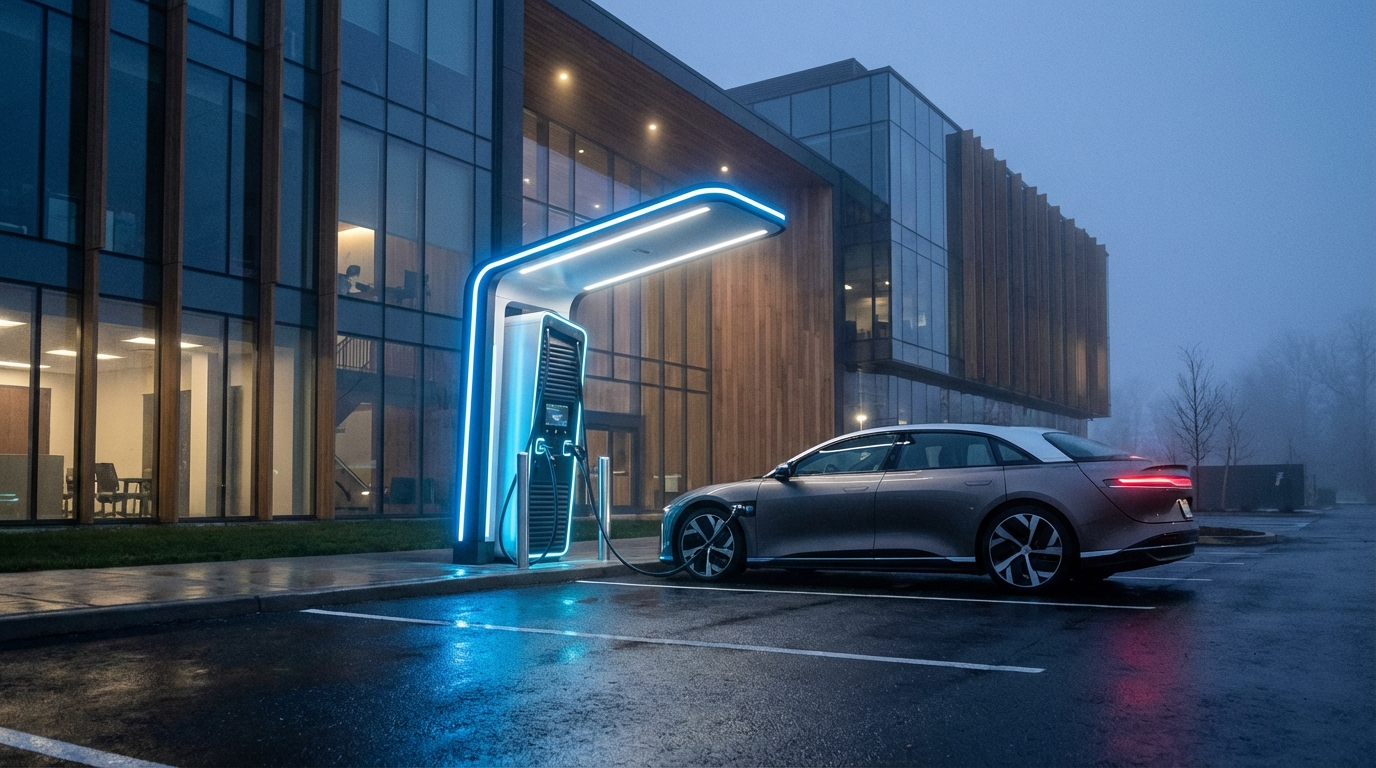
A DC fast charging station is the biggest decision a business makes in the charging field: it requires a large electrical connection, coordination with the Israel Electric Corporation (IEC), a management and payment system, and ongoing maintenance. This guide is intended for fuel stations, charging operators, shopping malls, vehicle fleets, local authorities and developers weighing 40kW against 240kW, and it explains what really determines charging speed, what is needed on the electrical side and how much the whole project costs, not just the unit.
In short: The actual power is set by the lowest of three factors: the station's power (and how it is split between the connectors), the maximum power the vehicle can accept, and the battery's charging curve. 60kW suits a parking stay of about an hour; 120kW and up suits a short stop on a highway. Before buying, check the electrical connection, OCPP, payment, service and warranty.
What is a DC fast charging station and how is it different from an AC station?
At an AC station the vehicle receives alternating current, and the vehicle's built-in charger (On-Board Charger) converts it to direct current for the battery. That's why the power is limited by the on-board charger: 7.4kW to 11kW in most vehicles and 22kW in some. At a DC station the conversion takes place inside the station, and direct current flows straight into the battery. This makes it possible to reach tens and hundreds of kilowatts.
In Israel, the most common fast charging connector is CCS2 (the European version of the Combined Charging System). Some older vehicles use CHAdeMO, and vehicles built to the American standard (such as imported pickups) come with CCS1. The Electricity Administration guidelines for installing a charging system require a DC station (charging mode 4) to comply with IEC 61851-23 and the vehicle connector to comply with IEC 62196.
What determines the power the vehicle actually receives?
The most common mistake when buying an ultra-fast charging station is assuming that a 240kW station will charge every vehicle at 240kW. In practice, three factors determine the power, and the lowest of them wins.
1. The vehicle's maximum charging acceptance
Every vehicle has a maximum DC power it can accept, determined by its voltage architecture (400V or 800V), the current limits of the battery and cables, and the cooling system. A vehicle that accepts up to 100kW will charge at the same speed at a 120kW station and at a 240kW station. Power is voltage multiplied by current: in a 400V vehicle, even a current of 250 amps yields only about 100kW, which is why 800V vehicles are the ones that truly make use of 180kW and 240kW stations.
2. The charging curve
The vehicle does not receive constant power throughout the charge. The battery management system (BMS) requests high power from the station when the battery is relatively empty and gradually lowers it as the charge approaches 80%, to protect the cells. Above 80% the power drops sharply, which is why fast charging times are always quoted for the 10-80% range. Battery temperature also matters: a very cold or very hot battery will accept less power. Many vehicles preheat the battery when you navigate to a fast charging station.
3. Power sharing between two connectors
Most fast public charging stations are built with two connectors and a shared power module. When one vehicle is connected, it can receive the full power. When a second vehicle connects, the power is split. For example, according to our product pages: on the DSG-7540 one connector delivers up to 240kW and two connectors at once deliver 120kW each; on the DSG-7420 the power drops to 60kW per connector; and on the DSG-7360 to 30kW per connector. When planning a busy site, it's important to calculate the power per vehicle in a two-vehicle scenario, not just the headline figure.
Which DC fast charging station suits which location?
The table shows the estimated charging time from 10% to 80% for a 60-80kWh battery (that is, about 42-56kWh going into the battery). This is a conservative estimate: it assumes one connected vehicle, an average power lower than the rated power because of the charging curve, and a vehicle able to accept that power. A vehicle limited to lower power will charge more slowly. To calculate for your own vehicle, use thecharging time calculator by power.
| Station power | Estimated time 10-80% | Suitable location | DSGCharge models |
|---|---|---|---|
| 20kW | About 2.5-3.5 hours | Fleet overnight, garage, office; also portable | DSG-5120, DSG-5020 portable |
| 30kW | About 1.5-2.5 hours | Employee parking, fleet, site without a large connection | DSG-5130, DSG-5030 portable, DSG-5230 with storage |
| 40kW | About 70-100 minutes | Hotel, restaurant, neighborhood shopping center, business | DSG-5140, DSG-5240 public |
| 60kW | About 50-75 minutes | Shopping mall, supermarket, municipal parking facility, local authority | DSG-5260, DSG-6960, DSG-7360, DSG-7060 with advertising screen |
| 80kW | About 40-60 minutes | Shopping center with advertising exposure | DSG-7080 with advertising screen |
| 120kW | About 30-50 minutes | Fuel station, junction, fleet hub | DSG-7420 |
| 180kW | About 25-40 minutes (in a vehicle that accepts 150kW or more) | Intercity fuel station, public fast charging hub | DSG-7480 |
| 240kW | About 20-35 minutes (limited mainly by the vehicle) | Ultra-fast hub on a highway, heavy fleet depots | DSG-7540 |
Rule of thumb: a 60kW charging station suits a place where the customer stays for about an hour anyway (shopping, a meal). A 120kW-and-up charging station suits a place where the driver stops only to charge and wants to leave within half an hour. You can see all models in the categories DC fast chargers andPublic stations.
What electrical connection does a DC charging station need at each power level?
A DC station is fed by a three-phase supply, and its input current is much higher than that of a home connection. For comparison, a 3X40 amp connection is about 27.7 kVA according to the Electricity Authority's tariff book, which is less than a single 40kW station. The table shows the input current as listed on our product pages, and the estimated apparent power based on a 400V line voltage (our own calculation, for estimation only):
| Power | Input current (per the product page) | Estimated apparent power |
|---|---|---|
| 40kW (DSG-5140, DSG-5240) | 63 amps three-phase | About 44 kVA |
| 60kW (DSG-5260, DSG-7360) | 91 amps three-phase | About 63 kVA |
| 120kW (DSG-7420) | 182 amps three-phase | About 126 kVA |
| 180kW (DSG-7480) | 285 amps three-phase | About 197 kVA |
| 240kW (DSG-7540) | 364 amps three-phase | About 252 kVA |
What this means in practice:
- A single 40-60kW station at most businesses requires at least a check of the spare capacity in the existing connection, and often a connection upgrade.
- 120kW and up, or several stations at one site, reach hundreds of kVA. At this scale the IEC may require a new dedicated connection, and in some cases a high-voltage supply with a customer-owned transformer, which is subject to separate IEC technical and safety requirements.
- Load management between the stations and the other consumers on the site can reduce the required connection size, at the cost of lower power during peak load hours.
The process with the IEC starts with a request for a connection upgrade or a new connection. According to the IEC guidelines for charging station supply configurations, stations in public spaces are fed from a dedicated connection ordered by the responsible body (for example, a local authority), and not from street lighting or traffic lights. The payment for a connection upgrade is set in the tariff book according to the kVA added, and the timeline depends on whether grid works are required. That's why the first step in any project is a site survey and an electrical feasibility check, before ordering equipment. You'll find more on the full process on the page Setting up public charging stations.
OCPP, payment and app: how do you manage a public DC fast charging station?
All DSGCharge public charging stations, AC and DC, are managed with the OCPP protocol from a cloud computing system. A public station isn't just an electrical device – it's a point of sale. Three components determine whether it will work as a business:
- OCPP (Open Charge Point Protocol) is an open protocol that connects the station to a central management system: remote start and stop, pricing, reports, fault alerts and software updates. The protocol is developed by the Open Charge Alliance, and OCPP 2.1 was published in December 2025 as international standard IEC 63584-210. A station with OCPP doesn't lock you into a single software provider. A detailed explanation is in thecharging station glossary.
- Payment processing: activation via app, RFID card or credit card. On our public models the credit card terminal is a paid add-on, so it's worth deciding in advance whether the site is meant for casual customers (who need credit card payment) or for a fleet and regular customers (for whom an app and card are enough).
- Communication: 4G or a LAN connection. At underground sites, check reception in advance.
Maintenance and SLA
A fast charging station that doesn't work means lost revenue and damage to the location's reputation. Before signing, ask for a written service level agreement (SLA) that defines: fault response time, repair time, remote monitoring, preventive maintenance (cleaning filters and fans, checking cables and connectors), and who holds spare parts. The Electricity Administration guidelines require an inspection by an inspecting electrician before first operation and a repeat inspection at least once every six years.
How much does a DC charging station cost? Hardware price vs. total cost
Hardware prices in our store (as of 11/2026, for the station only, without installation): DSG-5120 20kW ₪9,428; DSG-5130 30kW ₪15,328; DSG-5140 40kW ₪22,408; DSG-5240 40kW public ₪24,900; DSG-5260 60kW public ₪34,990; portable models DSG-5020 ₪10,990 andDSG-5030 ₪14,990. Additional 60kW public stations, 120kW, 180kW and 240kW stations, stations with an advertising screen and the portable station with storage are sold by quote, according to configuration.
But the station price is only part of the cost. A full budget includes:
- Site survey and electrical design by an engineer or certified electrician.
- Payment to the IEC for a connection upgrade or a new connection, and sometimes a transformer and high-voltage infrastructure.
- Electrical panel, circuit breakers, protections and feeder cables (at high power levels, thick and expensive cables, depending on the distance from the panel).
- Civil works: concrete foundation, excavation, trenches, asphalt restoration.
- Parking accessories: protective bollards, stoppers, marking, lighting and signage.
- Credit card terminal and management system (license or monthly subscription), and cellular communication.
- Inspection by an inspecting electrician and approvals before operation.
- Service and maintenance agreement, warranty extension and spare parts inventory.
- Ongoing electricity cost according to your tariff, including the demand charge during peak hours.
The ratio between the components varies greatly from site to site. A site that already has a large connection and a panel close to the parking area can cost a fraction of a site that needs a new connection. That's why there is no single “installation price”, and a reliable figure is available only after a site survey.
What should you check with a supplier before buying a DC fast charging station?
- Warranty: how long, what it covers (parts, labor, site visits) and whether it can be extended. On DSGCharge models the warranty is 24 months according to the product pages, with a paid extension option.
- Spare parts in Israel: power modules, cables and connectors wear out. Check that they are in stock in Israel and not ordered from abroad.
- Service in Israel: nationwide service teams, a fault call center and remote monitoring.
- Connector compatibility: CCS2 is the baseline. DSGCharge DC stations are ordered with a CCS1 or CCS2 connector, your choice. The Electricity Administration guidelines (11/2025) prohibit using an adapter for an EV connector, so if you expect vehicles with the CCS1 standard, order a station with the matching connector instead of an adapter solution.
- Compliance with standards: IEC 61851-23 for the station, IEC 62196 for the connector, DC leakage protection and a manufacturer or importer declaration.
- OCPP and software: supported OCPP version, ability to work with an external management system, remote software updates.
- Power allocation: what the power per connector is when two vehicles are connected.
- Durability: ingress protection rating (IP55 on our public models), heat resistance and cable length.
Why buy a DC fast charging station from the importer?
When you buy from the importer, the party that sold you the station is also the one holding the technical know-how, the relationship with the manufacturer and the spare parts. There is no chain of distributors in which every fault passes through several hands, and the price doesn't include layers of middlemen. With DC stations, where every day of downtime costs money, this is the key difference.
DSGCharge, part of S.M.C. Dor HaAtid, has been active since 2021. DSGCharge is the importer of its charging stations – the brand is DSGCharge's own – from home stations to an ultra-fast charging station of up to 480 kilowatts (to order; up to 240kW in the store). About 20,000 chargers and charging stations sold and installed; we provide nationwide installation and service with dozens of teams. Beyond sales, we build, manage and maintain public charging networks: the location owner provides the space, and we take care of the rest. You'll find the full range on the page EV charging stations.
And what if there's no large electrical connection?
Some sites can't get a connection upgrade within a reasonable time. Two alternatives: portable DC stations (DSG-5020, DSG-5030) for a fleet, a garage or roadside rescue, andPortable 30kW station with energy storage DSG-5230, which charges from the grid at low power and stores energy for charging. And in locations with foot traffic, stations with an advertising screen (DSG-7060, DSG-7080) add a revenue source beyond selling electricity.
Want a proposal for your site?
Tell us where the site is, how many vehicles you expect to charge per day and the size of the existing connection. We'll carry out a site survey, check electrical feasibility and recommend the power, model and operating model. If most of your vehicles park for hours, first read the guide Charging stations for businesses, because AC may be enough. Leave your details to schedule a survey, or check charging times with thecharging time calculator.
Frequently asked questions
How long will each vehicle stay at a DC fast charging station on our site?
This is a key figure for planning parking turnover. For a vehicle with a 60-80kWh battery, charging from 10% to 80% takes, by a conservative estimate, about 50-75 minutes at a 60kW station and about 30-50 minutes at a 120kW station. The actual time depends on the power the vehicle can accept, the charging curve and the battery temperature.
Will a 240kW station charge every vehicle at 240kW?
No. The vehicle receives the lower of the station's power and its own maximum power. A vehicle limited to 100kW will charge at the same speed at 120kW and at 240kW. In addition, when two vehicles are connected, the power is split between the connectors.
How much does a DC charging station cost?
As of 11/2026, hardware prices in the store start at ₪9,428 for a 20kW station and ₪34,990 for a 60kW public station (DSG-5260), without installation. 120-240kW stations are sold by quote. The total cost also includes the electrical connection, infrastructure, payment and maintenance, which are determined in a site survey.
What electrical connection does a 60kW station need?
According to the product page, the DSG-5260 requires a 91 amp three-phase connection, which is an estimated 63 kVA. That's more than double a home 3X40 connection, so in most cases a spare capacity check or a connection upgrade with the IEC is required.
What is CCS2 and is it suitable for all vehicles in Israel?
CCS2 is the European fast charging connector and is found on most new electric vehicles in Israel. Some older vehicles use CHAdeMO and vehicles built to the American standard use CCS1. DSGCharge DC stations are ordered with CCS1 or CCS2, your choice; a matching original connector on the station is preferable, because the Electricity Administration guidelines (11/2025) prohibit using an adapter for an EV connector.
Why is it important for the station to support OCPP?
OCPP is an open protocol for managing stations remotely: pricing, activation, fault monitoring and updates. A station that supports it can be connected to different management systems, so you aren't dependent on a single software provider throughout the station's life.