
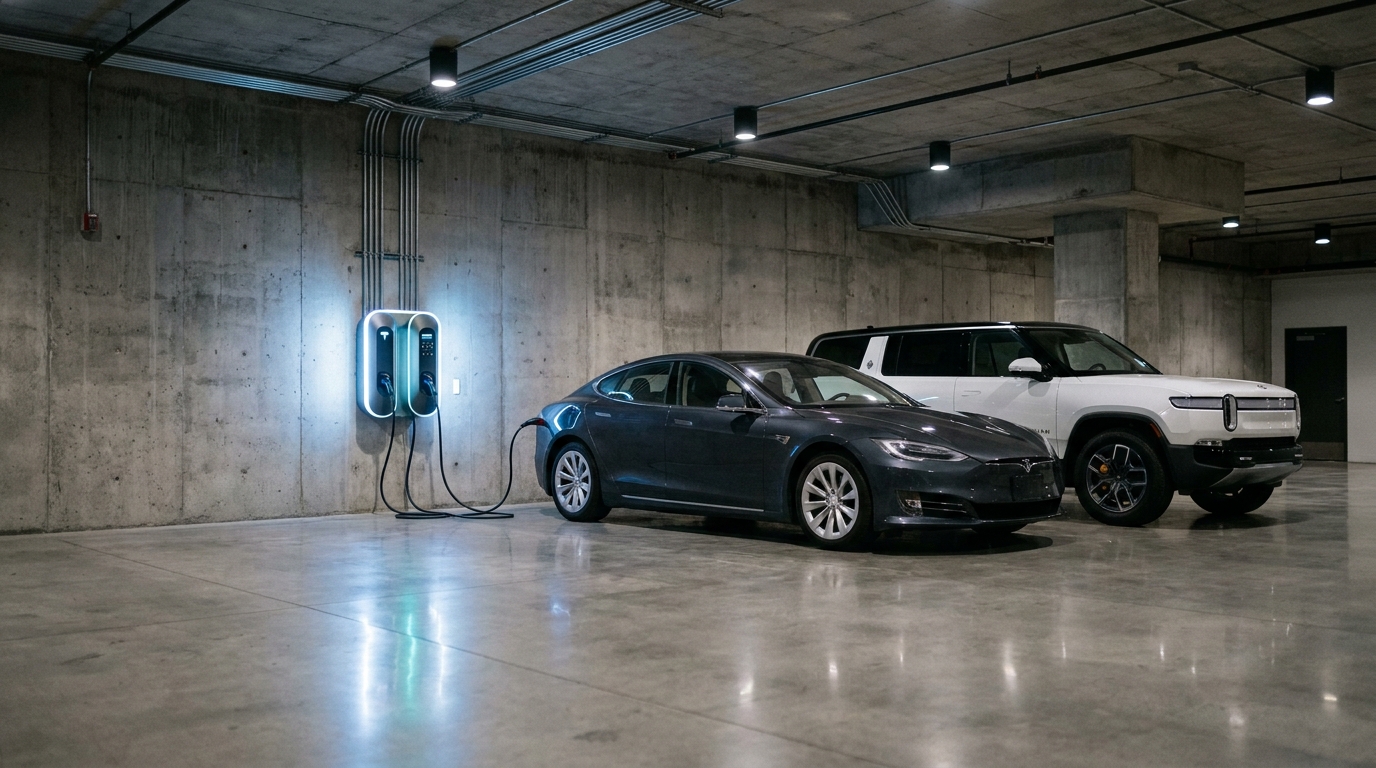
Dual EV charging station: how to charge two cars and what it costs
Updated: November 2026
In short: A dual charging station is a single unit with two outlets that charges two electric cars at the same time. The DSGCharge store offers 2×11kW (₪5,990) and 2×22kW (₪6,490) dual charging stations, and managed dual charging stations for buildings and businesses (₪6,990-₪7,990). To get 22kW for each car at the same time, you need a 64-amp three-phase connection. With a smaller connection, the power is split between the cars.
More and more families and businesses own two or more electric cars, and then the question arises of who charges tonight. A dual charging station solves this with a single installation: two cables, one feed line and one point of control over consumption. In this guide you'll find what to check before buying: power, electrical connection, load management, price including installation, and what suits a home, an apartment building and a business.
DSGCharge (DSG Charging Solutions) is one of Israel's leading companies in EV charging solutions: managed charging systems for buildings, public charging networks and parking facilities, fleet management, charging stations and accessories, and installations. DSGCharge is the importer of its charging stations – the brand is DSGCharge's own. The company has been active since 2021, and about 20,000 chargers and charging stations have been sold and installed nationwide.
What is a dual EV charging station?
A dual charging station is an AC station with two charging outlets (usually two tethered cables with a Type 2 plug) in one housing. It is connected to the electrical panel with one feed line, and it splits the power between the two cars according to the connection and the settings.
The main difference from a regular station is that there's no need to take turns charging or move a car in the middle of the night. Both cars plug in when they park, and in the morning both are charged. For more models and types, see the EV charging stations in the DSGCharge store.

Does a dual charging station charge both cars at full power?
It depends on the electrical connection. A 2×22kW dual charging station needs 32 amps per outlet, meaning a 64-amp three-phase connection, to deliver 22kW to each car simultaneously. A 2×11kW station needs 16 amps per outlet, meaning 32 amps three-phase.
In a private house with a 3X25 or 3X40 amp connection, two 22kW outlets at full power are more than the connection can supply. In that case, the installer limits the current, or load management is added that splits the power according to household consumption. This way both cars charge without the main circuit breaker tripping. A full explanation of the methods is in the guide Load management for charging stations.
It's important to remember: the car also limits the power. A car whose on-board charger (OBC – the charger inside the car that converts AC to DC) is limited to 11kW will charge at 11kW even from a 22kW outlet. A detailed comparison is in the guide 11kW or 22kW charging station.
How long does it take to charge two cars at a dual charging station?
The table shows the estimated time to charge 40 kWh (kWh is the amount of energy; kW is the charging rate), roughly 10%-80% of a 60 kWh battery. Actual times depend on the car, the temperature and the settings.
| Power per car | When this happens | Time for 40 kWh (estimated) |
|---|---|---|
| 7.4kW | 2×22kW on a limited connection, or a single-phase car | About 5.5 hours |
| 11kW | DSG-3011, or a car with an 11kW on-board charger | About 3.5-4 hours |
| 22kW | DSG-3012 on a 64-amp connection, and a car that supports 22kW AC | About 2 hours |
A general estimate, not including charging losses. Tables by battery size are in the guide 22kW charging station.
In practice, most cars are parked for 8-10 hours at night. So even 7.4kW per car is usually enough for both to be charged in the morning.
Which dual charging station should you buy? Comparison of models and prices
Prices from the DSGCharge store, as of November 2026, for the station only (without installation):
| Model | Power | Electrical connection | Communication and activation | Suitable for | Price |
|---|---|---|---|---|---|
| DSG-3011 | 2×11kW | Three-phase 32A | Bluetooth, RFID, app | Home with two cars | ₪5,990 |
| DSG-3012 | 2×22kW | Three-phase 64A | Bluetooth, RFID, app | Home or small business | ₪6,490 |
| DSG-6052 | 2×22kW, managed | Three-phase 63A | Wi-Fi, LAN, 4G, RFID, app, OCPP | Apartment building, parking facility, business | ₪6,990 |
| DSG-6112 | 2×22kW, managed, floor-standing | Three-phase | Cloud management via OCPP | Open parking lot, business, public parking | ₪7,990 |
| 2 × DSG-1062 | 2 separate 22kW stations | Two feed lines | Smart station | Parking spaces far apart | 2 × ₪1,790 |
All the dual charging stations in the table have: Type 2 sockets, a 5-meter built-in cable (8 meters available), built-in AC 30mA and DC 6mA leakage current protection, and IP55 ingress protection. The products have Standards Institution of Israel (SII) approvals, and the warranty is 24 months on-site at the customer's home. All models in the category: Dual charging stations.
How much does a dual charging station cost including installation?
The total cost is the price of the station plus installation. The DSGCharge store offers two standard installation packages: Installation up to 20 meters (DSG-9903) for ₪2,590, andinstallation up to 30 meters (DSG-9904) for ₪2,990. For example, DSG-3011 with installation up to 20 meters: 5,990 + 2,590 = ₪8,580 (as of November 2026).
What can raise the cost: a long distance from the electrical panel, chiseling or conduits, replacing the panel, load management or a connection upgrade. If the connection is small, it's worth comparing a connection upgrade with a management system before deciding. For a quick estimate, there's the Charging station installation cost calculator, and for details on the installation process: EV charging station installation.
A dual charging station or two separate stations?
- A dual charging station is suitable when the parking spaces are adjacent, when you want one installation and one feed line, and when there isn't much space on the wall or pole.
- Two separate stations are suitable when the parking spaces are far apart (for example, one in front and one on the side), or when each car needs full power regardless of the other.
- In a home with two vehicles It's also worth reading the guide Charging two electric cars at home, which compares the options by connection size.
Do you need a three-phase connection for a dual charging station?
In practice, yes. Dual charging stations of 11kW and 22kW per outlet are connected to a three-phase connection. In a home with a single-phase connection, the power is very limited, so it's usually better to upgrade to three-phase or make do with a single station. The differences are explained in the guide Single-phase or three-phase for a charging station.
Dual charging stations in apartment buildings, parking facilities and businesses
In an apartment building, a parking facility or a workplace, supplying electricity isn't enough. You need to know who is charging, how much they consumed and who pays. That's why in these places managed dual charging stations are installed, the DSG-6052 or DSG-6112, which connect to a cloud-based management system viaOCPP (an open protocol for communication between a station and a management system).
- Permissions: An RFID card or the app for each resident or employee.
- Load management in the parking facility: Splitting the power among all the stations without exceeding the building's connection.
- Billing by consumption: Each user pays for what they charged. The service fee for a managed charging station: ₪35 a month plus 20 agorot per kWh.
- Investment model: When the building invests in the infrastructure – no commitment. When DSGCharge invests in the infrastructure – a 10-year commitment.
Details on the process in a building are on the page Managed charging stations in apartment buildings, and for businesses: Charging stations for businesses and offices.
When is it cheapest to charge two cars?
With a TOU (time-of-use) tariff, cheap charging is outside peak hours. Peak hours apply only Sunday to Thursday: 17:00-22:00 in winter and the transition seasons, and 17:00-23:00 in summer. Weekends are off-peak in all seasons, and prices vary by season. In the station's app, you can schedule charging for the cheap hours. What it actually costs: How much does it cost to charge an EV at home, andCharging cost calculator.
Why choose a dual charging station from DSGCharge?
DSGCharge is the importer of its charging stations – the brand is DSGCharge's own – so the stations are sold in the importer's own store. The company has been selling, installing and maintaining stations nationwide since 2021, and it also sets up managed systems for buildings and parking facilities. This way you can start with a dual charging station at home and move on to a managed solution as your needs grow. To get a recommendation based on your connection and parking, leave your details or call 077-9920350.
Frequently asked questions about dual charging stations
How much does a dual EV charging station cost?
As of November 2026, in the DSGCharge store: DSG-3011 (2×11kW) for ₪5,990, DSG-3012 (2×22kW) for ₪6,490, and the managed dual charging stations DSG-6052 for ₪6,990 and DSG-6112 (floor-standing) for ₪7,990. A standard installation of up to 20 meters (DSG-9903) costs ₪2,590, and up to 30 meters (DSG-9904) ₪2,990.
Does a dual charging station charge both cars at full power?
Only if the electrical connection is sufficient for both outlets together. The DSG-3012 needs a 64-amp three-phase connection to deliver 22kW to each car simultaneously. When the connection is smaller, the current is limited during installation or load management is used, and the power is split between the cars. In addition, each car charges according to its own on-board charger.
Do you need to upgrade the electrical connection to install a dual charging station?
Not always. A 2×11kW dual charging station (DSG-3011) needs 32 amps three-phase, and a home with a 3X40 connection can usually handle it with proper planning. For 2×22kW at full power you need a larger connection, or load management that splits the power according to household consumption.
A dual charging station or two separate stations – which is better?
A dual charging station saves wall space, needs one feed line and one installation job, and is suitable when the cars park side by side. Two separate stations are suitable when the parking spaces are far apart, or when you want full power for each car regardless of the other.
Can you install a dual charging station in an apartment building?
Yes. In an apartment building, managed charging stations (DSG-6052 or DSG-6112) are usually installed, connected to a cloud-based management system via OCPP: permissions for each resident, load management in the parking facility and billing by consumption. The service fee for a managed charging station is ₪35 a month plus 20 agorot per kWh.
What's the difference between the DSG-3012 and the DSG-6052?
Both are 22kW dual charging stations with Type 2 sockets. The DSG-3012 is designed for homes and small businesses: Bluetooth communication and activation via RFID or the app. The DSG-6052 is a managed charging station with Wi-Fi, LAN and 4G that connects to a cloud-based management system and suits buildings, parking facilities and businesses that need permissions and billing.