
In short: A charging station importer is the company that brings the stations to Israel and is responsible for the Standards Institution of Israel (SII) approvals, the warranty and the spare parts. DSGCharge is the importer of its charging stations – the brand is DSGCharge's own: home charging stations from ₪1,590, managed charging stations, DC fast charging stations, portable EV chargers and adapters, with installation and service nationwide.
If you're looking for EV charging station You'll come across many names: importers, distributors, electricians, online stores and car importers offering a station together with the car. Behind each of them is a different model of warranty and service. In this guide we'll explain the difference, why it's worth buying directly from the importer, and how to check an importer before you order.
Who are the charging station importers in Israel?
Several companies in Israel import EV charging stations. Some are importers of a single brand, and some distribute products from several manufacturers without being their official importer. DSGCharge is the importer of its charging stations, and the DSGCharge brand is the company's own — not a distributor of someone else's brand. The company has been active since 2021, and about 20,000 chargers and charging stations have been sold and installed. Installation and service are provided nationwide by dozens of installation and service teams.
Who is the importer of DSGCharge charging stations? DSGCharge (DSG Charging Solutions) is one of Israel's leading companies in EV charging solutions. DSGCharge is the importer of its charging stations – the brand is DSGCharge's own. The company has been active since 2021, about 20,000 chargers and charging stations have been sold and installed, and the products carry standards approvals. Its activity covers five areas:
- Charging stations and accessories – home, smart and managed AC charging stations up to 22kW, DC stations up to 480kW, portable EV chargers, cables and adapters.
- Installation and service nationwide, with dozens of installation and service teams.
- Setting up and managing managed charging systems in apartment buildings.
- Setting up and managing public charging stations in parking facilities and commercial locations.
- Electric vehicle fleet management for businesses.
For an overview of all areas: EV charging solutions.
What's the difference between a charging station importer, distributor and installer?
| Importer | Distributor / store | Installing electrician | |
|---|---|---|---|
| Who is responsible for the product | The importer itself, toward the manufacturer and the Standards Institution of Israel | Passes responsibility on to the importer | Responsible for the installation, not the product |
| Warranty and repairs | Directly with whoever holds the stock and spare parts | Through a third party | Usually only on the work |
| Price | No middleman layer | Importer's price + distributor's margin | Depends on the product they buy |
| Technical knowledge and software updates | Direct access to support and updates | It varies | It varies |
Why buy a charging station directly from the importer?
- Real warranty: DSGCharge home charging stations have a 24-month on-site warranty at the customer's home (12 months for portable EV chargers). Whoever holds the stock is also the one who replaces or repairs.
- Standards Institution of Israel approval: DSGCharge products carry Standards Institution of Israel approvals for use in Israel. The importer is responsible for these approvals.
- Spare parts and stock: A station installed for years needs spare parts, cables and adapters available from the same source.
- Price without a middleman: Store prices are the importer's prices, with delivery within up to 5 business days.
- A complete solution: Beyond the station itself — installation, managed systems for buildings, public charging stations and an operations system developed by DSGCharge.
How do you check a charging station importer before you buy?
- Is it the importer or just a distributor? Ask who actually provides the warranty and who holds the spare parts in Israel.
- Standards Institution of Israel approval: Make sure the product is approved for use in Israel.
- Written warranty terms: How long, on-site or at a lab, and what's not covered.
- Installation and service: Whether there are installation and service teams in your area, and who comes out when there's a fault.
- Communication and management: For a smart charging station — an app and Wi-Fi/4G. For a building, parking facility or fleet — a managed charging station with an open protocol (OCPP) that doesn't lock you into a single supplier.
- Range: An importer that carries AC stations, DC stations and cables and adapters can tailor a solution as needs change.
Which charging stations does DSGCharge import?
| Type | Example models | Store price (as of November 2026) |
|---|---|---|
| Home smart charging station | DSG-1061 (11kW), DSG-1062 (22kW), DSG-1072 (22kW) | ₪1,590 / ₪1,790 / ₪2,390 |
| Managed charging station for buildings, parking facilities and businesses | DSG-6012 (22kW) | ₪3,290 |
| Dual station | DSG-3011 (11kW), DSG-3012 (22kW) | ₪5,990 / ₪6,490 |
| Managed public dual charging station (OCPP) | DSG-6052, DSG-6112 | ₪6,990 / ₪7,990 |
| DC fast charging station | DSG-5120 (20kW), DSG-5240 (40kW); up to 480kW | ₪9,428 / ₪24,900 |
| Portable charger and granny cable | DSG-350, DSG-352, DSG-359 | ₪699 / ₪1,190 / ₪1,690 |
All the stations and accessories are on the page EV charging stations. The installation price depends on the distance from the electrical panel and the connection type — you can estimate it with theinstallation cost calculator.
What do you get from the importer after the purchase?
The value of buying directly from the importer shows mainly after installation: when there's a fault, when you need a spare part or when you want to expand the system. At DSGCharge, the same company imports, holds stock, installs and provides service, so there's no “ping-pong” between distributor, electrician and manufacturer.
| Service | What's included | Price (as of October 2026) |
|---|---|---|
| Home charging station warranty | 24 months, at the customer's home | Included |
| Portable EV charger warranty | 12 months | Included |
| Extended warranty | One additional year for the station | ₪199 |
| Charging station installation | Installation up to 20 meters from the panel | ₪2,590 |
| Technician service call | Technician visit for an out-of-warranty fault | ₪590 |
Problem with your station? Before calling a technician, it's worth going through the 5 checks when a charging station isn't working.
Charging station importer for buildings, parking facilities and businesses: what's different?
In a project for a building, parking facility or vehicle fleet, the importer needs to supply more than a station: a system that manages all the stations together. All DSGCharge public charging stations – DSG-6052, DSG-6112 and the DC stations – are managed via the OCPP protocol from a cloud computing system. OCPP is an open communication protocol between a charging station and a management system, and it enables permissions, load management, per-user billing and reports.
- Apartment buildings: Load management, TOU meter reading, billing each resident and transferring the payment to the building committee. When the building invests in the infrastructure – no commitment; when DSGCharge invests – a 10-year commitment. Details incharging stations in apartment buildings.
- Parking facilities and site owners: Setting up, managing and maintaining a charging network, with no financial investment by the site owner; revenue sharing is set according to the location and subject to a feasibility check. See Setting up public charging stations.
- DC fast charging stations: From 20kW up to 480kW to order, with a choice of CCS1 or CCS2 connector. Full buying guide: DC fast charging station.
- Fleets: Real-time monitoring, activation by license plate recognition and metering of charging at the employee's home for expense reimbursement – inEV fleet management.
How do you order a charging station directly from the importer?
- Check your electrical connection: Single-phase allows up to 7.4kW, three-phase – 11kW or 22kW. The differences are explained inSingle-phase vs. three-phase.
- Choose a station: Based on the vehicle, the number of vehicles and the need for permissions or billing. All models are inEV charging stations.
- Estimate the installation cost: in theCharging station installation cost calculator.
- Schedule the installation: DSGCharge installation teams operate nationwide – see EV charging station installation, or leave your details / 077-9920350.
A station from the car importer or from a charging station importer?
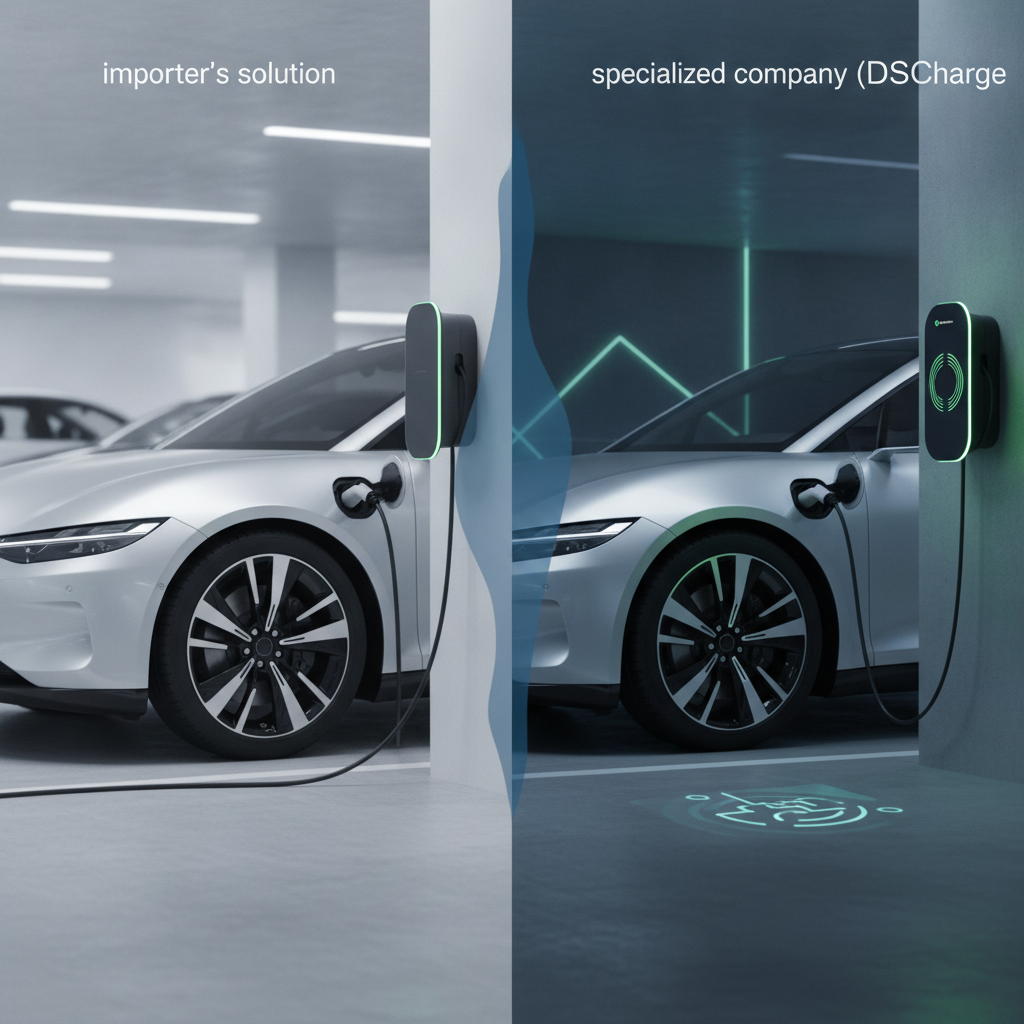
Many car importers offer a charging station together with the car. It's convenient, but the station isn't always suited to your home's electrical connection, to an apartment building or to the next car you buy, and it's usually the cheapest station on the market. A detailed comparison is in the guide The car importer's charging station vs. a specialist company.
Smart charging station or managed charging station: what's the difference when buying from the importer?
A smart charging station connects to Wi-Fi, LAN or 4G and lets you control charging from the app: scheduling for off-peak hours, limiting current and tracking consumption. A managed charging station adds a management layer for several users and stations: permissions, power sharing between stations, billing and reports. In a private home a smart charging station is usually enough; in a building, parking facility or business a managed charging station is required.
| Smart station | Managed station | |
|---|---|---|
| Control | App for a single user | Management system for multiple users and stations |
| Permissions | Station owner | RFID / app by groups |
| Billing and reports | Consumption tracking | Per-user billing and reports |
| Models (as of October 2026) | DSG-1061 / 1062 / 1072 – ₪1,590-₪2,390 | DSG-6012 – ₪3,290; public OCPP DSG-6052 / 6112 – ₪6,990 / ₪7,990 |
More details: Smart charging station andManaged charging station and OCPP.
5 common mistakes when buying a charging station
- Buying from a seller with no local warranty: A cheap station from a foreign website or a casual distributor leaves you with no one to replace it when it breaks down.
- Choosing 22kW for a car that accepts 11kW: The car's onboard charger determines the AC charging rate. It's worth checking before you buy – see 11kW or 22kW charging station andHow long does it take to charge an electric car.
- Ignoring the electrical connection: With a single-phase connection the practical power is up to 7.4kW, and sometimes a connection upgrade is required.
- Two cars without load management: Two stations drawing full power at the same time can trip the main circuit breaker. A dual charging station or load management solves this.
- Confusing a portable EV charger with a granny cable: The granny cable DSG-350 comes with a standard household plug. The 7.4kW, 11kW and 22kW portable EV chargers connect with an industrial (CEE) plug to a dedicated socket installed on a separate line from the electrical panel.
Frequently asked questions
Who is the importer of DSGCharge charging stations?
DSGCharge is the importer of its charging stations, and the DSGCharge brand is the company's own. It has been active since 2021 and provides installation and service nationwide.
What's the warranty on a DSGCharge home charging station?
24 months on-site at the customer's home. For portable EV chargers and cables — 12 months.
Are DSGCharge charging stations approved in Israel?
Yes. The company's products carry Standards Institution of Israel approvals for use in Israel.
Does DSGCharge also install the station?
Yes. Installation and service are provided nationwide by dozens of installation and service teams, in private homes, apartment buildings, businesses and parking facilities.
Why buy from the importer and not from a general store?
Because the importer is responsible for the product, the approvals and the spare parts, and the price comes without a middleman layer.
Want advice on a station for your home, building or business? leave your details and we'll get back to you, or visit the store.