
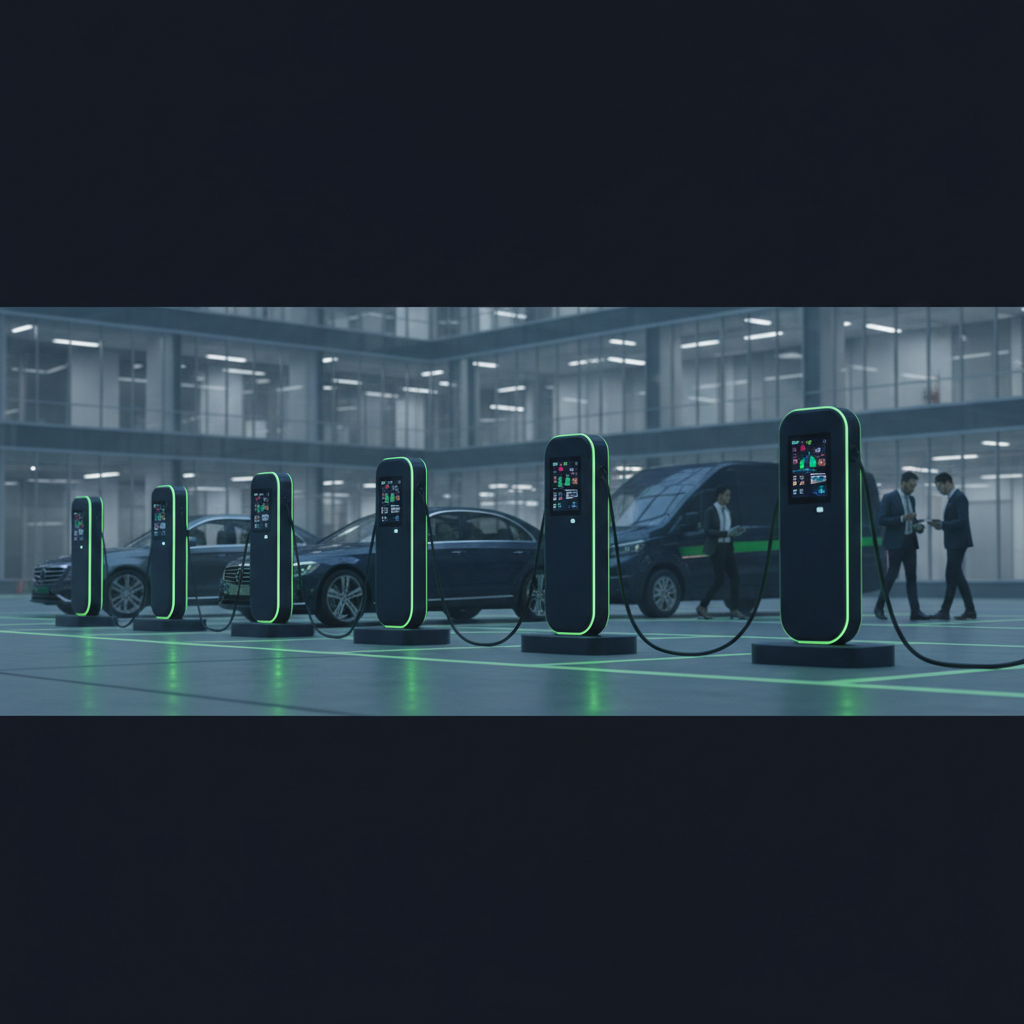
Charging stations for businesses are no longer just a nice perk for employees. In a business with company cars, employees who arrive in an electric vehicle, or customers who park for an hour or more, a charging point in the parking lot saves time, money and dependence on public charging stations. This guide explains how to plan charging stations for a business according to its size and type of users, how many stations to install, what is needed on the electrical side, how to manage permissions and billing, and when AC is preferable and when DC.
In short: Most businesses do fine with 11–22kW AC stations, because vehicles stay parked for hours. Start by checking the available capacity on the connection, decide who charges (employees, company cars, customers) and who pays, and choose stations that can be managed remotely and expanded. DC is suitable only when vehicles need to charge in less than an hour.
The models and prices of Public charging stations and managed charging stations for businesses are available in our store.
Who are charging stations for businesses suitable for?
Three types of users determine the planning, and most businesses have more than one of them:
- Company cars and vehicle fleets: The vehicles belong to the business, and electricity is a business expense. It is important to know which vehicle charged, how much and when, in order to control costs.
- Employees with a private car or company car: They park for a full workday. You need to decide whether charging is a benefit, whether the employee pays, and how to allocate stations when there are more vehicles than stations.
- Customers and visitors: They come for a limited time and expect simple charging with clear payment. A station open to the public is also subject to the Electricity Authority's regulatory rules.
A common mistake in small businesses is installing one station “for everyone”. After a few weeks it turns out that an employee is plugged into it from morning to evening, and a customer who wanted to charge couldn't find a spot. The decision about who uses the station and when should be made before installation, not after.
Charging stations for offices: how is it different from a business that serves customers?
In an office, employees park for 8–9 hours straight, so AC stations of 7.4kW to 22kW are enough to replenish each vehicle's daily driving. DC fast charging stations are needed in an office only when there are fleet vehicles that return to the parking lot and need to head out again within an hour or two.
What determines the success of an office project is management, not the number of stations:
- Permissions: Only authorized employees charge – with an RFID card or app, with separation between employees, fleet vehicles and guests.
- Load management: The available capacity on the building's connection is automatically divided among the connected vehicles, so you can install more stations without upgrading the connection. The full explanation is in theLoad management for charging stations.
- Billing policy: Free charging as an employee benefit, billing per kWh, or a monthly quota per employee – with a report by employee or department.
- Fleet vehicles: When some of the vehicles are company cars, it is worth connecting the stations to the EV fleet managementsystem, including expense reimbursement for charging at the employee's home.
| Office situation | Suitable station | Price (as of October 2026) |
|---|---|---|
| Several employees, permissions and reports needed | Managed charging station DSG-6012 (22kW) | ₪3,290 |
| Two vehicles on one pole | Dual charging station DSG-3012 (2 × 22kW) | ₪6,490 |
| Parking facility shared by several companies, managed via OCPP in the cloud | DSG-6052 / DSG-6112 | ₪6,990 / ₪7,990 |
How to plan charging stations for offices, step by step
- Count: How many employees arrive in an electric vehicle today, and how many are expected to switch to electric in the next two to three years (including company cars and leasing).
- Electrical check: A check of the connection size and the available capacity in the parking lot panel – this determines how many stations can run simultaneously with load management.
- Policy: Free charging as a benefit, billing by consumption or a monthly quota – and who gets priority (fleet vehicles, managers, shift workers).
- Phased installation: Install the required number of stations now, and prepare infrastructure (cabling and conduits) for future expansion without opening up the parking lot again.
- Cloud management: Stations that support OCPP let you manage permissions, reports and billing from one place – the explanation is in theManaged charging station: what is OCPP.
How many charging stations does a business need?
You don't plan by the number of parking spaces, but by the number of electric vehicles, the dwell time and how much energy each vehicle needs per day. A vehicle that drives 60–80 km a day needs roughly 10–15 kWh, and at a 7–11kW AC station it replenishes that in an hour or two. So one station can serve several vehicles a day, if there is order.
| Business size | Typical situation | Recommended starting solution |
|---|---|---|
| Self-employed or a business with 1–3 vehicles | Vehicles return in the evening and charge overnight, or park near the business during the day | One or two 7–11kW smart charging stations, with an app or RFID for identification. No complex payment processing |
| Small to medium business with 4–15 vehicles | Employees and company cars park for a workday | 22kW dual AC stations with load management, per-user permissions and consumption reports |
| Offices, a factory or a campus with dozens of vehicles | More vehicles than stations, arrivals at similar times | A system of managed stations via OCPP: permission groups, queues, prioritization, billing by employee or department |
| A business with customers (hotel, mall, restaurant) | Occasional customers, from an hour to overnight | Public charging stations with payment processing, and for short stays DC as well |
Rule of thumb for businesses with employees: you can start with one station for every 3–5 electric vehicles, provided there is permission and queue management, and add stations as usage grows. It is important to prepare infrastructure (conduits, space in the panel) for the next phase already in the first installation.
AC or DC: which station suits a business?
At an AC station, power is limited by the charger inside the vehicle – 7.4–11kW in most vehicles and 22kW in some. That is entirely sufficient when a vehicle is parked for several hours. A DC station converts the power inside the station and reaches tens and hundreds of kilowatts, but requires a large electrical connection and a much higher investment.
- AC is suitable for employee parking, company cars that charge overnight, hotels and offices. This is the solution for most businesses.
- DC is suitable for fleets working in shifts that have no time to wait, for fuel stations, and for places where customers stay less than an hour. Full details, including the electrical connection required for each power level, are in the guide DC fast charging station for businesses.
To compare power levels and charging times, you can use theCharging time calculator and the guide AC or DC charging station.
What is needed electrically?
The first step in any project is checking the available capacity on the existing connection, not just the connection size. A business has air conditioning, machinery, lighting and elevators, and sometimes less remains than you think. For illustration: a 3X40 amp connection is about 27.7 kVA, a 3X63 connection about 43.6 kVA, and a 3X80 connection about 55.4 kVA (calculated at 400V). A 22kW dual charging station at full power consumes 44kW.
This is where Load management for charging stations: the system divides the available power among the connected vehicles and takes the business's other consumers into account, so you can connect more stations without immediately upgrading the connection. If a connection upgrade is still needed, check it early, because it depends on the IEC's approval and work.
The installation is carried out by an electrician with the appropriate license and in accordance with the Electricity Administration guidelines (11/2025), including a suitable RCD and periodic inspections. The requirements are detailed in the guide Guidelines for installing an EV charging station.
How do you manage permissions, queues and prioritization among employees?
When there are more vehicles than stations, without clear rules, fights over spots break out. A charging management system solves this with several tools:
- Permissions by user or group: Only authorized users can activate the station, via the app or an RFID card. You can define groups such as management, service vehicles, employees and guests.
- Prioritization: Service vehicles that go out into the field get priority in power or time.
- Time limit and queue: A notification to the employee when the vehicle has finished charging, so they free up the spot for the next in line.
- Reports: Consumption by employee, vehicle or department, for monitoring and billing.
All of DSGCharge's public charging stations are managed via the OCPP protocol from a cloud computing system, so you can manage permissions, pricing and reports remotely and connect additional stations later. For a business with a vehicle fleet, see also EV fleet management, including vehicle identification by license plate and a home charging expense reimbursement report for the employee.
Who pays for the electricity? Billing and payment in a business
There are three main approaches, and they can be combined:
- The business pays: Suitable for company cars, or when charging is an employee benefit. The management system provides a consumption report for monitoring.
- The employee pays: Billing per kWh at a rate set by the business, via payroll deduction or payment in the app.
- Customers pay: A station open to the public with payment via app, card or credit card. The business sets the price and can turn the station into a source of income.
Payment processing and billing are run by the DSGCharge operations system: an app, credit card payment terminals at the station, RFID cards and per-user permissions. Full details on the page Charging station operations system. It is also worth checking the business's electricity tariff: with a time-of-use tariff, charging during off-peak hours and on weekends is cheaper, and a management system can schedule charging accordingly.
A station open to customers: what does regulation require?
If the station is open to the public, the Electricity Authority's rules for public charging stations apply to it (Decision 73006, in effect from 26.7.2026): price display, a payment option for occasional customers, and for stations above 50kW a credit card payment terminal. The obligations apply to the station operator. A station intended for the business's employees only and not open to the public is exempt from these rules (as of 10/2026). Full explanation on the page Charging stations for parking facilities.
A business that wants to offer charging to customers without investing or operating can choose a partnership model: the site owner provides the space and infrastructure, and DSGCharge sets up, manages and maintains the stations, with revenue sharing depending on the location and subject to a feasibility check. Details on the page Setting up public charging stations.
Which stations suit a business?
- Managed charging station 22kW DSG-6012 – a managed charging station for one vehicle, connects to the cloud management system via OCPP. Suitable for employee parking and company cars. ₪3,290 (as of 10/2026).
- Dual public station 22kW DSG-6052 – two charging points in one wall-mounted unit, managed via OCPP. ₪6,990 (as of 10/2026).
- Dual free-standing public station 22kW DSG-6112 – a free-standing version for open parking lots. ₪7,990 (as of 10/2026).
- DC station 40kW DSG-5240 andDC station 60kW DSG-5260 – for fleets that need fast charging between trips. ₪24,900 and ₪34,990 (as of 10/2026).
- For a small business with one or two vehicles: smart charging stations for home and business in the category Charging stations and accessories.
Common mistakes when planning charging stations in a business
- One station for employees and customers without rules. The first employee to arrive takes it for the whole day.
- Installing without checking available capacity. The stations overload the connection at peak times, or a need to upgrade the connection is discovered in the middle of the project.
- Stations that can't be managed. Without user identification there is no control over who charges, and no report for billing.
- DC in a place where vehicles park all day. A high investment with no benefit for the employee.
- Not preparing infrastructure for expansion. Every additional station requires digging and panel changes again.
Why DSGCharge?
DSGCharge, part of S.M.C. Dor HaAtid, has been active since 2021. DSGCharge is the importer of its charging stations – the brand is DSGCharge's own: AC stations up to 22kW including dual stations, and DC fast and ultra-fast charging stations up to 480kW. About 20,000 chargers and charging stations sold and installed, and installation and service are provided nationwide by dozens of teams. As the importer, we supply the equipment, installation, management system and maintenance from a single source.
How to get started?
- Tell us about your business: How many electric vehicles you have today and will have in a year, who charges (employees, fleet, customers) and the connection size.
- Infrastructure check: Available capacity, distance from the panel and station locations.
- Planning: Number of stations for the first phase, load management, permissions and billing.
- Installation and activation: Connection to the management system and training for the administrator.
Leave your details to plan charging stations for your business and we will get back to you.
Frequently asked questions
How many charging stations does a business with employees need?
You can start with one station for every 3–5 electric vehicles, provided there is permission and queue management, because a vehicle parked for a workday needs only an hour or two of AC charging. Add stations as usage grows, and prepare infrastructure for expansion already in the first installation.
Does a business need a DC station, or is an AC station enough?
For most businesses an 11–22kW AC station is enough, because the vehicles stay parked for hours. DC is suitable for fleets working in shifts, fuel stations and places where customers stay less than an hour.
How do you bill employees for charging at work?
A management system identifies each employee via the app or an RFID card and generates a consumption report per employee. The business can fund charging as a benefit, bill per kWh at a rate it sets, or combine the two.
Does a station for employees only have to comply with the Electricity Authority's rules for public charging stations?
A station intended for the site's employees and not open to the public is exempt from the regulatory rules for public charging stations. A station open to customers is subject to them (as of 10/2026).
What do you do if there isn't enough capacity on the business's electrical connection?
Start with load management, which divides the available power among the vehicles and takes the other consumers into account. If that is not enough, submit a connection upgrade request to the IEC – and it is worth doing so early.