
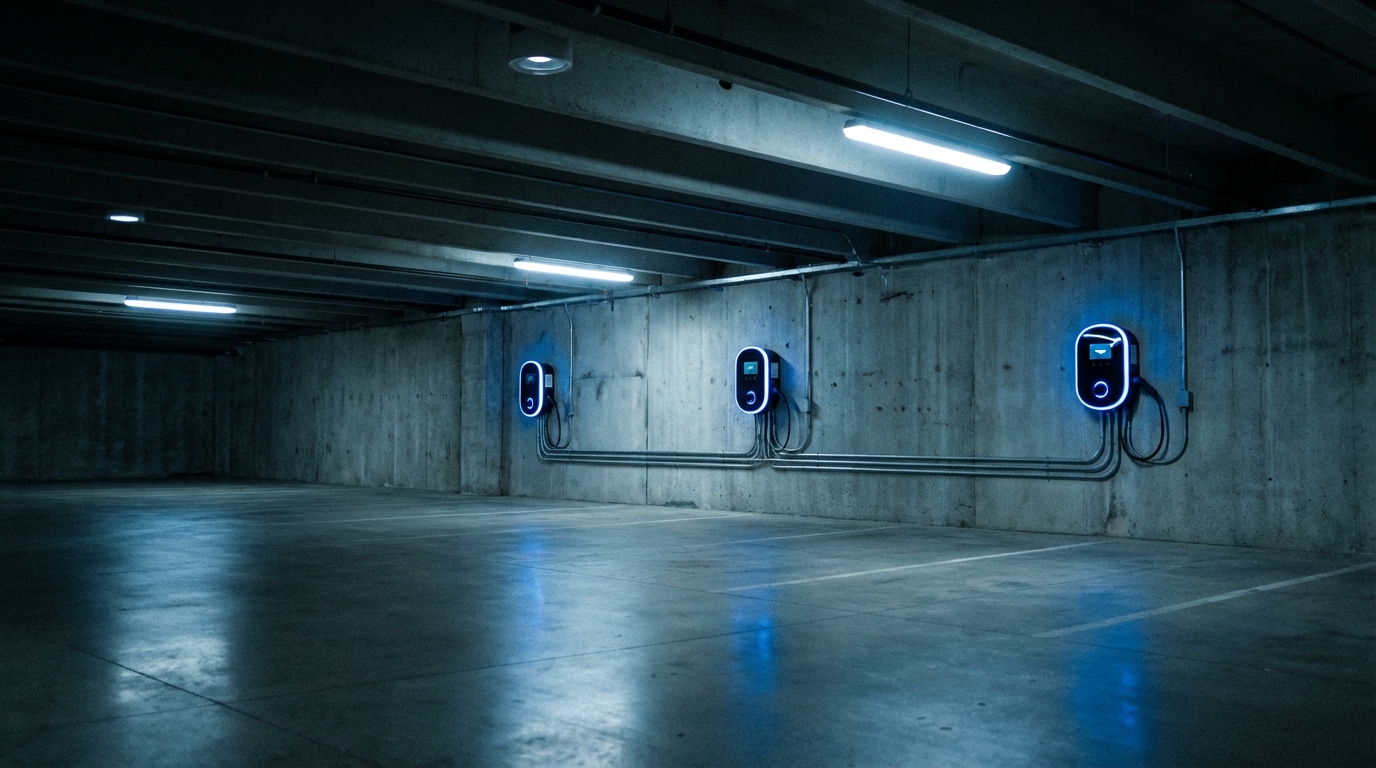
In short: Load management is a mechanism that continuously measures how much electricity the home or building is consuming, and lowers or raises the charging rate of the vehicles so that total consumption does not exceed the connection size. Thanks to it, you can charge two vehicles at home, or dozens of vehicles in a parking garage, without tripping the power and often without upgrading the connection. Managed station is a station connected to a cloud management system (usually via the OCPP protocol), and on top of load management it adds user identification, permissions, queues and separate billing for each user – which is why it is the standard solution for apartment buildings, offices and parking facilities.
📌 What you need for your situation
- Private home, one vehicle: Usually no system is needed – limiting the station's current to the connection size is enough.
- Private home, two vehicles: Dual station or two stations with dynamic load management – before upgrading the connection.
- Apartment building: Managed charging stations on a dedicated connection, with central load management and billing per resident.
- Office, parking facility or vehicle fleet: Managed charging stations with permission groups, prioritization and reports by department or company.
You can compare all models, from home charging stations to managed charging stations for buildings and parking facilities, in one place on the page EV charging stations from DSGCharge.
What load management is, in plain language
Every home and every building has a Connection size to the power grid – how many amps can be drawn at once before the main circuit breaker trips. The size appears on your electricity bill (on page 2, in the line “Payment for KVA capacity”). A charging station is a very heavy consumer: an 11kW station draws about 16 amps per phase, and a 22kW station about 32 amps per phase – more than a standard 3X25 amp residential connection can supply. Add air conditioners, the water heater and the oven in the evening, and the connection reaches its limit.
A load management system solves this in three steps:
- Measurement: A measuring component (usually current transformers – CTs – in the main panel) measures total consumption in real time.
- Calculation: The system calculates how much current is still available within the connection size.
- Regulation: The stations receive a command to raise or lower the charging current accordingly – and if necessary, to pause one vehicle and resume it later.
The vehicle itself does not need to support anything special: every electric vehicle receives the permitted current from the station and adjusts itself to it.
| Connection size | Connection capacity (kVA) | What it means for charging |
|---|---|---|
| 1X25 amps (single-phase) | 5.77 | A station of up to about 3.7kW without load management, or 7.4kW only with load management or a connection upgrade |
| 1X40 amps (single-phase) | 9.24 | A 7.4kW single-phase station, preferably with load management |
| 3X25 amps (three-phase) | 17.32 | An 11kW station; two stations – only with load management |
| 3X40 amps (three-phase) | 27.71 | A 22kW station, or two 11kW stations with load management |
Connection capacities – per the Electricity Authority tariff book (July 2026). What actually fits depends on the existing consumption in the home and is determined in an electrician's design.
Static vs. dynamic load management
There are two methods, and the difference between them is very noticeable in charging speed:
| Static | Dynamic (DLB) | |
|---|---|---|
| How it works | The stations are allocated a fixed amount of current, regardless of what is happening in the home | All consumption is measured in real time and the stations get everything that remains available |
| One vehicle connected, the home is “quiet” | Receives only the share allocated to it | Receives all available power |
| An air conditioner turns on in the middle of the night | No change – so the allocation must be conservative | Charging drops automatically and recovers when the air conditioner turns off |
| Required equipment | A setting in the station only | A measuring component in the panel + stations that support it |
| Suitable for | One vehicle, a connection with plenty of headroom | Two or more vehicles, a tight connection, buildings and parking facilities |
The Electricity Administration guidelines (November 2025) also allow a station to be configured for a limited power that suits its circuit – a setting that must be made by a certified electrician. This is essentially the most basic form of static load management.
What is a managed charging station – and how is it different from a smart charging station?
These three terms are often confused, so here is the difference:
- Standard station: Charges at a fixed power. No app and no data.
- Smart charging station: It has an app (usually via Bluetooth or Wi-Fi), charging scheduling, RFID and consumption data – but it is managed by the station owner only. Suitable for a private home. More details: Smart charging station – what it offers and who it suits.
- Managed charging station: Connected via the internet (Wi-Fi, LAN or 4G) to a cloud management system, usually via the OCPP protocol – an open standard that allows stations from different manufacturers to work with the same system. The system identifies each user (via the app or an RFID card), decides who charges and at what power, and bills each user according to their consumption.
What a good management system delivers in practice:
- dynamic load management for all stations together, on the shared connection.
- Permissions: Only authorized users can charge; you can block the card of a resident who moved out or an employee who left.
- Billing and payment: kWh metering for each user, a monthly invoice by email and credit card billing.
- Reports and remote control: Consumption by station, user or group; remote station reset in case of a fault.
- Off-peak scheduling: Deferring charging to cheaper hours when you don't need the vehicle right away.
- Works without internet too: A quality managed charging station keeps authorizing approved RFID cards when communication drops, stores the charging data and syncs it when the connection is restored.
At DSGCharge this is the Managed charging station DSG-6012: 22kW, Wi-Fi, LAN and 4G communication, RFID or app activation, and a 24-month on-site warranty.
Load management in a private home: two vehicles without upgrading the connection
The most common problem: a family with a second electric vehicle. Assume a 3X25 amp connection (17.32 kVA). Two 11kW stations running simultaneously need about 32 amps per phase – more than the entire connection, even before the air conditioners. There are three ways to solve this:
- Dynamic load management: two stations (or a Dual station) with a measuring component in the panel. At night, when the home uses little power, both vehicles charge at nearly full power; when something heavy turns on – charging drops. In most families both vehicles are full by morning.
- Alternating charging: The station charges one vehicle and then switches to the other. Simple, but slower.
- Connection upgrade: Upgrading from 3X25 to 3X40 amps. Under the regulated tariff, a payment to the IEC of about ₪2,900 before VAT, with completion within up to 30 business days of payment. The full comparison: Upgrading the connection to 40 amps or a load management system.
The rule of thumb: if evening consumption in the home is not particularly high, load management is almost always cheaper and faster than a connection upgrade. If the main breaker already trips today – it is worth looking into a connection upgrade. The full guide for two vehicles: Two electric vehicles at home – a dual charging station or two stations.
Load management in an apartment building
In a building, the problem is bigger: dozens of apartments on one connection, and every year more residents with an electric vehicle. If every resident runs a cable to a private station from their apartment panel, the parking garage fills with cables, and at some point the building's connection will not be able to handle it. The standard solution:
- A dedicated charging connection: Electricity Authority Regulation 34F allows the representative of the apartment building or a registered apartment owner to order an additional public connection for charging stations, for the fee of a new connection. This way charging does not “steal” from the building's electricity.
- Managed charging stations on that connection, with central load management that divides the power among everyone connected at that moment – equally or according to priorities set by the building committee.
- Billing per resident: Each resident pays for their own kWh, and the shared electricity bill does not balloon. The monthly invoice also lets residents get reimbursed by their employer or record a business expense.
- Adding stations gradually: Initial infrastructure is prepared, and stations are added to the system as more residents with electric vehicles arrive.
How does DSGCharge plan load management in a building?
Before installation: DSGCharge carries out a roughly two-week check of the building's entire electrical system. Based on the measurement, it determines how much power can be allocated to the charging stations without affecting the building's consumption.
After installation: A cloud management system controls all stations via Wi-Fi, 4G or LAN and regulates charging in real time. When there is not enough power for all connected vehicles, an algorithm decides what to do:
- reduce the charging rate at the stations, so that more vehicles can charge simultaneously.
- Put a vehicle in a queue: The station starts charging as soon as another vehicle finishes and power becomes available.
The cabinet you see in the parking garage is a sub-panel – the residents' connection point to the system. The load management itself happens in the cloud.
What about the neighbors' approval? As of September 2026 there is no dedicated law. The Land Law bill (Amendment No. 36) passed its first reading in May 2024 and has not yet been approved. In practice, according to a (non-binding) opinion of the Israeli Housing Culture Association from March 2025: a station in an assigned parking space connected to the apartment's meter – does not require consent, but written notice 45 days in advance is needed; connection to the common panel – a majority of apartment owners and a separate meter; a station in common parking – two-thirds of the apartment owners. This is general information, not legal advice – before a decision at the general meeting, check the bylaws and the current situation.
More on the process in a building: Installing charging stations for residents in apartment buildings andSetting up and managing charging systems in buildings.
In offices, parking facilities and vehicle fleets: permissions, queues and prioritization
In a workplace, the problem is no longer just electricity – but who charges, when and at whose expense. Several departments or several companies in the same building share the same stations, and without rules, arguments start quickly. What works in practice:
- Permission groups: Define a group for each department, each company in the building, the fleet vehicles and guests. For each group – which stations it may use, during which hours, and who pays.
- Prioritization: Fleet and operations vehicles that must get on the road receive power priority; vehicles that stay until evening charge more slowly.
- Time limit and queue: So that a station is not occupied all day by a fully charged vehicle – a time limit, a notification when charging is complete, and if necessary – an idle fee for parking after charging ends.
- Separate billing: When several companies share a parking facility, each company receives its own report and bill; within a company – a report per employee, for expense reimbursement or taxable benefit value.
- A station for employees and customers: One station can serve both employees (with authorization) and occasional customers (paying via the app), at a rate set by the site owner – and become a source of income.
- Load management vs. the rest of the building: In an office building with elevators and central air conditioning, dynamic management ensures that charging does not bring down the building during peak hours.
For vehicle fleets and businesses: EV fleet management.
Off-peak charging: how the system saves money
A managed system (and most smart charging stations too) can defer charging to the cheaper hours. On the IEC's TOU tariff, weekday peak hours are 17:00–22:00 in winter (December–February) and in the transition seasons, and 17:00–23:00 in summer (June–September); on weekends in summer and the transition seasons the whole day is off-peak, while in winter the peak applies on weekends too. All other hours are off-peak. The difference is greatest in summer: at July 2026 rates, a kWh at summer peak costs about ₪1.72 incl. VAT, compared with about 50 agorot off-peak.
Customers who have switched to a private electricity supplier can also take advantage of this: most suppliers have night plans with a discount of about 15%–21% between 23:00 and 07:00 – and the system schedules charging for that window. The full calculation: How much does it cost to charge an EV at home.
Load management is part of a broader system: Energy management system (EMS) coordinates the charging stations, a solar system and the other consumers in the home or building, and automatically shifts charging to off-peak hours.
How much it costs
| Component | Price at DSGCharge |
|---|---|
| Managed charging station DSG-6012 (22kW, Wi-Fi/LAN/4G) | ₪3,290 |
| Smart home charging station (11kW–22kW) | ₪1,590-₪2,390 |
| Dual charging station (2 vehicles) | ₪5,990-₪6,490 |
| Installation up to 20 m / up to 30 m | ₪2,590 / ₪2,990 |
| Site survey in an apartment building | ₪690 (credited against the installation) |
| Splitting from the meter | ₪2,790 |
| Management service for a managed charging station in a building | ₪35 per month + 20 agorot per kWh (in addition to the cost of electricity) |
The price of a load management system for a project (building, office or parking facility) depends on the number of stations, the connection size and the distances, so it is determined after a site survey. In some projects DSGCharge invests in the shared infrastructure in exchange for a commitment to a service period. For details of all prices: How much does a charging station cost – full price list.
Frequently asked questions
What is load management in electricity?
A mechanism that measures total consumption in the home or building and regulates vehicle charging so that consumption does not exceed the connection size. The result: no main breaker trips, and several vehicles can charge on the same connection.
Do you have to upgrade the electrical connection to install a second station?
In most cases, no. Dynamic load management lets you charge two vehicles on an existing connection, with slower charging only during hours when the home uses a lot of power. If the main breaker already trips today – it is worth looking into a connection upgrade.
What is the difference between a smart station and a managed station?
A smart charging station is managed by its owner via an app. A managed charging station is connected to a cloud system (usually OCPP) that manages several stations and several users together – with permissions, shared load management and billing for each user.
What happens if the internet goes down?
A quality managed charging station keeps charging authorized users with an RFID card, stores the charging data and transfers it to the system when communication is restored.
Is the system suitable for every electric vehicle?
Yes. Regulation takes place in the station, and every electric vehicle receives the current the station allows. Stations from different manufacturers can also work together if they support OCPP.
Do you need the neighbors' approval to install in a building?
It depends on where the station is and what it is connected to. A station in an assigned parking space connected to the apartment's meter – advance notice is usually enough; a connection to the common panel or common parking – a decision at the general meeting. There is still no dedicated law, so check the current situation before deciding.
Sources: Electricity Authority tariff book (connection capacities, TOU and July 2026 tariffs); the Electricity Administration's “Guidelines for installing an electric vehicle charging system” (25.11.2025); Electricity Authority Regulation 34F; TheMarker – electrical connection for a charging station (updated 30.9.2026); TheMarker – TOU tariff. DSGCharge prices – per the website, October 2026. This information is general and does not replace design by a certified electrician or legal advice.