
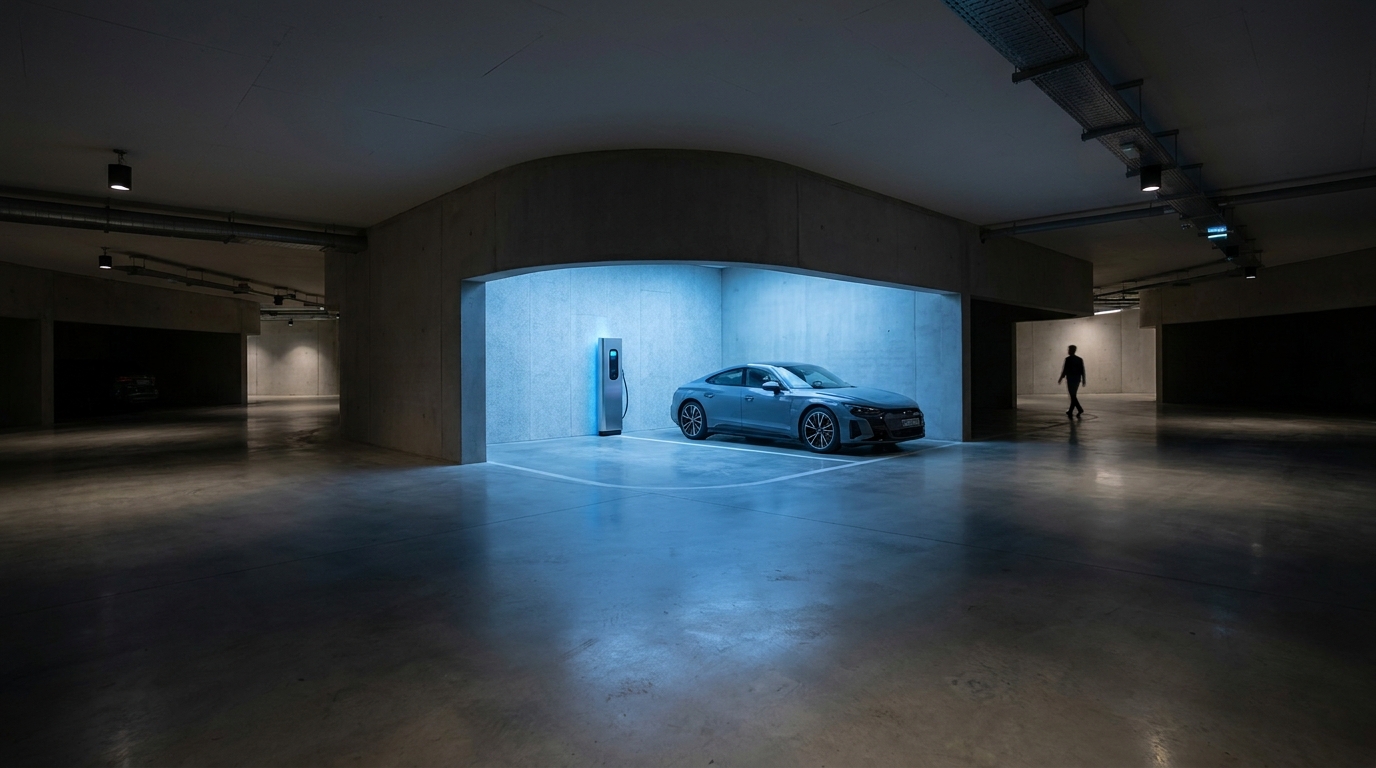
Bought an electric car, and you have a parking space in your building's garage? Charging station installation in apartment buildings is possible today in almost every building, but the right path depends on three questions: what electricity will feed the station, who owns the parking space, and how many other residents will want to charge in the coming years. This guide explains what the law allows as of 11/2026, the difference between the three installation methods, the steps, how much it costs and how to split the electricity fairly between residents.
In short: A resident with an assigned parking space can connect a station to the apartment's electricity without the neighbors' consent, by giving written notice to the building committee and the apartment owners 45 days in advance. Connecting to the common electricity or installing in common parking requires a decision by the residents. When several residents want to charge, a managed system for the whole building, with load management and billing via a TOU meter, is the stable solution. It all starts with a site survey.
Which company installs charging stations in apartment buildings?
DSGCharge, one of Israel's leading companies in EV charging solutions, installs charging stations in apartment buildings and residential towers nationwide: from a private station for a single resident to a managed system for the entire parking garage, with cloud-based load management and billing each resident for their own consumption. DSGCharge is the importer of its charging stations, and the brand is DSGCharge's own. The company has been active since 2021, with about 20,000 chargers and charging stations sold and installed. Before a managed system is installed, the building's electrical system is monitored for about two weeks to determine how much power can be allocated to charging. Details on the Charging stations in apartment buildings and residential towers.
What does the law say about a charging station in an apartment building?
As of October 2026, there is still no dedicated law for charging stations in apartment buildings. There is case law that is already applied today, and there is a bill that has not yet been completed. It is important to distinguish between the two:
- What applies today (case law): According to a decision of the land registry superintendent in Tel Aviv (case 639-21, 2023), a resident who connects a station in the parking space assigned to their apartment to the apartment's electricity does not need the neighbors' consent. The conditions: written notice to the building committee and all apartment owners at least 45 days before installation, detailing the location and infrastructure; minimal harm to the common property and the building's appearance; compliance with electrical and planning law; and bearing all the costs.
- What is proposed (a bill, not a law): The bill passed its first reading in the Knesset in May 2024. Under the bill, connecting a station to the electricity of the common property will require the consent of a majority of apartment owners and the installation of a separate meter, and installing in a parking space that is common property will require the consent of two-thirds of the apartment owners.
The bill does not resolve technical questions such as increasing the building's electrical connection or splitting power between several cars. It is also worth checking the building's bylaws, and in case of a dispute, seeking legal advice. The information here is general and is not legal advice.
What are the ways to install a charging station in an apartment building?
In practice, there are three ways. The difference between them is where the electricity comes from, who pays for it and what consent is required:
| via | Power source | Who pays for the electricity | Required consent | Suitable when |
|---|---|---|---|---|
| 1. Apartment meter, assigned parking space | The apartment's connection, via splitting from the meter or from the panel | The resident, on their own electricity bill | Written notice 45 days in advance (case law) | A single resident, there is spare capacity in the apartment's connection and the distance is reasonable |
| 2. Common property electricity | The building's common services panel, with a separate meter for the station | The committee pays the IEC, and the resident pays the committee by metering | A majority of apartment owners (per the bill) | Two or three cars and there is spare capacity in the common connection |
| 3. Managed system for the whole building | Common connection or a dedicated charging connection, with load management | Each resident by consumption, via a TOU meter and a monthly report | Building committee or general meeting decision; two-thirds for common parking (under the bill) | Several residents already, or a building planning ahead |
The first way is the fastest for anyone who wants a station now. The downside shows up later: every building has limited space in the shaft, the panels and the connection, and when every resident runs their own cable, the fifth or sixth resident may discover there is no way left for them to connect. With the third way, the infrastructure is built once, and each new resident simply installs a station in their own parking space.
What do the Electricity Administration's guidelines require for a charging station in an apartment building?
On 25.11.2025, the Electricity Administration at the Ministry of Energy published updated guidelines for installing EV charging systems. The requirements that are especially important in an apartment building:
- Who installs: An electrician holding at least a certified electrician license.
- Dedicated circuit: The station is fed from a final circuit dedicated to charging only, with overcurrent protection.
- Residual current device (RCD): 30mA for each connection point, Type B, or Type A or F with added direct current (DC) leakage detection. In some stations, the detection is built in.
- Surge protection: Mandatory for stations in the common parking garage of a residential building.
- Testing: Testing by an inspecting electrician before first operation, and delivery of documentation and a test report to the owner.
If someone offers to connect the station to an existing socket in the parking garage or to skip one of the protections to save money, that is a sign to look for another installer. The full details are in the guide EV charging station installation.
How do you install a charging station in an apartment building, step by step?
- Building site survey. A technician checks the apartment's connection and the common connection, the panels and shafts, the cable route to the parking space and the cellular reception in the parking garage. At the end of the site survey, it is clear which method suits the building. Order here: Site survey for a charging station in an apartment building DSG-9900.
- Choosing the method and the station. Apartment meter, common electricity or a managed system, and accordingly a smart charging station or a managed charging station with a power rating suited to the connection and the car.
- Notice or decision. When connecting to the apartment's electricity in an assigned parking space: written notice to the building committee and all apartment owners, at least 45 days before installation, detailing the location, route and infrastructure. For common electricity or common parking: a decision of the residents' general meeting.
- Coordination with the Israel Electric Corporation (IEC). When splitting from the meter, a separate meter or a connection upgrade is required, the timeline depends on the IEC.
- Installation by a certified electrician. A dedicated circuit, a suitable RCD, overvoltage protection, running the cable along a route that does as little harm as possible to the common property, and mounting the station.
- Testing and activation. Testing before activation, a test charge, delivery of documentation, and in a managed system, also registering the resident in the system and setting up billing.
How much does it cost to install an EV charging station in an apartment building?
There is no single price, because in a building the distance between the panel and the parking space is greater, and sometimes the cable runs through several parking levels. The table shows the prices of services and stations in the DSGCharge store, as of 11/2026:
| Component | Price (as of 11/2026) | Note |
|---|---|---|
| Survey in an apartment building DSG-9900 | ₪690 | The first step: determines the method and the route |
| Installation up to 20 m of cable DSG-9903 | ₪2,590 | Standard installation in an external conduit |
| Installation up to 30 m of cable | ₪2,990 | Each additional meter: ₪69 |
| Separate connection from the IEC meter DSG-9907 | ₪2,790 | When the station is fed directly from the apartment's meter |
| Smart charging station 11kW DSG-1061 | ₪1,590 | Assigned parking space on the apartment's meter |
| Smart charging station 22kW DSG-1062 | ₪1,790 | Three-phase connection |
| Smart charging station 22kW DSG-1072 | ₪2,390 | Three-phase connection |
| Managed charging station 22kW DSG-6012 | ₪3,290 | For a managed system: user identification, load management and billing |
What is not included in a standard installation: chiseling, digging, cutting, a connection upgrade with the IEC (paid to the IEC) and construction work. The final price is set according to the actual work. For an initial estimate for your parking space, use theCharging station installation cost calculator.
Which station is right for a parking space in a building?
The power rating is determined by three things: the size of the connection feeding the station, the car's onboard charger (how many kW it accepts on AC), and your driving pattern. In most parking garages the car stays parked all night, so even an 11kW station is enough for normal daily driving. Anyone connecting to the apartment meter will usually choose a smart charging station with current limiting, so that charging doesn't trip the main breaker when the air conditioner and the oven are running. Anyone joining a managed system needs a station that supports OCPP, such as DSG-6012, so the management system can identify them, measure consumption and allocate power. For charging stations in an apartment building with two adjacent parking spaces belonging to the same family, you can also Dual charging station 22kW DSG-3012 (₪6,490, as of 11/2026).
When is it better to set up managed charging stations in an apartment building?
When more than two or three residents want to charge, or when the committee knows it is only a matter of time, it is worth thinking of the building as one system rather than as individual stations. A managed system includes a single connection for charging, a dedicated panel, stations connected to the cloud via the OCPP protocol (the open standard that allows remote management of stations), and software that identifies each user and measures their consumption. The advantages:
- Load management: The system distributes only the available power in the connection between the cars, so several stations can be connected without upgrading the connection for each apartment. A full explanation in theGuide to load management in charging stations.
- Fairness: Those who don't charge don't pay for their neighbors' charging.
- The committee doesn't collect payments: Metering, billing and collection are done remotely.
- Simple onboarding: A new resident installs a station in their own parking space and connects to the existing infrastructure.
There are two models for investing in the common infrastructure. If the building invests in the infrastructure itself, there is no commitment period. If DSGCharge invests in the infrastructure, a 10-year commitment is required, and the committee does not finance the panel, the main cabling and the system up front. All the details on the Managed charging stations in apartment buildings.
How do you manage charging for several residents in a common parking garage?
When several residents charge in the same parking garage, the power of the building's connection is divided between them. A load management system measures in real time how much power is available and distributes it between the connected cars, so stations can be added without upgrading the connection and without tripping the main circuit breaker. Permissions (an RFID card or an app) ensure that each resident charges and pays only for their own charging.
A full explanation of setup, management, planning infrastructure that grows with the building and billing via a TOU meter – on the charging stations in apartment buildingspage, and about power distribution – in theLoad management for charging stations.
EV charging in an apartment building: how does each resident pay for their own electricity?
With the first method it is simple: the electricity passes through the apartment's meter, and the resident pays on their own electricity bill. When the stations are connected to common electricity or a dedicated connection, metering and billing are needed. In a DSGCharge managed system, the stations are connected via a TOU (time-of-use) meter. DSGCharge reads the meter, assigns each charging session to the resident who performed it, bills each resident according to their exact usage and passes the electricity cost on to the committee. The committee receives a transparent report. This is how it looks in theMonthly charging report by TOU meter.
Why does it matter? With a TOU tariff, the price depends on the season and the hour. Peak hours apply only Sunday–Thursday: 17:00-22:00 in winter and the transition seasons, and 17:00-23:00 in summer. Weekends are off-peak in all seasons, as are all night hours. A car charged overnight in the parking garage pays much less than the flat rate:
| Season | Off-peak (agorot per kWh) | Peak (agorot per kWh) |
|---|---|---|
| Winter | 46.63 | 114.70 |
| Transition | 45.78 | 49.58 |
| Summer | 50.42 | 172.23 |
| Flat rate (for comparison) | 63.52 | |
Prices include VAT, as of July 2026, and change with the Electricity Authority's tariff updates. The management system prioritizes charging during off-peak hours, which lowers the cost per kWh for all residents. To calculate charging costs based on your car and mileage, use theCharging cost calculator.
What can you do in an apartment building without private parking?
When the parking spaces in the building are common property and not assigned to apartments, the first method is usually not relevant: the resident has no fixed parking space to connect a private station to. Here, shared stations that all residents can use are the right fit, with user identification, billing by consumption and usage rules set by the residents, for example a maximum parking time next to the station. Under the bill, such an installation will require the consent of two-thirds of the apartment owners. The complete guide: Apartment building without private parking for an electric car.
What does the building committee need to decide before installing charging stations?
- Policy: Allow each resident to connect to their apartment separately, or set up a single managed infrastructure.
- Location and route: Where the panel will be placed and how the cable will run through the parking garage, with minimal harm to the common property.
- Investment model: The building finances the infrastructure with no commitment, or DSGCharge finances it with a 10-year commitment.
- Who pays for what: The resident pays for the station and the installation in their own parking space, and electricity is billed by consumption.
- Safety: A certified electrician, overvoltage protection and testing before activation.
Why DSGCharge for installing charging stations in an apartment building?
DSGCharge, part of S.M.C. Dor Ha'atid, has been active since 2021. DSGCharge is the importer of its charging stations – the brand is DSGCharge's own. About 20,000 chargers and charging stations have been sold and installed, and the installation and service teams operate nationwide. In an apartment building, this means a single point of contact for the entire chain: site survey, stations, installation, management system, resident billing and service. You can start with one resident and expand to the whole building without changing suppliers.
Want a charging station in your building?
Residents can order a apartment building installation survey or check the cost in theinstallation calculator. Building committees and management companies are welcome to leave their details or call 077-9920350, and we will get back to you with a proposal for a site survey and planning for the whole building.
Frequently asked questions
Do you need the neighbors' approval to install a charging station in an apartment building?
No, if the station is in the parking space assigned to the apartment and connected to the apartment's electricity. According to a ruling of the land registry superintendent in Tel Aviv (2023), written notice to the building committee and apartment owners is required at least 45 days in advance. Connecting to the common electricity or installing in common parking requires a decision by the residents.
Is there a law for charging stations in apartment buildings?
Not as of 11/2026. A bill passed its first reading in May 2024 and has not yet been completed. Under it, common electricity will require a majority and a separate meter, and common parking will require two-thirds. In the meantime, the rulings of the land registry superintendents apply.
How much does charging station installation in an apartment building cost?
At DSGCharge, as of 11/2026: site survey ₪690, installation ₪2,590 up to 20 meters or ₪2,990 up to 30 meters, and ₪69 for each additional meter. Splitting from the meter ₪2,790. Smart charging station from ₪1,590. Chiseling, digging and connection upgrades are not included.
Who pays for the electricity of a charging station in a building?
When connected to the apartment meter, the resident pays on their own electricity bill. In a managed system, DSGCharge reads the TOU meter, bills each resident according to their exact usage and passes the electricity cost on to the committee.
Who is allowed to install a charging station in the parking garage of a residential building?
According to the Electricity Administration's guidelines of 25.11.2025, an electrician holding at least a certified electrician license. In a common parking garage, overvoltage protection, a Type B or A/F RCD with DC detection, and testing before activation are mandatory.
Does the building's electrical connection need to be upgraded?
Not always. Dynamic load management distributes only the available power between the cars, so several stations can run on an existing connection or on a reasonably sized dedicated connection. The site survey determines whether an upgrade is required.
What happens when another resident buys an electric car?
When there is a managed infrastructure, the resident installs a station in their own parking space and connects to the system, and load management allocates power to them as well. Without a common infrastructure, each resident has to re-check the apartment's connection and the space in the shaft.