
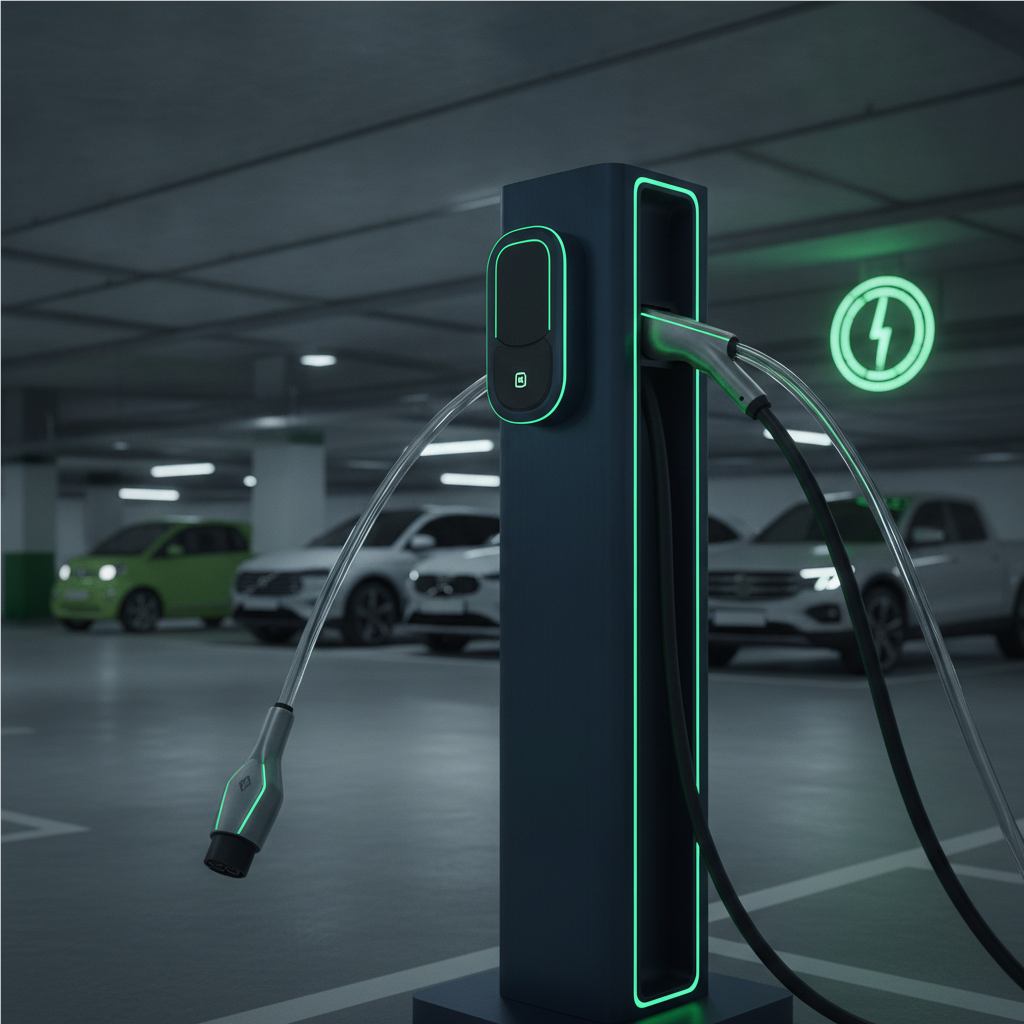
Will your charging station also suit your next electric car?
Buying EV charging station is an investment for years. It is not just another car accessory, but infrastructure that is supposed to become part of your daily routine at home, in the building or at the business. So it's completely natural to stop for a moment and ask: “Wait, what if in two or three years I switch to a newer model – will I have to replace the entire installation and start over?”
This concern is justified. The electric vehicle market is evolving rapidly, batteries are getting bigger and charging speeds are improving. It's easy to get lost among terms like 11kW, 22kW, single-phase, three-phase, Type 2 or Load management. Out of this confusion, many people make a common mistake: they focus on the “most powerful charging station” or the flashiest brand, instead of asking what will really guarantee them peace of mind and flexibility for years to come.
The good news is that in most cases, the answer is no – you won't have to replace everything. The less convenient news is that this flexibility doesn't depend only on the charging station itself, but on the advance planning. That's the difference between a quick purchase and building a charging solution that will serve you faithfully with your next car, and the one after it.
You can compare DSGCharge charging stations, from 11kW and 22kW home charging stations to managed charging stations for buildings and businesses, on the EV charging stations.
The main concern: will the connector fit the next car? (Spoiler: that's not the real problem)
Many customers assume that the biggest risk is that the plug type on the charging station won't fit their future car. In practice, this is the smallest concern. The Type 2 connector is the absolute standard in Israel and Europe for AC charging (home charging and slow public charging). All electric vehicles sold in Israel today are equipped with a Type 2 port, and there is no reason for this trend to change in the foreseeable future.
So where does the risk actually lie? In short-term planning. The problem won't be whether you can plug in the car, but whether the electrical system and infrastructure you set up can support it efficiently, safely and without turning every charge into a headache. Your future flexibility is not determined by the shape of the plug, but by three main factors:
- Charging power (kW): Does the power you chose match your home's infrastructure and your real needs?
- Electrical infrastructure: Was the installation done professionally in a way that allows flexibility, or is it “just enough” for the current car?
- Smart management capabilities: Do you have control over electricity consumption, especially if a second car joins the family or more residents in the building switch to electric?
In other words, the question isn't “will the charging station fit the next car”, but “were the Installing the charging station and the advance planning done with the future in mind”.
What does change? Power, infrastructure and smart management capabilities
Let's break down the factors that really determine whether your charging solution will stand the test of time.
1. Charging power: why 22kW is not always the right solution
It's easy to assume that higher power (22kW) is always better. In reality, it's not that simple. The maximum charging speed depends on the weakest link in the chain: the charging station, the property's electrical infrastructure, and the vehicle's own on-board charger.
- Single-phase infrastructure: The maximum a charging station can deliver is 7.4kW, provided you have at least 32 amps to allocate to the charging station and the vehicle can charge on a single phase at that rate.
- Three-phase infrastructure: In most homes in Israel with a standard electrical connection (25A three-phase), the maximum power that can be allocated to a charging station is up to 11kW. Even if you install a 22kW charging station, it won't be able to deliver more than that.
- Three-phase infrastructure: If you have a three-phase connection, you can install more powerful 11kW or 22kW charging stations. However, many electric vehicles (especially plug-in hybrids) don't support such fast AC charging at all, and are limited to 3.7kW.
The right choice: Instead of chasing the highest number, it's important to match the charging station's power to the existing infrastructure and the current car, but with an eye to the future. Sometimes, installing an 11kW charging station is a balanced solution that will serve most cars today and in the future, without overloading the electrical system.
2. Electrical infrastructure: the foundation for everything
The difference between an amateur and a professional installation is critical for the future. A proper installation is not just running a cable from the panel to the parking space. It includes a thorough inspection of the electrical panel, an assessment of the existing loads in the home, choosing the right cable cross-section for the distance, and installing the required protection devices. Infrastructure built “on the cheap” may not only limit you in the future, but can also be dangerous and, on top of that, cause voltage drops.
The right choice: work with a company like DSGCharge that provides a complete solution – from consultation and an on-site suitability check to Charging station installation by certified electricians. Quality infrastructure built today will let you replace a charging station or upgrade the power relatively easily in the future, without the need for chiseling and complex electrical work all over again.
3. Load management: what makes the charging station truly smart
This is where the real key to the future lies, especially in homes with high electricity consumption, in apartment buildings or in businesses. Load management (dynamic, DLM) is a component installed in the electrical panel that lets the charging station “talk” to the rest of the house. It measures total consumption in real time, and if heavy appliances are turned on (air conditioner, water heater, oven), it automatically lowers the charging power to keep the main breaker from tripping. When the load drops, charging returns to full power.
The right choice: Home charging station with load management capability is a smart investment. It ensures that charging will always be optimal and safe, even if you add a second electric vehicle or your home's electricity consumption grows.
Long-term planning: how do you choose a solution that will grow with you?
A “future-proof” charging solution is not necessarily the most expensive or most powerful one, but the one that is properly planned for your specific situation.
- In a private home: Even if you have one car today, it's worth considering whether a second electric vehicle may be added in the future. In that case, planning the infrastructure in advance or choosing a charging station with load management capability can save thousands of shekels in the future.
- In an apartment building: Here, planning is critical. A situation where each resident installs a charging station independently very quickly leads to overloading the building's infrastructure, disputes and high costs. The right solution is a central managed charging system that allows dynamic load management across all the charging stations, user management and accurate billing for each resident. This is infrastructure that can easily be expanded as more residents switch to electric vehicles.
- At a business or public parking facility: The future depends on the system's ability to grow. You need a solution that allows permission management (who can charge and when), usage monitoring, and the option of payment processing and billing customers. Such a system must be modular so that more Charging stations can be added easily as demand grows.
So how do you choose correctly? Questions you must ask before installation
Instead of focusing only on your next car model, focus on your reality. Before you buy a charging station, ask yourself (and your installer):
- What is the electrical connection size at the property (single-phase or three-phase)?
- How many electric vehicles are expected to use the charging station in the coming years?
- Is it a private home, an apartment building, an office or a commercial parking facility?
- Is load management needed to prevent power trips?
- Is it worth preparing infrastructure that will make it easy to add charging stations in the future?
The answers to these questions will steer you to the right solution much more than comparing technical data on paper. Keep in mind: any general information online is only a starting point. When it comes to electricity, only a professional on-site inspection can give you the full picture.
At DSG Charging Solutions, we don't just sell off-the-shelf products. We build comprehensive charging solutions. Our process starts with understanding your unique needs – whether you are a private homeowner, a building committee, a fleet manager or a developer. We plan together with you a system that will work great today, and be ready to grow with you tomorrow.
Instead of guessing which of the dozens of The charging stations is the right one, let's talk about a solution that is truly tailored to you. Contact us for a consultation and initial planning, and we'll make sure your investment today will still be a smart one many years from now.
Frequently asked questions
If I change cars, will I have to replace the charging station too?
In most cases, no. The Type 2 connector is a uniform standard. The more important question is whether the infrastructure, the electrical capacity and the management capabilities of the existing solution were planned in advance in a flexible way that will also suit future cars with different charging capabilities.
What is more important for future planning, the charging station itself or the electrical infrastructure?
Both are important, but the infrastructure is the critical foundation. Quality, professional electrical infrastructure laid with the future in mind is what will let you upgrade or replace a charging station easily in the future, while poor infrastructure will limit you and make every change more expensive.
I live in an apartment building. Should I install a private charging station or think about a shared solution?
A “pirate” private installation can overload the building's infrastructure and cause problems. The recommended and correct long-term solution is to set up a managed charging system for all residents. Such a system takes care of proper load management, makes it easy to add residents in the future, and handles billing for electricity consumption.