
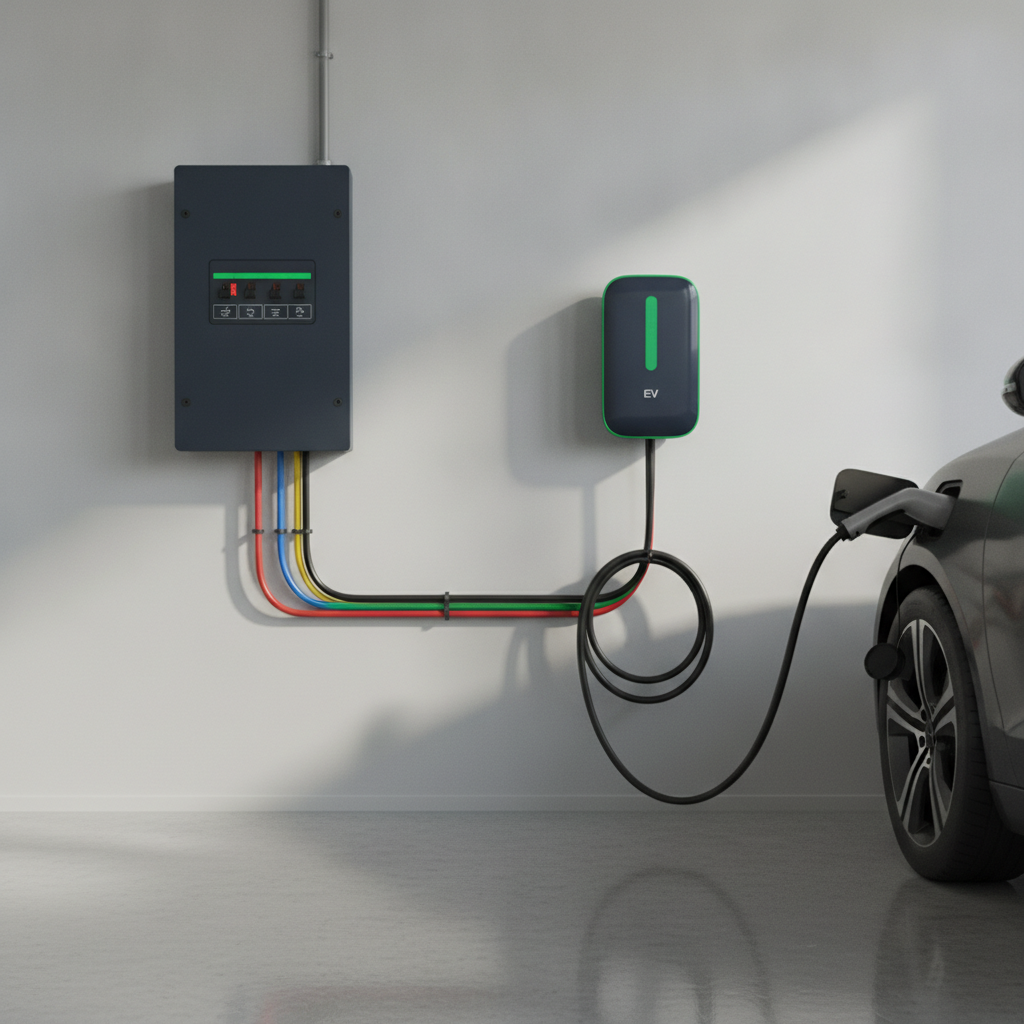
You are planning a new commercial parking facility, and the architect or engineer asks you “How many charging stations do you want at this stage?” – and the honest answer is that it's not clear yet. This is exactly the point where many projects miss out. Not because there is no intention to install charging stations, but because the question is asked too late, or the answer given refers only to what is needed “now”, without thinking about what will be required two or three years from now.
This problem recurs especially in commercial parking facilities – malls, shopping centers, office buildings with shared parking, or public parking areas. The stage of infrastructure work, excavation, electrical design and conduits happens once. After the concrete is poured, the trenches are closed and the panels are in place – every change becomes complex, expensive and sometimes involves dismantling finishing work that has already been completed.
The difference between planning infrastructure in advance and retrofitting
There is a fundamental difference between two situations: one is planning infrastructure in advance that takes future upgrades into account, and the other is trying to “add charging stations” to a parking facility that was never built with charging in mind. In the first situation, the infrastructure designer can mark, already at the engineering stage, locations for electrical panels, a cabling route, space for buried conduits, and even an electrical capacity reserve – without actually installing any station. In the second situation, every intervention in existing infrastructure involves dismantling trenches, cutting into concrete that has already been poured, re-excavation, and an electrical connection that has to be “hidden” in an existing structure. This difference is not a minor technical matter – it is the difference between a project that runs on a planned budget and a project that runs into unplanned work midway.
What to take into account at the engineering design stage
At the stage when the parking facility is still being planned on paper – whether it is an underground garage, a multi-story garage or an open parking area – there are several parameters worth clarifying with the professional accompanying the project, even before ordering any charging station:
- Location of the electrical panels and the distance from them – a long distance from the electrical panel to the future stations affects the cabling length, the type of trenches required and sometimes also the cable cross-section. Planning the right panel locations already at the engineering stage can save unnecessary infrastructure work later.
- Electrical capacity reserve – it is important to check with the project's electrical engineer whether a capacity reserve for future charging stations is possible, so that there will be no need to upgrade the grid connection at a later stage.
- Trench routes and buried conduits – even if no stations are actually installed on day one, you can lay conduits and empty pipes (without cabling) along pre-marked routes, so that in the future the cabling itself will be the only work required.
- Division by parking zones – in a large commercial parking facility, it is worth deciding already at the planning stage which zones are intended for charging (for example, an employee parking zone alongside a public parking zone), so that the infrastructure suits the expected type of use in each zone.
Planning for a future number of stations, not just the current need
A question that comes up again and again in planning discussions: “Why plan for more stations than I need now?” The answer is simple – because demand for charging in commercial parking facilities tends to grow over time, and the cost difference between proper planning in advance and a retrofit is especially significant when the infrastructure work has already been closed up. The key point is not to actually install more stations than you need today, but to plan the infrastructure – the conduits, the routes, the capacity reserve and the panel locations – so that adding stations in the future will be simple cabling work and not a new infrastructure project. In this context, DSGCharge accompanies such projects through a professional infrastructure check at the planning stage, which looks not only at the immediate need but also at reasonable expansion scenarios – whether it is adding AC stations to an employee parking area, or at a more advanced stage also examining DC fast charging stations in zones that require a shorter charging time.
The connection between early planning and a charging management system
In a commercial parking facility, it is not enough to install a charging station – you also need to know who uses it, how billing works, and how to prevent a situation where one station “grabs” all the available power while other stations stand empty. That is why infrastructure planning in a commercial parking facility should include, at an early stage, thought about a suitable charging management system. Load management system makes it possible to divide the existing power among several stations dynamically, so there is no need to bring huge electrical capacity to each station separately – but rather to manage what exists intelligently. This is especially relevant in a commercial parking facility where the number of users changes during the day, and sometimes also between weekdays and weekends. In addition, when the parking facility belongs to a business, a mall or a building committee, it is also relevant to examine aspects of user management, payment processing and billing – who can use the station, how payment is made, and how employee charging is separated from public charging. Alongside its charging stations, DSGCharge also offers managed charging systems for buildings, parking facilities andVehicle fleet, including load management, monitoring and an infrastructure solution that suits future growth in the number of electric vehicles in the parking facility.
About DSGCharge – for details on the company's approach to planning end-to-end charging solutions, including infrastructure checks, installation and management.
When to involve DSGCharge in the process
The earlier the planning takes place – when the engineering plans are still on paper and no infrastructure work has yet been done on site – the easier it is to adapt the plan to future needs without affecting the project's schedule or costs. That is why it is recommended to involve a professional who knows the charging field already at the stage when decisions are made about the location of the electrical panels, trench routes and the division of parking zones. DSGCharge specializes in the planning and installation of EV charging stations nationwide, adapted to the private, business and public sectors – including parking facilities, shopping centers, building committees and office buildings. In an initial consultation call, you can review the existing plans, understand expectations regarding the number of electric vehicles expected to use the parking facility, and get a clear direction on what is worth planning in advance so you don't get stuck with infrastructure that won't be enough. It is important to note – the final price of a charging infrastructure planning and installation project varies according to the type of station, the required power, the distance from the electrical panel, single-phase or three-phase, the need for trenches, cutting or excavation, a load management system, communication and payment processing, and the overall complexity of the installation. Every commercial parking project is different, and the right fit starts with an infrastructure check, not a generic quote.
If you are in the process of planning a new commercial parking facility, or the engineering work has not yet been completed, now is the right time to look into the issue – and not after the concrete has already set. You can browse the existing solutions inEV charging stations or also look into the related need forEV charging cables, but the recommended first step is a conversation with DSGCharge to understand what suits your specific project.
Want to review the plans for your commercial parking facility before continuing with the infrastructure work? You can contactDSGCharge for advice and a charging solution that takes into account both today and what will come in two or three years.
📊 In brief: key points of the article
The difference between planning infrastructure in advance and retrofitting
There is a fundamental difference between two situations: one is planning infrastructure in advance that takes future upgrades into account, and the other is trying to "add charging stations" to a parking facility that was never built…
What to take into account at the engineering design stage
At the stage when the parking facility is still being planned on paper – whether it is an underground garage, a multi-story garage or an open parking area – there are several parameters worth clarifying with the professional accompanying…
Planning for a future number of stations, not just the current need
A question that comes up again and again in planning discussions: "Why plan for more stations than I need now?" The answer is simple – because demand for charging in commercial parking facilities tends to grow over time,…
FAQ
When is the right time to start planning charging infrastructure in a new commercial parking facility?
The ideal time is at the engineering design stage, before the concrete is poured and the trenches are closed. Once engineering design is underway, you can mark locations for electrical panels, trench routes and a capacity reserve without significant additional cost, whereas a retrofit may require cutting or new excavation.
Do all the stations need to be installed in the first phase?
Not necessarily. You can install in the first phase only the number of stations actually required, but plan the infrastructure – the conduits, the potential cabling and the capacity reserve – so that future expansion is simple and does not require dismantling finishing work.
What is the difference between planning infrastructure in advance and adding stations retroactively?
Planning in advance makes it possible to leave trench routes and buried conduits free during construction, so that in the future only cabling work is needed. A retrofit usually involves cutting into existing concrete, dismantling trenches and additional infrastructure work that make the project more expensive and complicated.
Does a commercial parking facility need a load management system, or is a single charging station enough?
When several charging stations are planned in a parking facility, a load management system makes it possible to divide the existing power among the stations dynamically, so there is no need to increase the total electrical capacity for each station separately. This is especially relevant in commercial parking facilities with usage that changes during the day.
How can DSGCharge help at the planning stage, before a charging station is actually installed?
DSGCharge carries out a professional infrastructure check and accompanies the engineering design stage, so that the location, routes and capacity reserve suit both the current need and future expansion. This prevents a situation where infrastructure that has already been completed has to be changed.
What do you do after the parking facility is built?
Once the infrastructure is ready, you can choose an operating model: stations owned by the parking facility, a partnership with DSGCharge with no financial investment on your part (revenue sharing is determined by location and subject to a feasibility check), or purchasing AC and DC stations. The full comparison of the models is in the guide Charging stations for parking facilities. Payment processing, the app and reports are run by the charging station operations system from DSGCharge.