
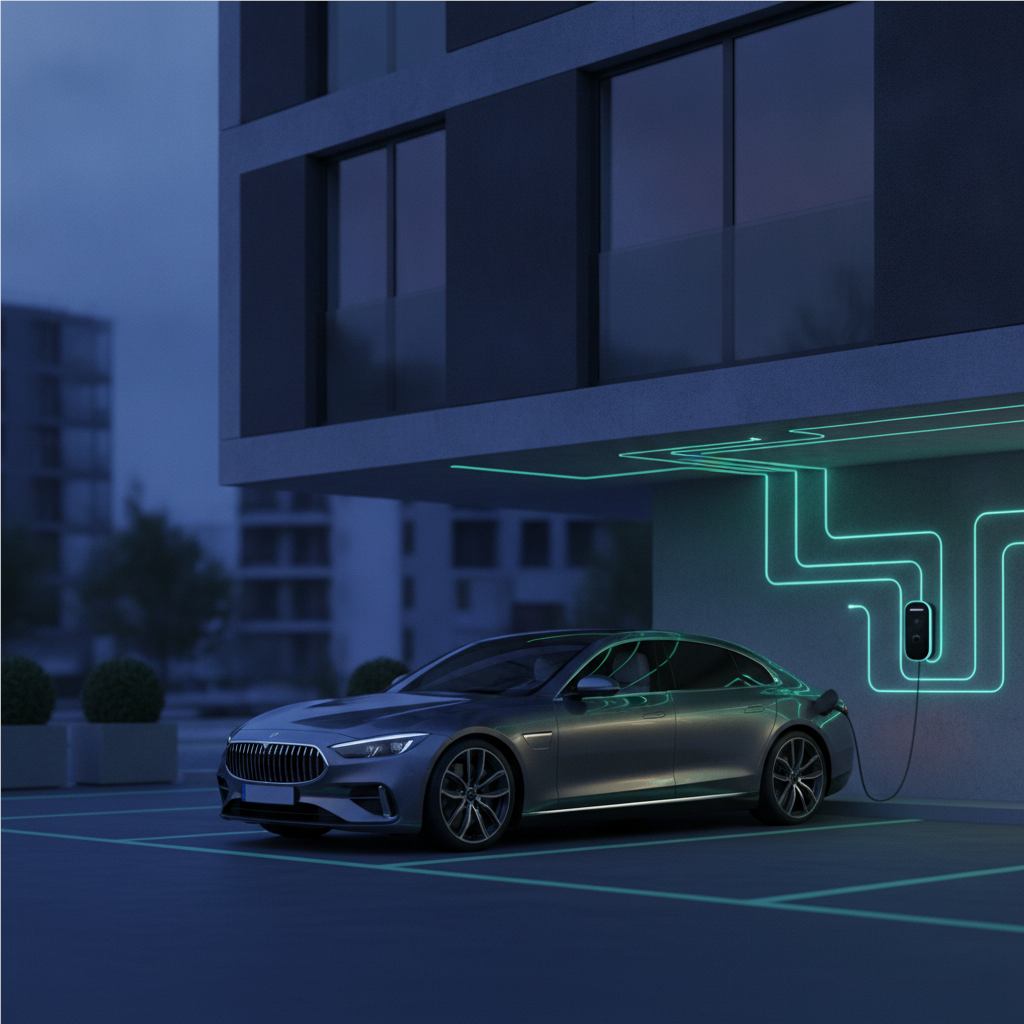
Buying an apartment from a developer? 5 questions you must ask about EV readiness
At the time of sale it sounds great: “Of course, the building is EV-ready”. You breathe a sigh of relief, tick the ‘box’ in your head, and move on to talk about exposures, the kitchen and upgrades. But this is exactly where a costly trap lies. Close to handover, or sometimes after you have already moved in, it turns out that the word “readiness” is not one clear promise but a flexible term that can describe anything – from an empty conduit in the wall to comprehensive infrastructure.
Is there a dedicated conduit? Is there free space in the electrical panel? Does the line reach your parking space? And the most important question of all: will this infrastructure withstand the load when, five years from now, another 20 neighbors have an Electric car?
When we talk about EV readiness in a new building, it is not enough to hear that there is a “point for a charger”. The real question is whether the planning anticipates the future. A future in which more and more residents will need EV charging station in their parking space, without starting to tear down walls, argue with the building committee, or discover that the general electrical infrastructure simply cannot support the demand.
Instead of settling for a general answer, we have prepared five precise questions for you. They don't require you to be electrical engineers, but they will help you understand whether this is serious readiness or a marketing headline. The goal is to make sure that the foundation you get today does not become a costly limitation tomorrow.
1. What exactly does the ”readiness” include in practice – beyond a conduit in the wall?
This is the most important question, and most buyers miss it. The term “readiness” can describe very different scenarios from project to project. At best, it means full infrastructure from the apartment or the main electrical panel all the way to the parking space. At worst, it means an empty plastic conduit someone threaded through the wall, and you will have to do everything else yourself and at your own expense.
Quality readiness is full planning of the physical route: wide enough conduits, dedicated trenches, reserved space in the electrical panels and easy access for adding cables in the future. If this planning is missing, every resident who will need a Charging station installation in the future will be forced to improvise a one-off solution. The result: a messy parking garage with “spaghetti” cables, higher costs for each resident, and technical limitations that are hard to solve.
Ask the contractor directly:
- Does the readiness include conduits and full cabling from the electrical panel to each parking space, or only empty conduits?
- Has physical space been reserved in the apartment or common electrical panels for dedicated charging circuit breakers?
- Does the planning allow additional charging stations to be added easily in the future, or will every addition require new cutting and infrastructure work?
If the answers are vague (“It'll be fine”, “Everyone does it”), that is a warning sign. It is precisely at the construction stage that proper planning saves thousands of shekels and a lot of headaches in the future. Insist on understanding what is actually being done, not just what is written in the specification.
2. Is the planning for a private solution for each resident, or for a central system that will prevent chaos in the future?
Here we move from a technical question to a question of approach. There are two main models forcharging planning in an apartment building:
- The private model: Each resident is responsible for running a power line from their apartment to the parking space. This solution may seem simple when there are only one or two electric vehicles in the building, but it becomes a logistical nightmare as demand grows.
- The central model: The contractor prepares main, shared electrical infrastructure for the entire parking garage, allowing orderly connection of many Charging stations in the future.
Why is this critical? Because in a new building, it is reasonable to assume that in 5–7 years, 30% or more of the residents will drive an electric vehicle. In the private model, you will find yourselves with unmanaged electrical loads, difficulty allocating consumption, and operational difficulty with the building committee. Every new installation will become a project in its own right.
In contrast, infrastructure planned for a managed charging system allows maximum flexibility. Stations can be added gradually, usage permissions managed, each resident's power consumption tracked and billed separately, and most importantly – the load on the building's electrical network managed.
Ask the contractor: Is the planning based on each resident connecting individually to their apartment, or has infrastructure been prepared for a central managed charging system? If the answer is “a central system”, ask to understand what it includes: is there planning forLoad management? Is there preparation for a billing system?
atDSG Charging Solutions, we specialize in planning and building exactly such systems, because we know that the costliest planning mistake is thinking only about the first vehicle. A building is an asset for decades; make sure it is ready for the future, not just the present.
3. Does the infrastructure installed today also support your next vehicle, or is it limited to low power?
This may sound technical, but it directly affects your wallet and your user experience. Most buyers assume that if charging is possible, that is enough. But there is a huge difference between infrastructure that allows slow charging (single-phase, 7kW) and infrastructure that supports faster charging (three-phase, 11kW or 22kW), which most new vehicles already support.
If the contractor cut corners and installed conduits that are too narrow or cables that are too thin, you may discover in the future that you are “stuck” with slow charging. Such an upgrade after the fact is expensive, complicated and sometimes impossible. Put simply: a small saving for the contractor today could become a permanent and costly limitation for you tomorrow.
You don't need to be experts. Just ask: “What is the maximum power the prepared infrastructure supports? Is it three-phase and does it allow installing a 22kW charging station in the future, or is it intended only for a single-phase connection?”
The answer to this question will reveal how forward-looking the planning is. The right infrastructure should give you the flexibility to choose the charging speed that suits you, even if you change vehicles in the future or have two electric vehicles in the household.
4. How will the building manage loads and allocate billing when there are 20 electric vehicles, not two?
This is the moment when a marketing promise meets physical reality. As long as there is one electric vehicle in the parking garage, the building's electrical connection can cope. But what will happen when another 10, 20 or 50 vehicles join, and they all want to charge at night? Without a smart system, the result will be an overload and a tripped main breaker.
This is where the concept of load managementcomes into the picture. It is not a luxury add-on but an essential component in the planning of a modern building. A dynamic load management system “knows” the building's available electrical capacity at any given moment, and intelligently divides it among all active The charging stations . This way, all vehicles charge efficiently without endangering the stability of the electrical network.
In addition, in an apartment building the question of billing immediately arises: how do you make sure each resident pays exactly for the electricity they consumed? A modern solution includes an identification system (for example, via an app or RFID card) and an automatic billing system that prevents arguments and disputes.
So ask the contractor:
- Does the planning include preparation for a dynamic load management system?
- Does the infrastructure allow clear separation of power consumption for each parking space for accurate billing?
These are not purely technical questions; they are questions about your quality of life in the building a few years from now. Proper planning today will save a lot of friction between neighbors tomorrow.
5. What exactly do I get on key handover day?
This is the summary question, which translates all the promises into reality. There can be a gap between the architectural plan and the actual handover. At the sales stage everything sounds orderly, but during construction changes and shortcuts are made. That is why it is important to understand exactly what you will receive.
Phrase the question like this: “On the day I receive the key, if I want to install a Home charging station, what will already be ready on site and what will I still have to do at my own expense?”
The more detailed the answer you get, the more surprises you will avoid. Ask for these details to appear as an appendix to the apartment's technical specification. This doesn't turn the purchase into an interrogation, but into smart consumer behavior. Just as you ask about air conditioning points or the size of the storage room, it is important to ask about the charging infrastructure – which has become an integral part of modern life.
From the planning stage to actual charging – we are here
You have understood from the contractor what the readiness includes, but you are not sure what the answers mean? This is exactly the time to consult a professional who lives and breathes the field. At DSGCharge, we accompany developers, contractors and apartment buyers from the early planning stage throughCharging station installation and system operation.
We don't just sell equipment; we build a complete charging solution tailored to the building, the residents and future needs. If you want to make sure that the readiness in your building is a solid foundation and not an illusion, we are the address.
Talk to us for an initial consultation and we will be happy to help you understand what smart, efficient and future-ready charging infrastructure looks like. It is better to ask the right questions now, before the concrete sets.
Frequently asked questions
If I don't have an electric vehicle yet, is it still worth checking the readiness with the contractor?
Absolutely. Before you have a vehicle is precisely the best time to make sure the infrastructure in the new building is planned correctly. The future value of your apartment will also be affected by the ability to offer a convenient charging solution. Fixing or upgrading infrastructure in an occupied building will always be more complex and expensive.
Does “readiness” mean I can immediately install a charging station in my parking space?
Not necessarily. “Readiness” is a broad term. At best, you will only need to connect the charging station. In many cases, you will need to complete cabling, install protections in the electrical panel and carry out additional work. That is why you must find out in advance exactly what is included.
What is more important in a new building: the station itself or the infrastructure?
The infrastructure, without a doubt. You can choose, upgrade and replace the charging station. But if the building's electrical infrastructure was not planned correctly – if it is limited in power, lacks load management capability or does not allow expansion – even the most advanced charging station will not solve the problem.