
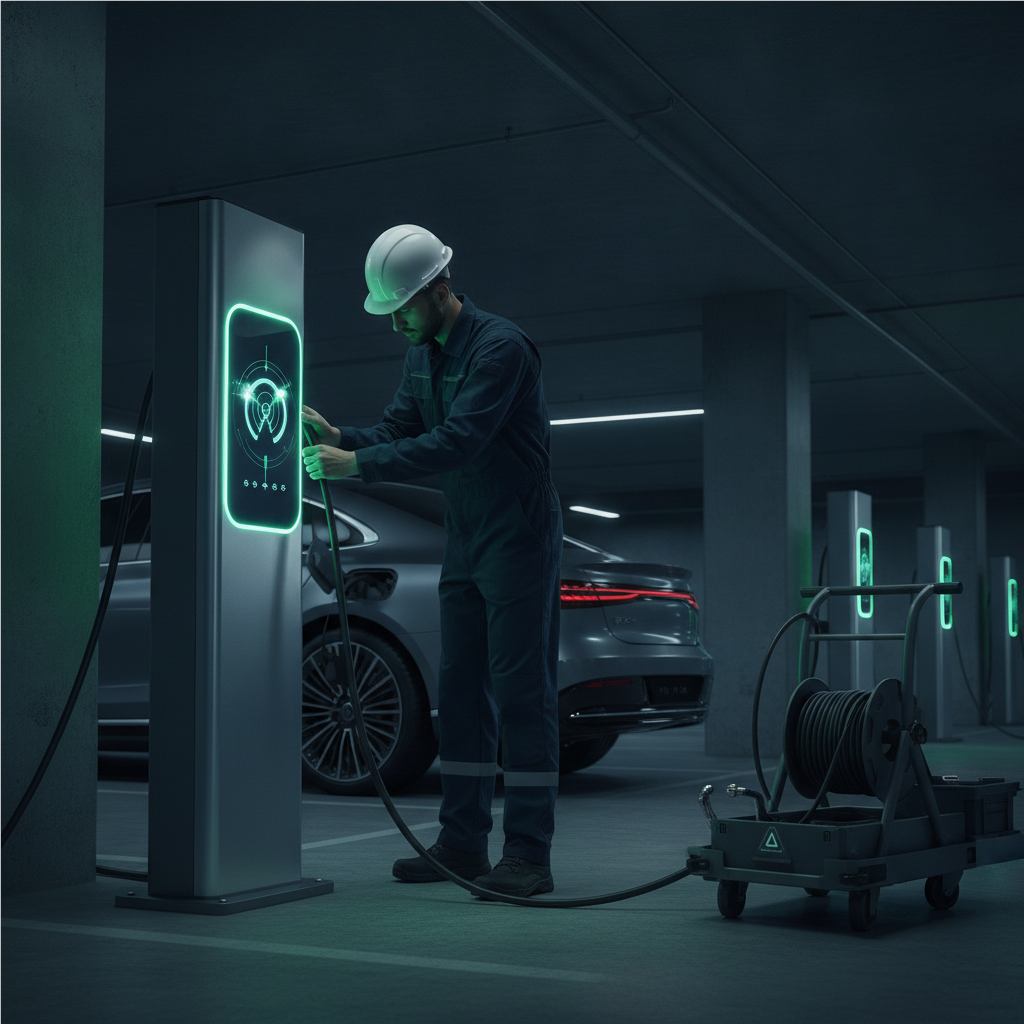
EV charging station installation guidelines in Israel are set out in a single document issued by the Electricity Administration at the Ministry of Energy: “Guidelines for Installing an Electric Vehicle Charging System”, published on 25.11.2025. The document specifies who may install, how the station is supplied, which protections are mandatory, which connectors and cables are permitted and which inspections are required. Here you'll find all 18 sections in plain language, and what each section means for a private homeowner, an apartment building and a business.
In short: Under the Electricity Administration guidelines (published on 25.11.2025, in force since the end of May 2026), a charging station may be installed only by an electrician holding at least a certified electrician license, on a dedicated circuit with a circuit breaker, a 30mA Type B RCD (or Type A/F with a DC leakage current detector) and an isolating switch near the station. The charging cable is up to 8 meters, the connector is Type 2 (or Type 1 in private parking), no adapters are allowed, and the system is inspected by an inspecting electrician before it is first put into operation.
Before choosing a station, you can compare all DSGCharge models on the page EV charging stations.
What are the Electricity Administration guidelines for installing a charging station, and when did they take effect?
The Electricity Administration is the body at the Ministry of Energy that sets the safety rules for electrical installations. Its guidelines on installing an EV charging station apply to every charging system: a home AC charging station, a station in a building's parking garage, stations in business and public parking facilities, DC fast charging stations and portable EV chargers. They are signed by the head of the Electricity Administration and divided into seven chapters: interpretation, general conditions, protections, equipment, special uses, inspections and miscellaneous.
- Advertising: 25.11.2025. The document is available on gov.il: Guidelines for Installing an Electric Vehicle Charging System, Electricity Administration (PDF).
- Entry into force: Under section 18, six months from the date of publication, i.e. from the end of May 2026. It was permitted to follow them from the date of publication.
- As of 10/2026 The guidelines are in force, and every new installation must comply with them.
What does each section require? EV charging station installation guidelines section by section
The table summarizes the 18 sections. The wording is abbreviated; for any question of implementation, the official document is the binding text.
| Section | What it requires | What it means in practice |
|---|---|---|
| 1. Definitions | Defines charging modes under IEC 61851: Mode 2 (AC via a cable with an in-cable charging device), Mode 3 (AC at a fixed station), Mode 4 (DC at a fixed station). | A “portable EV charger” is Mode 2; a wall-mounted station is Mode 3; a DC station is Mode 4. |
| 2. General | Charging only through a charging system (Modes 2, 3, 4); Mode 1 is prohibited. Next to a road or sidewalk and in open parking lots, only a fixed station. One vehicle per connection point. | In an open parking lot or a parking space next to a sidewalk, you don't charge from a portable EV charger. |
| 3. Design and installation | At least a certified electrician; charging power is limited to the rated current of the circuit breaker. | The station is configured for the current the circuit can carry. |
| 4. Supply | A dedicated final circuit made of cable only, overcurrent protection for each connection point, signage, and an isolating switch near the station. | A station is not connected to an existing circuit or to a socket. |
| 5. Protection against electric shock | In accordance with the Electricity Regulations; special protection methods only under defined conditions. | The electrician chooses a permitted protection method and documents it. |
| 6. RCD | A dedicated 30mA RCD for each AC connection point: Type B, or Type A/F with a DC leakage current detector. | A “standard” RCD is not enough. The protection may be built into the station. |
| 7. Overvoltage | Mandatory for public use and in common parking in a residential building. | In an apartment building or a business, this is a line item in the quote. |
| 8. Charging cable | A direct cable between the station and the vehicle, per IEC 62893, up to 8 meters; up to 10 meters with a cable management system. | Position the station close to the parking space. |
| 9. Connectors | AC: Type 2 per IEC 62196; single-phase Type 1 in residential or private parking. DC: per IEC 62196. An adapter for the vehicle connector is prohibited. | Choose a station with the connector that fits the vehicle. |
| 10. Station equipment | Approval from an accredited laboratory (IEC 61851-1 or 61851-23), compatibility with a charging management system, IP44 outdoors, mechanical protection or IK08, height 0.5-1.5 meters. | Not every station sold online is suitable; ask for the laboratory approval. |
| 11. Dual charging station | May be supplied from a single circuit rated for the combined current; installation in parking facilities is permitted. | A dual charging station does not require two circuits. |
| 12. Portable EV charger | Approval per IEC 62752, single-phase up to 16A, industrial plug, no extension cords or adapters; a household socket only for occasional charging up to 10A. | A household socket is a solution for visiting relatives, not for your regular parking space. |
| 13. Wireless charging | Per IEC 61980, with the supply per sections 3-6. | Relevant to few people at the moment. |
| 14. V2X | Using the vehicle battery to supply an installation per the energy storage guidelines; adapted protections and a warning sign on the panel. | Connecting a car to a home is a design project, not a plug. |
| 15. Initial inspection | An inspecting electrician before first operation and after a major modification, covering 12 topics, on a standard form. | A station must not be operated before inspection. |
| 16. Maintenance | Owners: RCD test-button check and visual inspection once a year. Electrician: an inspection once every six years. | You have ongoing responsibility even after installation. |
| 17. Documentation | The installer hands over station data, a certificate of conformity, a supply diagram, operating instructions and an inspection report. | Keep the file; you'll need it for theInsurance and when selling the property. |
| 18. Commencement | Six months from publication; it was permitted to follow them from the date of publication. | In force since the end of May 2026. |
Who is allowed to install a charging station?
Under section 3, a charging system is designed, installed and maintained by an electrician holding a license of At least a certified electrician. An electrician with a lower license, a handyman or “someone who knows electricity” may not do the work. The inspection before commissioning (section 15) is performed by an inspecting electrician, not by whoever installed the system. It's worth asking the installer for the license number and confirming who will perform the inspection.
Section 3 also states that the system must match the planned charging power, and that the charging power is limited to the rated current of the protective device protecting the circuit. In practice: if the circuit is protected at 32A, the station is set to 32A at most, not “as much as the station can do”.
Why does the station need a dedicated circuit, and which RCD is required?
A 7.4kW station draws about 32A, and a 22kW three-phase station draws 32A on each phase, sometimes for hours on end. That's why section 4 requires:
- Final circuit for charging only, made of cable only, with overcurrent protection (an MCB or automatic circuit breaker) for each connection point.
- Signage identifying which panel supplies the station, and marking or concealing cables that pass through another panel's area.
- A dedicated isolating switch near the station, visible from it or lockable, and labeled: double-pole for a single-phase station, four-pole for a three-phase station.
Section 6 deals with the RCD, the main protection against electric shock in AC charging (Modes 2 and 3):
| RCD type | Permitted under the guidelines? | Note |
|---|---|---|
| Type B, 30mA | Yes | Also detects DC leakage current. |
| Type A or F, 30mA | Yes, only with a DC leakage current detection device | In many stations the detector (usually 6mA DC) is built into the station. Check the specifications. |
| Type AC | No | Does not detect DC leakage current that may originate from the charging system. |
The RCD is dedicated to each connection point and may be built into the station, installed next to it or in the panel. The upstream protection in the panel must be suitable for DC leakage current, and the designer decides whether the final circuit itself also needs RCD protection.
When is overvoltage protection mandatory?
Under section 7, overvoltage protection is required at charging points for public use and at stations in the common parking of a residential building. The designer determines the type and location of the protection. In a private home the guidelines do not require it, and the electrician will advise according to the situation. In an apartment building or a business open to the public, a quote without overvoltage protection is incomplete.
How long can the charging cable be?
Section 8 states that charging is done with a direct cable between the station (or portable device) and the vehicle, per IEC 62893, with a length of Up to 8 meters. For a station with a cable management system up to 10 meters is permitted. The practical meaning: you plan the station's location according to where the charging port is on the car, rather than compensating for distance with a long cable. If the station is far from the parking space, move the station (for example, onto a pedestal) – don't extend the cable.
Which connectors are permitted: Type 2, Type 1 and DC?
- AC station (Mode 3): A Type 2 connector or socket-outlet per IEC 62196. This is the default in Israel.
- Type 1: Permitted for a single-phase station in a parking space supplied from a residential installation or in privately used parking. This is how an American or Japanese car with a Type 1 port is charged at home.
- DC station (Mode 4): A connector per IEC 62196. CCS2, CCS1 and CHAdeMO are all defined in Part 3 of the standard, so a DC station with a native CCS1 connector for an American pickup meets the requirement.
- Section 9(d): “The use of an adapter for the electric vehicle connector is prohibited”, meaning an adapter between the connector on the charging cable and the vehicle's port.
Therefore, in a fixed charging installation you choose a station with the vehicle's native connector. DSGCharge adapters carry the CE mark, and you'll find a full explanation of each adapter type and what the guidelines say about it in the guide DC and AC adapters for EVs. If you're considering a DC station at home, for example for a pickup with CCS1, you'll find the connection requirements in the guide Home DC charging station.
What is permitted with a portable EV charger (charging Mode 2)?
Section 12 deals with a portable charging device – a cable with a control unit that plugs into a socket:
- Type approval and a certificate of conformity to IEC 62752 from an accredited laboratory.
- Single-phase charging at a current of up to 16A, with an industrial plug (CEE, known in the field as a “sikum”).
- Extension cords are prohibited, as are adapters and splitters at the socket.
- Regular household socket Permitted only for occasional charging, at a parking spot that is not your regular one, at a current of up to 10A. In this case sections 4 and 6 (a dedicated circuit and a dedicated RCD) do not apply.
- While charging, the device rests on a stable surface.
What this means: at your regular parking space, a portable EV charger plugs into an industrial socket installed for that purpose, not into the living room socket. DSGCharge's 7.4/11/22kW portable EV chargers come with an industrial CEE plug. Granny cable DSG-350 (₪699, as of 11/2026) comes with a standard household plug and lets you adjust the amperage and charging power, so on a household socket you limit it to 10A for occasional charging. Remember section 2 as well: in an open parking lot or next to a sidewalk, you charge only at a fixed station.
Which standard must a charging station meet?
There is no single Israeli “charging station standard”. The guidelines refer to international standards and require a certificate of conformity from an accredited laboratory:
- IEC 61851-1 for AC stations, andIEC 61851-23 for DC stations (section 10).
- IEC 62196 for connectors, IEC 62893 for the cable, IEC 62752 for portable EV chargers, IEC 61980 for wireless charging.
- Charging management system: Under section 10(c), stations in charging Modes 3 and 4 must be compatible with a charging management system, as the Electricity Authority may require. So it's worth making sure the station has communication (for example via the OCPP protocol) that allows it to be connected to such a system.
- Outdoor installation: An ingress protection rating of at least IP44, both when the plug is connected and when it's disconnected. Indoors, a rating suited to the location.
- Mechanical protection: A location protected from impact, or equipment rated at least IK08 (IEC 62262). The station is installed on a stable surface. In open parking or next to a sidewalk, a Charging station cabinet or a parking stopper is a simple way to provide this protection.
- Height: Controls, sockets and connectors at a height of 0.5-1.5 meters above the ground.
A dual charging station (section 11) can be supplied from a single circuit rated for the combined current of both connection points, such as the Dual charging station 22kW DSG-3012 (₪6,490, as of 10/2026).
Which inspections are required before commissioning and afterward?
| When | Who | What | Section |
|---|---|---|---|
| Before first operation and after a major modification | an inspecting electrician | Inspection covering 12 topics: laboratory approvals, panel protections, cable route, stability and signage, earthing and its continuity, RCD and DC detection, overvoltage, measurements and a V2X test. The results are recorded on a form. | 15 |
| At least once a year | Station owner | Pressing the RCD test button and a visual inspection. | 16(a) |
| Once every six years | Electrician (ordered by the owner) | Inspection of the charging system and an instrument test of the RCD, with documentation. | 16(b) |
| When the RCD is the only protection against electric shock | Owner / electrician | With the test button every six months, with an instrument every two years. | 16(e) |
| For any defect | Owners | Repair as soon as possible; a defect that poses an immediate hazard requires disconnection until it is repaired and re-inspected. | 16(f)-(g) |
Periodic inspections of the entire electrical installation also include the charging system. For electricians and installers, DSGCharge also sells testing equipment, such as the AC charging tester DSG-500 (₪1,190, as of 11/2026).
Which documents should you receive from the installer?
Under section 17, the installer hands over to the owner: the station data, the certificate of conformity to the standard, service details, a supply diagram, operating instructions and the inspection report. The owners keep the documents and the periodic inspection reports, as well as as-built drawings and documentation of the supply route, so it can be located in the future. This file is also useful with the insurance company, the building committee and a future buyer of the property.
What do the guidelines say about V2X and connecting the car to the home?
Section 14 deals with using the vehicle battery to supply electricity outside the vehicle, to an electrical installation. This is subject to the guidelines for energy storage in grid-connected batteries (or other guidelines issued by the head of the Electricity Administration) and the relevant regulations. The designer adapts the protections to supply from the battery, and a warning sign is installed on a panel supplied this way, stating that voltage is present even after disconnection from the grid. In short: V2H/V2G is a design project, not a cable.
Before you hire an installer: a checklist
- The installer holds at least a certified electrician license, and it has been decided who the inspecting electrician will be.
- The quote includes a dedicated circuit, a circuit breaker, a suitable RCD (Type B or A/F with DC detection) and an isolating switch nearby.
- In an apartment building or a business open to the public: overvoltage protection is included.
- The station has approval from an accredited laboratory (IEC 61851-1 or 61851-23) and is compatible with a charging management system.
- The connector fits the vehicle (Type 2, Type 1 in private parking, or CCS1/CCS2 for DC) and no adapter is needed.
- The station location allows a cable of up to 8 meters, at a height of 0.5-1.5 meters, protected from impact and rated at least IP44 outdoors.
- The station's charging current will be set according to the circuit breaker and the connection size.
- At the end of the job you'll receive an inspection report, a supply diagram and a documentation file.
How does DSGCharge install charging stations in line with the guidelines?
DSGCharge (DSG Charging Solutions), part of S.M.C. Dor HaAtid, has been active since 2021. DSGCharge is the importer of its charging stations – the brand is DSGCharge's own. About 20,000 chargers and charging stations have been sold and installed, and the installation and service teams work nationwide. Every installation includes a check of the connection and panel, a dedicated circuit with the protections the guidelines require, setting the charging current according to the circuit breaker, inspection and handover of documentation. Our DC stations are ordered with a CCS1 or CCS2 connector to match the vehicle, and managed charging stations such as the Managed charging station 22kW DSG-6012 (₪3,290) work with a cloud-based charging management system.
- Charging station installation up to 20 m DSG-9903: ₪2,590.
- Charging station installation up to 30 m: ₪2,990.
- Site survey for a station in an apartment building DSG-9900: ₪690.
- Smart charging station 11kW DSG-1061: ₪1,590.
Prices are as of 10/2026. For the full process, what affects the price and the difference between a private home, an apartment building and a business, see the page EV charging station installation.
Want an installation that meets the guidelines?
Get an initial estimate with theCharging station installation cost calculator, call 077-9920350 or leave your details, and we'll check your connection, panel and station location with you.
Frequently asked questions
Who may install an EV charging station?
Under section 3 of the Electricity Administration guidelines, only an electrician holding at least a certified electrician license may design, install and maintain a charging system. Before first operation, the system is inspected by an inspecting electrician.
When did the new guidelines take effect?
The guidelines were published on 25.11.2025 and, under section 18, took effect six months later, at the end of May 2026. It was permitted to follow them from the date of publication.
Which RCD does a charging station need?
A dedicated 30mA RCD for each AC connection point: Type B, or Type A or F plus a DC leakage current detection device. The protection may be built into the station, installed next to it or in the panel.
What is the maximum length of a charging cable?
Up to 8 meters. For a station with a cable management system, up to 10 meters is permitted. The cable connects the station directly to the vehicle.
Is it permitted to charge an electric car from a household socket?
Only for occasional charging, at a parking spot that is not your regular one, at a current of up to 10A. At your regular parking space, a portable EV charger needs an industrial plug, single-phase charging up to 16A, and no extension cords or splitters.
Is it permitted to use an adapter between the station and the vehicle?
Section 9(d) states: “The use of an adapter for the electric vehicle connector is prohibited”. So in a fixed installation you choose a station with the vehicle's native connector: Type 2, single-phase Type 1 in private parking, or CCS1/CCS2 at a DC station.
How often should a charging station be inspected?
Owners test the RCD with the test button and carry out a visual inspection at least once a year, and an electrician performs an inspection once every six years. If the RCD is the only protection against electric shock, testing is more frequent: every six months with the test button and every two years with an instrument.