
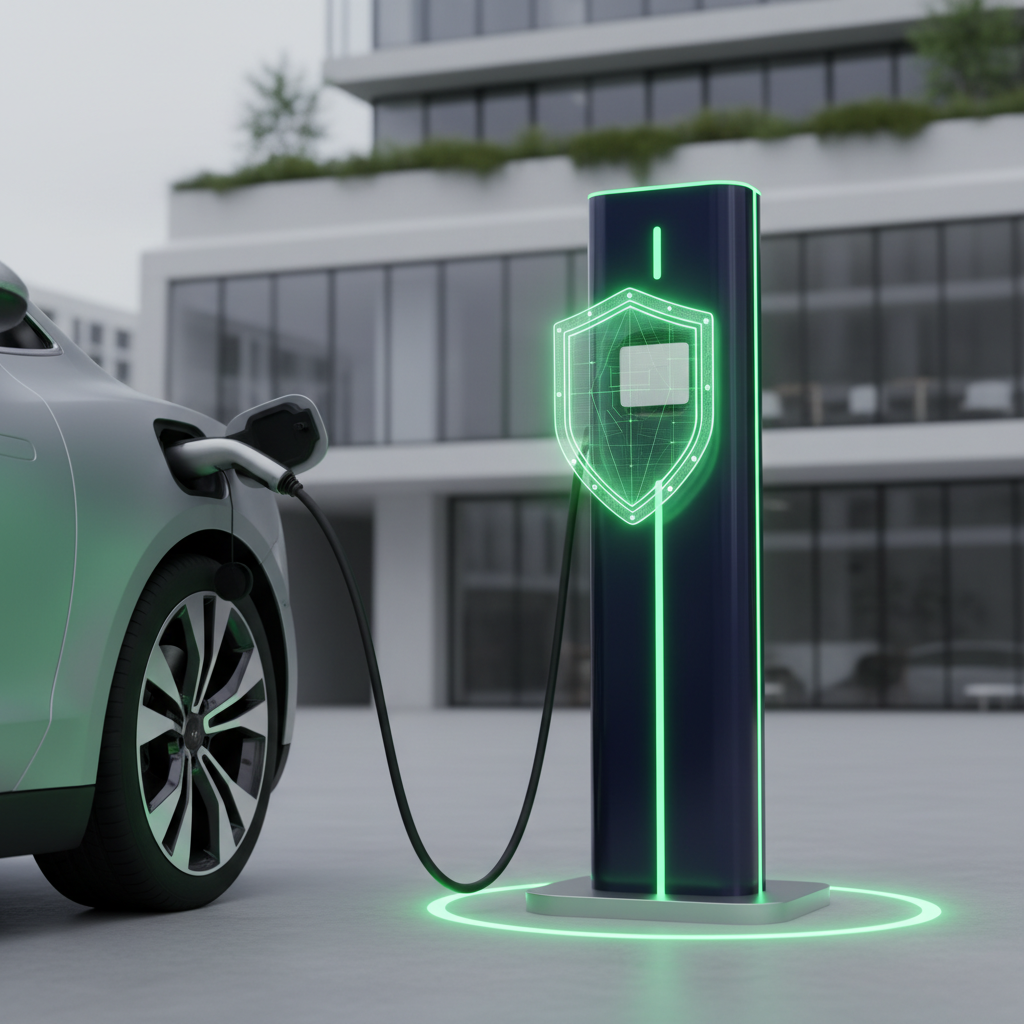
EV charging station insurance: what's covered, how to insure it and how it differs from a warranty (2026)
Updated: November 2026
In short: EV charging station insurance is usually arranged as an extension of your home or building insurance (in a private home), or through the common property and business insurance (in a building, parking facility or business), rather than as a separate policy. Make sure you have coverage for damage to the station itself, fire and electrical damage, theft and third-party liability. The product warranty covers only product faults, not external damage.
A charging station is fixed electrical equipment that works for long hours, sometimes in an open or common parking area. That's why it's worth checking two separate things in advance: who pays if the station is damaged from the outside (insurance), and who repairs it if it breaks down on its own (warranty). In this guide, we explain what charging station insurance includes, how to add it to your existing policy, what changes in an apartment building and in a business, and which documents to prepare before talking to your insurance agent.
Do you need insurance for an EV charging station?
There is no dedicated policy you are required to buy for a private home station, but a charging station is property worth thousands of shekels (a smart home charging station starts at about ₪1,590, and a managed charging station for a building or business costs ₪3,290, plus installation). Damage to the station, to the vehicle or to another person can cost much more than that. So the recommendation is to make sure the station is declared and covered under your existing policy.
In an apartment building, a parking facility or a business, the picture is different: the property owner, the building committee or the management company may require third-party coverage before approving an installation, especially when it comes to a charging system shared by several users.
What does charging station insurance include?
There is no uniform “charging station policy” on the market. Coverage is built from several components, and each of them needs to appear in the policy or in an extension. The table summarizes the main risks and what to ask about them:
| Risk | Example | Where it's usually covered | What to ask the agent |
|---|---|---|---|
| Physical damage to the station | A vehicle that hit the station in the parking space, a falling object | Building or contents insurance (home), property insurance (building or business) | Is the station defined as part of the building or the contents? What is the deductible? |
| Fire, lightning and power surges | A lightning strike, a short circuit in the electrical panel | Building and contents insurance, including coverage for electrical damage | Is surge and lightning damage to electrical equipment included? |
| Water and flooding | A flooded underground parking garage | Building or property insurance, depending on the policy terms | Is there an exclusion for an underground parking garage? |
| Theft and vandalism | Theft of the charging cable, vandalism | Burglary and theft extension | Is theft from an open or common parking area covered? |
| Third-party liability | A neighbor who trips over the cable, damage to another vehicle | Third-party insurance for the home, the building or the business | What is the liability limit, and does it include use of the station by others? |
| A fault in the product itself | An electronic component that stopped working | Product warranty and warranty extension, not insurance | (A question for the station supplier, not the agent) |
Home charging station insurance: how do you add it to your home insurance?
In most private homes, the simple way is to update your existing home insurance. A station installed on the wall of the house or in the assigned parking space is usually considered part of the building or the contents – but only if the insurer knows about it. Here's how to do it:
- Notify your agent after installation of the model, the power rating and the station's location (the house wall, covered parking or open parking).
- Ask for written confirmation that the station is covered under the building or contents sections, and that electrical and lightning damage is included.
- Check the sum insured: if you've added a station, cables and an upgraded electrical panel, you may need to update the value of the building.
- Ask about theft if the station or the cable is in an open parking area.
- Make sure you have third-party coverage, especially if the cable runs across a sidewalk or a shared path, or if guests charge at your place.
Professional installation according to the Electricity Administration's guidelines is an important part of the picture: insurers check whether damage was caused by an improper installation. For details on the process and prices, see EV charging station installation, and to estimate the cost based on the distance from the panel, use theinstallation cost calculator.
Charging station insurance in an apartment building: who insures, the resident or the building committee?
In an apartment building there are two situations, and each has a different way of insuring:
- A resident's private station in their assigned parking space: the resident is responsible for insuring it, usually through their home insurance. It's worth making sure the policy covers equipment located in a common parking area and not just inside the apartment.
- A shared charging system that the building sets up for all residents: the system is insured through the building's common property insurance and third-party insurance, which are managed by the building committee or the management company.
A managed system has an insurance advantage: the stations are connected to load management, and a fault or an overload is detected remotely. DSGCharge sets up and manages charging stations in apartment buildings, including load management, billing each resident according to a TOU meter and transferring the payment to the building committee. That way the building committee gets one system with orderly records that are easy to present to the insurer. For towers with dozens or hundreds of parking spaces, see Charging stations in residential towers.
Third-party insurance for charging stations: when is it especially important?
Third-party insurance covers damage the station causes to another person or to someone else's property, for example tripping over a charging cable or damage to a vehicle parked nearby. It is especially important in three situations:
- The station is in a common parking area or near a walkway.
- Other people use the station: neighbors, employees, customers or guests.
- The station is open to the public, paid or free.
Pay attention to the liability limit in the policy and whether it includes use of the station by others. For a public or business station, also make sure the coverage is suitable for commercial activity.
Charging station insurance for businesses, parking facilities and public charging stations
A business, a parking facility owner or a local authority that sets up charging stations usually insures them as part of its business insurance: property insurance (including electronic equipment), third-party liability and sometimes loss of income. DC fast charging stations are expensive equipment, so it's important to insure them at replacement value and make sure electrical damage is included.
When the stations are managed in the cloud (OCPP, an open communication protocol between the station and the management system), there is a full record of every charging session, fault and disconnection. These records also help when a claim is being investigated. DSGCharge supplies managed public charging stations (DSG-6052, DSG-6112 and DC stations), nationwide service and maintenance, and an operations system developed by the company. For details: Setting up public charging stations.
Insurance, manufacturer's warranty and warranty extension: what's the difference?
These are three different things, and they complement each other. Insurance covers external damage, and a warranty covers a fault in the product itself:
| Insurance | Product warranty | Warranty extension (DSG-8800) | |
|---|---|---|---|
| What's covered | Fire, lightning, flooding, theft, vandalism, third party | A fault in the product itself | A product fault, after the original warranty has ended |
| Duration | According to the policy period | 24 months on DSGCharge home charging stations (12 months on a portable EV charger) | 12 months per purchase, up to 5 years in total |
| Where to buy it | An insurance agent or insurance company | Included with the purchase of the station | DSGCharge, up to 90 days after the original warranty ends |
| Price | Depends on the insurer | No extra charge | ₪299 per year (as of November 2026) |
| What's not covered | An internal product fault (usually) | Breakage, tearing or unreasonable use | Breakage, tearing or unreasonable use; does not apply to public charging stations |
The right approach: confirm with your insurance agent that the station is included in the policy (including third-party coverage), and consider a warranty extension for the charging station. That way you're covered for both external damage and product faults.
Which documents will the insurance agent ask for?
- An invoice or proof of purchase for the station, with the model (for example Smart charging station 22kW DSG-1062 or Managed charging station DSG-6012).
- The station's power rating (7.4kW, 11kW or 22kW) and a single-phase or three-phase connection.
- The installation date and confirmation that the installation was carried out and inspected.
- A photo of the station's location: the house wall, covered parking, open parking or an underground parking garage.
- In an apartment building: the building committee's approval or the agreement with the management company.
DSGCharge products have Standards Institution of Israel (SII) approvals. Mention this to the agent when they ask about the equipment's compliance.
How do you reduce the risk of damage to your charging station?
- A dedicated power line and suitable protection from the electrical panel, according to the Electricity Administration's guidelines.
- Protected location: out of the driving path, with a wheel stop or a protective post in a tight parking area.
- A tidy cable: a cable holder, so the cable isn't on the floor and doesn't block the walkway.
- Smart or managed station: current limiting, RFID or app authorization (so only authorized users can charge), and remote monitoring.
- Prompt handling of faults: don't keep operating a station that shows signs of a fault. A diagnostic guide: Charging station not working.
How much does charging station insurance cost?
There is no uniform price. In most cases it's an update or extension of an existing policy, and the cost depends on the insurer, the value of the equipment, the location and the deductible. It's worth asking your agent for a written quote that details the coverage for the station, and comparing it to the cost of the warranty extension (₪299 per year) and the price of the station itself. Up-to-date station and installation prices are in the store: EV charging stations.
5 common mistakes in charging station insurance
- Assuming the station is covered automatically. If you haven't updated your insurer, the station may not be included in the value of the building or the contents.
- Confusing a warranty with insurance. A warranty won't pay for a station that was hit by a vehicle or by lightning, and insurance usually won't repair an internal product fault.
- Forgetting about third-party coverage. In a common parking area, this is the most important coverage, because damage to another person or vehicle can be much more expensive than the station.
- Ignoring the exclusions. An underground parking garage, open parking and business use are situations that insurers sometimes exclude or price differently.
- Installing without documentation. Without an invoice and confirmation that the installation was carried out and inspected, it's harder to prove the damage wasn't caused by a faulty installation.
About DSGCharge
DSGCharge (DSG Charging Solutions) is one of Israel's leading companies in EV charging solutions, active since 2021. DSGCharge is the importer of its charging stations – the brand is DSGCharge's own. The company operates in five areas: managed charging systems for buildings, public charging networks and parking facilities, fleet management, charging stations and accessories, and nationwide installations. About 20,000 chargers and charging stations sold and installed. DSGCharge is not an insurance company, but it will help you choose a station, install it correctly and extend the warranty. Phone: 077-9920350.
Frequently asked questions about EV charging station insurance
Do you need insurance for a home charging station?
There is no dedicated policy you are required to buy, but it's recommended to make sure the charging station is included in your home or building insurance: damage to the station itself, fire and electrical damage, theft and third-party liability. Update your insurance agent after installation.
Does home insurance cover a charging station?
Sometimes yes, as part of the home's contents or the building, and sometimes only after a declaration or an extension. A station installed in a common parking area or outside the home isn't always considered part of the home, so you should ask the insurer for written confirmation.
What is the difference between charging station insurance and a warranty on the station?
Insurance covers external damage: fire, lightning, flooding, theft, vandalism and harm to a third party. The product warranty covers a fault in the product itself. On DSGCharge home charging stations the warranty is 24 months, with an option to extend it up to 5 years.
Who insures a charging station in an apartment building?
A resident's private station is usually insured through the resident's home insurance. A shared charging system set up by the building is insured through the building's common property and third-party insurance, which are managed by the building committee or the management company.
Does DSGCharge sell charging station insurance?
No. DSGCharge is not an insurance company and does not sell policies. The company supplies charging stations, installation, service and warranty extensions (DSG-8800), and insurance is arranged through your insurance agent or insurance company.
Which documents will the insurance agent ask for?
Usually: an invoice or proof of purchase for the station, the model and power rating (for example 7.4kW, 11kW or 22kW), the installation date, confirmation that the installation was carried out and inspected, and a photo of the station's location.