
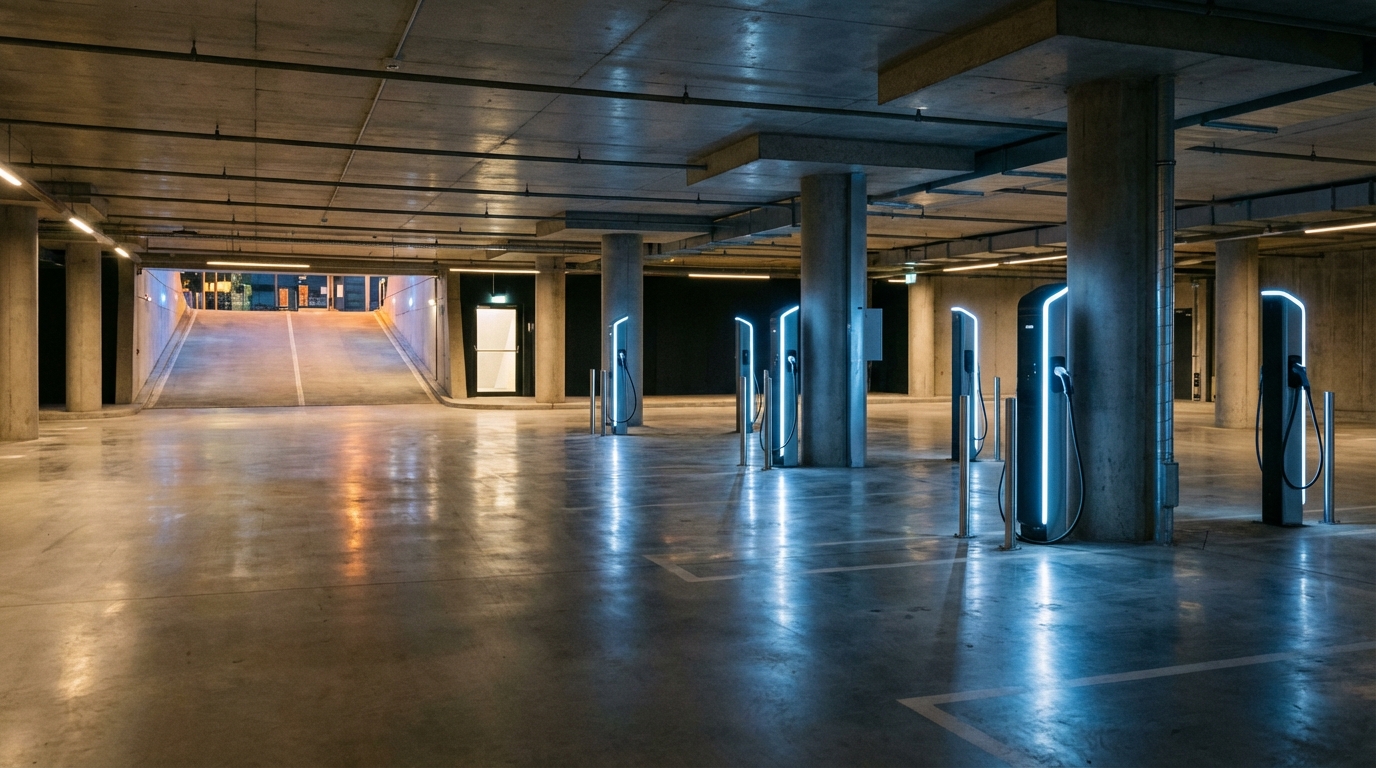
Charging stations for parking facilities have already become a commercial consideration, not just a service. EV drivers choose where to park based on the option to charge, and they stay longer. In this guide we'll go over the business models available to a parking lot owner, how to choose between AC and DC, how many stations to install at first, and what the Electricity Authority's new regulation requires of public charging station operators.
In short: A parking lot owner can profit from charging stations in three ways: a partnership in which the operator sets up, manages and maintains the stations; leasing space to an operator; or buying and operating the stations yourself. In parking lots where cars stay for hours, 22kW dual AC charging stations are the right fit; for short stays, a DC station fits. Start with a feasibility check of the electrical connection and the length of stay, and expand according to demand.
The models and prices of Public charging stations can be found in our store.
Why are charging stations for parking facilities a business decision?
A charging station creates three kinds of value for a parking lot owner. The first is direct income from the electricity sold, or a share of it under a partnership model. The second is traffic: a driver looking for an available station will choose a parking lot that offers charging, and at a mall or hotel they'll also stay and use the services. The third is property value, because commercial tenants and office owners are increasingly asking about a charging solution for employees.
This value depends on three variables: how long a car stays in the parking lot, how much electrical power is available, and who carries the operational workload. These determine the choice of model and type of station.
What business models are available to a parking lot owner?
Before choosing a product, it's worth deciding who invests and who operates. The table summarizes the three common models.
| Model | What the parking lot owner provides | Who sets up and operates | Source of income for the parking lot owner | Best for |
|---|---|---|---|---|
| Charging station partnership | Space and electrical infrastructure | The operator sets up, manages and maintains | Revenue sharing set according to the location, per the agreement | Malls, hotels, local authorities and properties on main roads that want income without managing the service |
| Leasing space to an operator | Parking spaces only | The operator, usually including the infrastructure | Fixed or variable rent, per the agreement | Those who prefer predictable income and have no infrastructure available |
| Purchase and self-operation | Everything: stations, infrastructure, management | The parking lot owner, with a management and payment system | All the income, minus electricity, operating and maintenance costs | Parking operators, local authorities and properties with an operations team that want control over pricing |
At DSGCharge the leading model is a partnership: the site owner provides space and infrastructure, and DSGCharge sets up, manages and maintains the stations, with no financial investment on your part; revenue sharing is set according to the location and subject to a feasibility check. Full details are on the page Charging station installation partnership. If you prefer to buy and operate the stations yourself, you can buy them directly from the importer and add a management system.
Charging stations for parking facilities: AC or DC based on length of stay?
The simple rule: length of stay determines the power. If the car stands for hours, an AC station is enough and costs much less to set up and connect. If the driver stops for half an hour, only DC will give them a meaningful amount of energy. Keep in mind that many vehicles accept less than 22kW on AC because of the car's onboard charger, so even at a 22kW station the actual charging rate depends on the vehicle.
| Parking facility type | Typical dwell time | Recommended station type | Note |
|---|---|---|---|
| Overnight parking (residential, assisted living, residents' parking) | 8 hours or more | AC, even at low power per vehicle | Load management is especially important here, because many cars are connected at the same time |
| Office parking lot | Workday | 22kW dual AC charging station or a managed charging station | Power can be shared between vehicles throughout the day |
| Mall and shopping center | 1–3 hours | A combination: dual AC charging stations for most spaces and one or two DC stations | DC attracts drivers who come specifically to charge |
| Hotel | One night or more | Dual AC 22kW | Guests arrive in the evening and leave in the morning |
| Municipal public parking lot | Mixed: minutes to a full day | Dual AC charging stations, and DC at high-turnover locations | For charging stations in public parking lots, local authorities can split: AC for residents, DC at traffic hubs |
To estimate how much energy a customer will get during their stay in your parking lot, enter the station power and time in the Charging time calculator. This way you can check whether two hours at the mall on AC are enough for customers, or whether you need DC.
Which stations are suitable for a parking facility?
All DSGCharge public charging stations, AC and DC, are managed via the OCPP protocol from a cloud computing system: user identification, pricing, payment processing, load management and remote fault monitoring.
- Managed charging station 22kW DSG-6012 – a managed charging station for one vehicle, managed via OCPP from the cloud. Suitable for residential or office parking. ₪3,290 (as of 10/2026).
- Dual public station 22kW DSG-6052 – a wall-mounted public dual charging station, two charging points in one unit. ₪6,990 (as of 10/2026).
- Dual free-standing public station 22kW DSG-6112 – a floor-standing version for open parking lots or islands between parking spaces. ₪7,990 (as of 10/2026).
- Public DC station 40kW DSG-5240 andPublic DC station 60kW DSG-5260 – for short stays. ₪24,900 and ₪34,990 respectively (as of 10/2026).
- Ultra-fast DC station 120kW DSG-7420 – for traffic hubs and fuel stations, by quote.
How many stations should you install at first, and how do you manage loads in a parking facility?
The common mistake is to start from the final number. It's better to start from what the existing connection allows, build infrastructure (conduits, panel, cabinet space) for the next stage, and add stations as usage grows.
Example: a 3X40 amp three-phase connection provides about 27.7kVA. Two 22kW dual charging stations at full power require more than that. With a load management system, power is divided among the connected vehicles according to what's available, so you can connect more charging points without immediately upgrading the connection. Each vehicle will charge more slowly at peak times, but in a parking lot where cars stand for hours this is usually not noticeable.
Rules of thumb for planning:
- Check the actual available power, not just the connection size. A parking lot that also has lighting, elevators and air conditioning leaves less power for charging.
- Plan according to the average length of stay and the expected number of electric vehicles, not the number of parking spaces.
- Prefer stations that can be managed remotely, so you can add stations and change power allocation without replacing equipment.
Managing charging stations in a parking facility also includes permissions (who may charge), pricing by time of day, fault monitoring and consumption reports. For a residential parking garage or an office building, the same principles are detailed on the page Setting up and managing charging systems in buildings.
What's needed in terms of electricity and coordination with the IEC?
Setting up charging stations in a parking facility starts with checking the existing connection: the connection size, the available power, the distance from the panel to the stations and space for installing a sub-panel. If the power isn't sufficient, there are two options: load management within the existing connection, or a request to the Israel Electric Corporation (IEC) for a connection upgrade. A connection upgrade requires design and approval, so it's worth looking into it early, especially when planning DC.
Installation is performed by an electrician holding at least a certified electrician license. Under the Electricity Administration guidelines (11/2025), the station owner tests the RCD with the test button and carries out a visual inspection at least once a year, and an electrician inspects the system and tests the RCDs with an instrument at least once every six years. When the RCD is the only protection against electric shock, the test-button check is required every six months and the instrument test every two years (as of 10/2026). Full details of all the requirements are in the guide Guidelines for installing an EV charging station.
Payment and apps: what does the new regulation require?
The Electricity Authority published a regulation for public charging stations (Decision 73006 of 31.12.2025), which took effect on 26.7.2026. The main points relevant to a parking lot owner (as of 10/2026):
- Who needs a license: An operator of stations in a public place with a cumulative capacity of more than 8MW. Up to 8MW the operator is exempt from a license but must still meet the set conditions. According to the Authority, 8MW is equivalent to about 350 AC stations or about 50 DC stations.
- Obligations on the operator: The regulation places the obligations on the station operator, not explicitly on the landowner. In a partnership model, the operator is responsible for meeting them.
- Price display (from 1.1.2028 under the exemption rules): At a slow station (up to 50kW) the price will be published online or next to the station; at a fast station (50-150kW) and an ultra-fast station, clearly next to the station.
- Credit card payment: Fast and ultra-fast stations require a credit card payment terminal compliant with the EMV standard. New stations put into operation from 1.1.2027 must have one from the start, and existing stations from 1.1.2028. At slow stations, a licensed operator will allow payment without registration and without an app, for example with a QR code.
- Charging for occupying a station: It is permitted to charge for a vehicle that stays connected after charging is complete, provided the customer has been notified and only after a reasonable time.
- No discrimination: Any occasional customer may charge, with no preference for regular customers other than price.
Note: by definition, a 40kW DC station counts as a slow station for the purposes of the regulation. A station dedicated to the site's employees that is not open to the public is exempt from these rules.
Accessibility and signage: what should you plan?
The regulation uses the definition of “public place” from the Equal Rights for Persons with Disabilities Law. As of 10/2026 we have not found a binding regulation that sets a specification for accessible charging parking. Access Israel recommends at least one accessible, signposted station for every ten stations, a parking space about 250 cm wide and about 500 cm long with an access area, and a screen and controls at a height of up to 130 cm. This is a recommendation, not an obligation, but it's easy to implement at the planning stage and expensive to fix later.
For signage, make sure it's clear from which space charging is allowed, what the price is and how to pay, and how to contact service in case of a fault. Clear signage reduces stations being blocked by vehicles that aren't charging.
Which parking accessories complement the stations?
- Wireless parking barrier DSG-436 – reserves the charging space for an electric vehicle. ₪499 (as of 10/2026).
- Parking stopper 183 cm DSG-430 andParking stopper 90 cm DSG-431 – protect the station from vehicle impact. ₪349 and ₪249 (as of 10/2026).
- Cable protector speed bump DSG-432 – protects cables crossing a driving lane. ₪299 (as of 10/2026).
- Universal wall enclosure DSG-410 andtelescopic pedestal DSG-405 – for protection and installation when there's no suitable wall.
Common mistakes parking lot owners make
- Choosing DC because it's “faster” in a parking lot where cars stand all day. The investment is much higher, and the benefit to the customer is small.
- Installing a single station without management and payment. Without user identification and payment, every charging session is free electricity, and there's no control over who charges and when.
- Not checking the available power and discovering after installation that the stations trip the connection or that an upgrade is needed.
- Placing stations far from the panel because that's where the free parking spaces are. Every meter of cable adds to the setup cost.
- Not planning maintenance. An out-of-service station undermines customer trust, and the regulation requires availability information to reflect whether the station is working.
- Signing an agreement without clarifying who is responsible for regulatory compliance, who pays for the electricity and what happens at the end of the term.
Why DSGCharge?
DSGCharge, part of S.M.C. Dor HaAtid, has been active since 2021. DSGCharge is the importer of its charging stations – the brand is DSGCharge's own: AC stations up to 22kW including dual stations, and DC fast and ultra-fast stations up to 480kW. About 20,000 chargers and charging stations have been sold and installed, and installation and service are provided nationwide by dozens of installation and service teams. As the importer, we supply the equipment, installation, management system and maintenance from a single source. For planning charging for employees and company cars, see Charging stations for businesses. For businesses planning fast charging, see also DC fast charging station for businesses.
How do you get started with DSGCharge?
- Initial inquiry: Tell us about the parking lot: location, number of spaces, typical length of stay and connection size.
- Feasibility check: We check the available power, the distances and the expected demand.
- Choosing a model: Partnership, or buying and operating yourself with a management system.
- Planning and coordination: Number of stations for the first stage, load management and, if needed, coordination with the IEC.
- Installation and commissioning: Installation, signage, parking accessories and connection to the management and payment system.
Want to check whether your parking lot is suitable? Read about Setting up public charging stations with DSGCharge, or leave your details for a feasibility check and we will get back to you.
Frequently asked questions
Does a parking lot owner need to invest money to set up charging stations?
Not necessarily. In a partnership model with DSGCharge, the site owner provides space and infrastructure, and DSGCharge sets up, manages and maintains the stations, with no financial investment on the owner's part; revenue sharing is set according to the location and subject to a feasibility check. When buying and operating independently, the parking lot owner invests in the stations and infrastructure and receives all the income.
Does a parking lot owner need a license from the Electricity Authority?
Under Decision 73006, a license is required for an operator of stations in a public place with a cumulative capacity of more than 8MW. A smaller operator is exempt from a license but must meet the set conditions. In a partnership model, the operator is responsible for regulatory compliance (as of 10/2026).
How many stations should you install at first?
As many as the existing connection allows with load management, with infrastructure ready for expansion. Start with dual AC charging stations based on length of stay, and add stations as usage grows.
Is it mandatory to allow credit card payment?
Fast and ultra-fast stations (over 50kW) require a credit card payment terminal: for new stations put into operation from 1.1.2027, from the start, and for existing stations from 1.1.2028. At slow stations, a licensed operator will allow payment without registration and without an app.
Which is better at a mall: AC or DC?
Usually a combination: 22kW dual AC charging stations for most spaces, because customers stay one to three hours, and one or two DC stations for drivers who come specifically to charge. The charging time calculator helps you check how much energy a customer will get.