
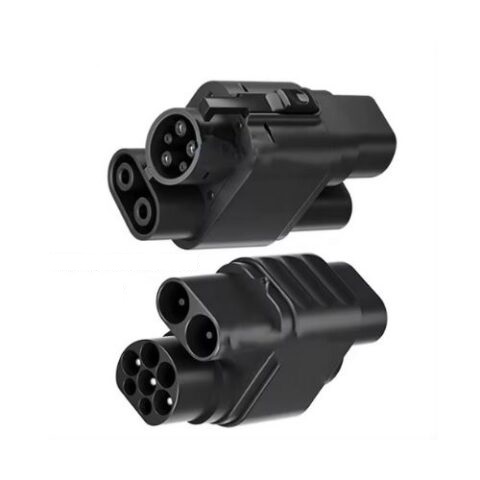
DC and AC EV adapters bridge two types of connectors: a European connector (Type 2 or CCS2) on one side, and an American or Japanese connector (Type 1, CCS1 or CHAdeMO) on the other. Israeli roads today carry American pickups, personally imported cars and older Japanese models, so the question “Which adapter do I need?” comes up a lot. In this guide we explain what each adapter does, what the CE marking means, what the Electricity Administration guidelines say, and when it is better to skip the adapter and install a station with the right connector for your car.
In short: A DC adapter (such as CCS1 to CCS2 or CCS2 to CHAdeMO) bridges direct-current fast charging connectors. An AC adapter (Type 1 to Type 2) bridges alternating-current charging connectors. The Electricity Administration guidelines of 11/2025 state explicitly: “The use of an adapter for an electric vehicle connector is prohibited”. Therefore, for a fixed charging installation, a station with the vehicle's original connector is preferable. Before using any adapter, consult a certified electrician.
Where can you buy a CCS1 to CCS2 adapter in Israel?
DC adapters between CCS1 and CCS2 are sold in the store of DSGCharge, the brand's importer, with nationwide shipping and a 12-month warranty. There are two adapter directions, and you choose according to the socket on the vehicle and the connector on the station:
| Model | Direction (station > vehicle) | Best for | Power and current | Store price (as of November 2026) |
|---|---|---|---|---|
| DSG-360 | CCS2 > CCS1 | A vehicle with a CCS1 socket (American pickups and cars) charging at a fast charging station with a CCS2 connector — the most common connector at fast charging stations in Israel | Up to 180kW, 250A | ₪899 |
| DSG-368 | CCS1 > CCS2 | A vehicle with a CCS2 socket charging at a station with a CCS1 connector | Up to 200kW, 250A | ₪899 |
All of the company's products are approved by the Standards Institution of Israel (SII) for use in Israel. For owners of American pickups (Silverado, Hummer and others) there is a full guide: Charging station for the Silverado and American pickups.
If you install a fast station at home, in a business or in a parking facility, you can choose a CCS1 or CCS2 connector in advance, with no need for an adapter, and compare models on the page DC charging stations from DSGCharge.
What is the difference between a DC adapter and an AC adapter?
The difference lies in the type of charging that passes through the adapter:
- AC (alternating current) charging: The station delivers power from the grid to the vehicle, and the vehicle's onboard charger converts it to direct current. This is charging at home, in the building and at work. The connectors are Type 2 (the European standard) and Type 1 (also known as J1772, common in North American vehicles and some Japanese models).
- DC charging (direct current): The conversion takes place inside the station, and the direct current goes straight into the battery at high power. The connectors are CCS2 (Europe), CCS1 (North America) and CHAdeMO (mainly older Japanese cars).
A DC adapter works at very high currents (for DSGCharge CCS adapters, the product pages state a maximum current of hundreds of amps). That is why the quality of the contacts, the insulation and compatibility with the communication between the station and the vehicle are critical. An AC adapter works at lower currents, but it too sits between the station and the vehicle's charging socket.
DC EV adapters: CCS1, CCS2 and CHAdeMO
CCS1 to CCS2 adapter (and vice versa)
CCS1 and CCS2 are two “combined” fast charging interfaces. They consist of an AC part (Type 1 or Type 2) with two large DC pins below it. A vehicle built for the North American market, such as the Chevrolet Silverado EV or GMC Hummer EV, usually comes with a CCS1 socket. The stations installed in Israel are built around the European standard. A CCS1 to CCS2 adapter is designed to bridge the two.
DSGCharge offers two models, in two directions:
Which side connects to the station and which to the vehicle, the maximum power and the usage limitations are detailed on each product's page.
The CCS1, CCS2 and CHAdeMO interfaces are all defined in the IEC 62196-3 standard. This is relevant because the guidelines in Israel require that the connector on a DC station comply with IEC 62196. This means a DC station can be installed with an original CCS1 connector, without an adapter. We expand on this below.
CHAdeMO adapter
CHAdeMO is a Japanese DC interface, found mainly in older vehicles. DC adapter CCS2 > CHAdeMO, model DSG-364 Designed to bridge a CCS2 connector and a vehicle with a CHAdeMO socket. Such an adapter also has to translate the communication between the station and the vehicle, because the two interfaces speak different protocols. This is one of the reasons it costs more than CCS adapters. Full specifications are on the product page.
AC EV adapters: Type 1, Type 2 and 230V adapters
Type 1 to Type 2 adapter (and vice versa)
For AC charging, Type 2 is the default in Israel. The guidelines state that an AC station “shall include a Type 2 socket-outlet or electric vehicle connector”. Vehicles with a Type 1 socket need some kind of bridge to charge at such a station. DSGCharge offers two adapter directions:
Note: Type 1 is a single-phase connector. A vehicle with a Type 1 socket will charge on single-phase even when the station is three-phase.
American pickup adapter and 230V adapters
This category includes two products that are not adapters between charging connectors:
- 230V adapter for American pickups, model DSG-365: an adapter between an American power connection and an Israeli power connection.
- 230V adapter from a charging station, model DSG-366: an adapter for drawing 230V power from a charging station.
These are products with a specific use context. The connection types, maximum current and limitations are detailed on the product page. Before use, read the guidelines section below, especially section 12(c).
Which adapter fits which vehicle? Comparison table
| Adapter | From – to | DC or AC | Use | DSGCharge model | Price (as of 11/2026) |
|---|---|---|---|---|---|
| CCS2 to CCS1 adapter | CCS2-CCS1 (connection direction per the product page) | DC | Bridging a European CCS2 connector and a North American vehicle with CCS1 | DSG-360 | ₪899 |
| CCS1 to CCS2 adapter | CCS1-CCS2 (connection direction per the product page) | DC | Bridging CCS1 and CCS2 connectors | DSG-368 | ₪899 |
| CHAdeMO adapter | CCS2 > CHAdeMO | DC | A vehicle with a CHAdeMO socket (mainly older Japanese cars) | DSG-364 | ₪3,599 |
| Type 2 to Type 1 adapter | Type2-Type1 | AC | Bridging a Type 2 connector and a vehicle with a Type 1 socket | DSG-361 | ₪499 |
| Type 1 to Type 2 adapter | Type1-Type2 | AC | Bridging in the opposite direction (per the product page) | DSG-362 | ₪499 |
| V2L adapter | According to the product page | AC (power output from the vehicle) | Running appliances from the vehicle battery in a car that supports V2L. Not for charging the vehicle | DSG-363 | ₪590 |
| American pickup adapter | 230V for American pickups (per the product page) | AC | According to the product page | DSG-365 | ₪690 |
| 230V adapter from a station | From a charging station to 230V (per the product page) | AC | According to the product page | DSG-366 | ₪499 |
All adapters, cables and other accessories are in the category Cables and adapters in the store.
What do the Electricity Administration guidelines say about adapters?
On 25.11.2025 the Electricity Administration published the “Guidelines for installing an EV charging system”. According to section 18, the guidelines take effect 6 months after publication, and it is permitted to act in accordance with them from the date of publication. These are the sections that relate to adapters, in the wording of the document as checked in October 2026:
- Section 9(d): “The use of an adapter for an electric vehicle connector is prohibited”. The parentheses explain that this refers to an ”adapter between the connector on the charging cable and the vehicle inlet”. The section does not distinguish between AC and DC.
- Section 12(c): For a portable charger (a Mode 2 charging device) “the use of an extension cord to supply a charging device is prohibited, and the use of adapters and splitters in the socket-outlet is also prohibited”.
- Section 8(a): Charging shall be carried out “only by means of a cable connecting the charging station or charging device to the electric vehicle” (except wireless charging).
- Section 9(a)-(b): An AC station shall include a Type 2 connector or socket-outlet. A single-phase station with a Type 1 connector is permitted in a parking space supplied from a residential installation or in a parking space in private use.
- Section 9(c): A connector on a DC station (Mode 4) shall comply with IEC 62196.
What does this mean in practice? Within a charging system subject to the guidelines, the connection to the vehicle must be made with a cable and connector that suit the vehicle, with no intermediate component between the cable connector and the vehicle socket. To accommodate American and Japanese vehicles, the guidelines themselves allow a station with the appropriate connector: single-phase Type 1 in a private parking space, or a DC connector per IEC 62196 (which also includes CCS1). The guidelines deal with the installation and operation of charging systems. They do not explicitly answer every question, for example use outside Israel or use other than vehicle charging. For such questions, do not rely on interpretation – contact a certified electrician or the Electricity Administration.
What does the CE marking say about an adapter, and what doesn't it say?
DSGCharge adapters carry the CE marking, meaning they comply with the European standard. It is worth understanding what the marking means:
- What it is: According to the European Commission, the CE marking is a manufacturer's declaration that the product met the EU requirements that apply to it as of the date it was placed on the market. Responsibility for compliance and for the marking lies with the manufacturer (Your Europe, European Commission).
- What it is not: CE is not a quality mark, and there is no central European body that grants it. Nor does it replace the installation and usage rules in Israel. A product with the CE marking is still subject to the Electricity Administration guidelines, including sections 9(d) and 12(c).
In other words: CE says something about the product. The guidelines say how and where it may be used in a charging system in Israel. You need to check both.
What is better for a fixed charging installation: a station with the right connector or an adapter?
If the vehicle charges in the same place every day – at home, in the building or in the business parking lot – our recommendation is a station with the connector that suits the vehicle:
- American pickup with CCS1 (Silverado, Hummer and similar): A DC station with an original CCS1 connector. The station charges with direct current, bypasses the onboard charger and complies with section 9(c). Full details, including charging times and the required electrical connection, are in the guide Charging station for American pickups: Silverado and Hummer. An example of such a station is the home DC station 20kW, model DSG-5120 (₪9,428, as of 11/2026). Check the availability of the CCS1 connector in the model you want with the team.
- Vehicle with Type 1 in a private parking space: A single-phase station with a Type 1 connector, as permitted by section 9(b).
- Any other vehicle: An AC station with Type 2, which is the default under section 9(a).
The advantages of a matching station are a direct connection without an additional contact point, compliance with the guidelines and, for DC charging, higher power as well. You can see all the options on the EV charging stationspage, and the installation steps on the EV charging station installationpage. To estimate the installation cost there is the Installation cost calculator.
And in any case where you are considering an adapter – any adapter, in any situation: consult a certified electrician first, and follow the Electricity Administration guidelines and the instructions of the vehicle and adapter manufacturers.
V2L adapter: when the vehicle is the power source
V2L (Vehicle-to-Load) is the complete opposite direction. The vehicle is not being charged; instead it serves as a power source for equipment: appliances while camping, power tools, or lighting during a power outage. According to J.D. Power, with V2L the vehicle acts like a “large portable battery” and there is no connection to the grid. This is different from V2H (powering the home), which requires bidirectional equipment and professional installation.
V2L adapter, model DSG-363 Designed for vehicles that support the technology. Before buying, check in the owner's manual that your vehicle supports V2L and what maximum power it delivers. Important to know:
- A V2L adapter is not intended for charging a vehicle.
- Connecting the vehicle to the home's electrical panel is not V2L use, and you must not do it yourself through an adapter. Section 14 of the guidelines deals with ”the use of an electric vehicle to supply electricity outside the vehicle” to an electrical installation. It requires compliance with separate guidelines, adaptation of the protections by a designer, and a warning sign on the panel. This is a job for an electrician, not a plug-in connection.
- Only run equipment whose power consumption is within the limits allowed by the vehicle and the adapter, and keep the cables away from moisture.
Before you buy an adapter: checklist
- Identify the charging socket on your vehicle: Type 1, Type 2, CCS1, CCS2 or CHAdeMO.
- Define the purpose: regular charging, occasional charging, or drawing power (V2L).
- For regular charging, first look into a station with the right connector.
- Read the connection direction, maximum current and power, and the IP rating on the product page.
- Consult a certified electrician, and for questions of applicability contact the Electricity Administration.
Why DSGCharge?
DSGCharge has been active since 2021. It sells charging stations under its own brand – DSGCharge is the importer – as well as cables, adapters and accessories. About 20,000 chargers and charging stations sold and installed, with installation and service provided nationwide. That is why we can offer American, Japanese or European vehicles not just an adapter, but also a station with the right connector.
Want to know the right solution for your vehicle?
Tell us what vehicle you have and where it charges. We will check the socket type and the electrical connection and recommend a suitable station or accessory. Call 077-9920350 or leave your details.
Frequently asked questions
Where can you buy a CCS1 to CCS2 adapter in Israel?
The store of DSGCharge, the brand's importer, offers two models: DSG-368 (CCS1 > CCS2) and DSG-360 (CCS2 > CCS1), at ₪899 each (as of November 2026), with nationwide shipping and a 12-month warranty. Choose according to the socket on your vehicle and the connector on the station, and check the specific use against the Electricity Administration guidelines with a certified electrician.
What is the difference between DC and AC EV adapters?
DC adapters bridge direct-current fast charging connectors: CCS1, CCS2 and CHAdeMO. AC adapters bridge alternating-current charging connectors: Type 1 and Type 2. DC adapters work at much higher currents, and a CHAdeMO adapter also has to translate the communication between the station and the vehicle.
Is it legal to use a CCS1 to CCS2 adapter in Israel?
The Electricity Administration guidelines of 11/2025 state in section 9(d): “The use of an adapter for an electric vehicle connector is prohibited”, meaning an adapter between the charging cable connector and the vehicle socket. The guideline-compliant solution for a vehicle with CCS1 is a DC station with an original CCS1 connector. For any question about a specific use, consult a certified electrician.
What does the CE marking say about an adapter?
The CE marking is the manufacturer's declaration that the product meets the EU requirements that apply to it. DSGCharge adapters carry the CE marking. The marking does not replace the installation and usage rules in Israel.
How do you charge an American pickup at home?
The fast option is a DC station with an original CCS1 connector. The slow option is a single-phase station with a Type 1 connector in a private parking space, as permitted by section 9(b) of the guidelines. Details are in the charging station for American pickups guide on the website.
What is a V2L adapter and what is it used for?
A V2L adapter lets you run appliances from the vehicle battery, in a car that supports it. It is not used for charging the vehicle. Connecting a vehicle to the home's electrical installation is a different matter, subject to section 14 of the guidelines, and requires an electrician.