
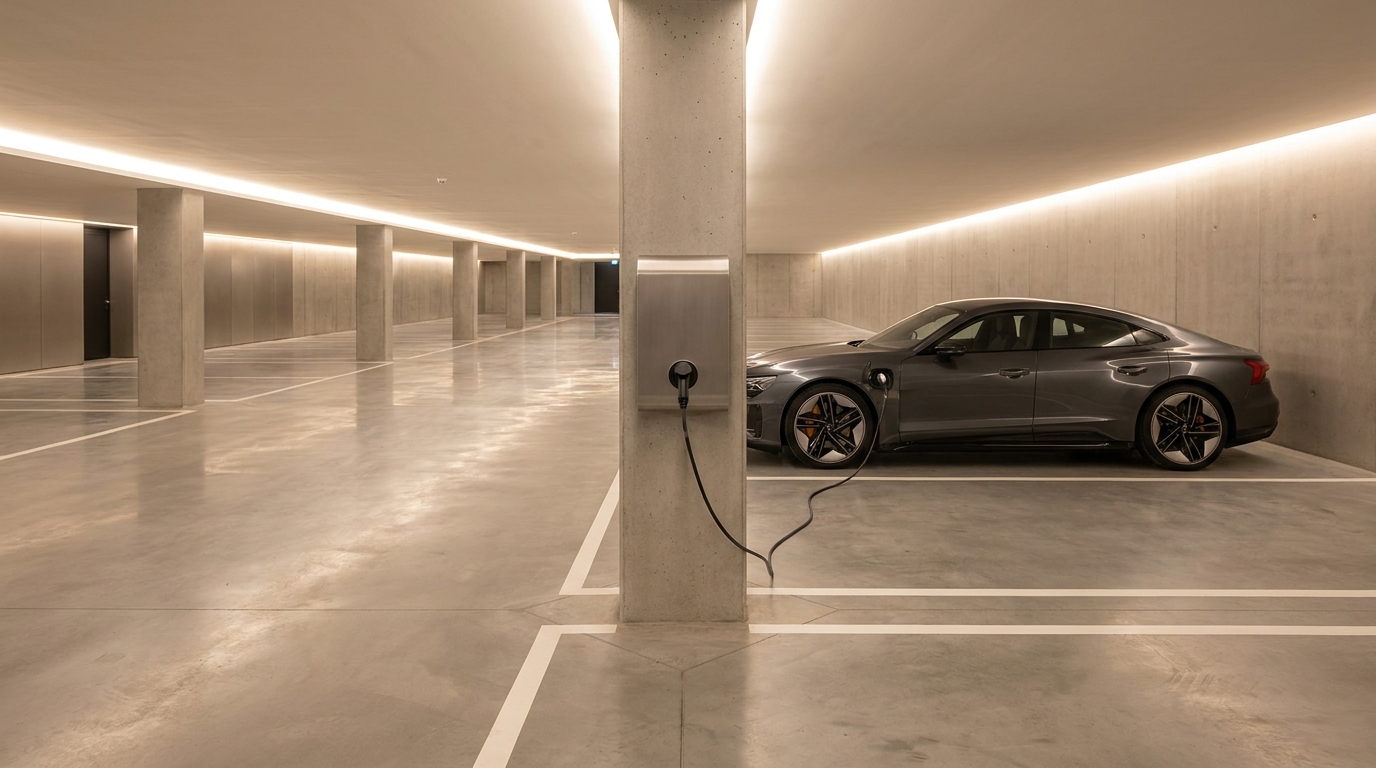
In a building where several residents charge an electric car in the parking lot, the important question isn't how to install a station, but who pays how much at the end of the month. Monthly charging report based on a TOU meter answers this question in numbers: how many kWh each resident charged, how many of them during off-peak hours and how many during peak hours, and the exact cost for each one according to the actual electricity tariff. On this page you'll find how it works, what such a report looks like, how the money reaches the building committee and what to do about a resident who doesn't pay.
In short: When the building's charging stations are connected to the power supply through a TOU meter, every kWh is priced according to the hour it was charged. DSGCharge manages the charging, reads the TOU meter, bills each resident according to their exact usage, issues a tax invoice and transfers the cost of charging to the building committee. The committee receives a transparent report and doesn't deal with collection.
What is a TOU tariff, and why does it matter for charging in a building?
TOU is a time-of-use tariff: instead of a flat price for every kWh, the price of electricity changes by season and hour of the day. During peak hours, when national demand for electricity is high, a kWh is more expensive. During the remaining hours (off-peak) it is cheaper, and in many cases cheaper than the flat tariff. To bill according to the TOU tariff, you need a digital meter that records consumption by time period, not just a total.
This is especially suitable for electric cars: most cars in a residential building's parking lot stay there all night. If charging takes place during off-peak hours, the building pays less for the charging energy than it would on a flat tariff. That's why a TOU tariff for electric cars in an apartment building isn't just a matter of accounting, but also of savings.
Peak and off-peak hours on the TOU tariff (in effect since 1.1.2023)
| Season | Months | Peak hours, Sunday–Thursday | Weekends and holidays |
|---|---|---|---|
| Winter | December, January, February | 17:00-22:00 | Off-peak all day |
| Transition | March-May, October-November | 17:00-22:00 | Off-peak all day |
| Summer | June-September | 17:00-23:00 | Off-peak all day |
All hours that are not peak hours are off-peak hours, including the entire night.
Low-voltage TOU prices, as of July 2026
| Season | Off-peak (agorot per kWh, incl. VAT) | Peak (agorot per kWh, incl. VAT) |
|---|---|---|
| Winter | 46.63 | 114.70 |
| Transition | 45.78 | 49.58 |
| Summer | 50.42 | 172.23 |
| Flat tariff (for comparison) | 63.52 | 63.52 |
Prices according to the Electricity Authority tariff book (update of 1.7.2026), as published in TheMarker; VAT (18%) is included in the calculation. They include only the energy component, without fixed charges. Note the gap: in summer a peak kWh costs three times or more than an off-peak kWh, and in winter more than twice as much. In the transition seasons the gap is smaller, but even then the off-peak price is lower than the flat tariff. Tariffs are updated from time to time, so a good report is always calculated according to the tariff that was in effect in the month of charging.
How does DSGCharge produce a monthly charging report based on a TOU meter?
In DSGCharge's system for buildings, the stations in the parking lot are managed charging stations: they are connected to the internet, communicate over the open OCPP protocol with a cloud-based management system, and are controlled from it. Every charging session begins with identifying the resident (for example, with a smart card), so the system knows who charged, when and how much. Here's how it works, step by step:
- Connection through a TOU meter. The stations are connected to the power supply through a meter that records consumption by peak and off-peak hours.
- Identification and metering for every charging session. Each resident identifies at the station, and the system records their charging session.
- Meter reading. DSGCharge reads the TOU meter, so billing is based on the consumption actually measured.
- Calculation according to exact usage. Each resident is billed for the cost of their own usage, not according to an arbitrary split.
- Report and invoice. Each user has a detailed usage report and receives a tax invoice for the charging.
- Transfer to the building committee. DSGCharge manages the collection and transfers the cost of charging to the building committee, in a transparent and orderly way.
In addition, the system prioritizes charging during off-peak hours to lower the cost for the building. Want to understand in depth what Managed charging station makes possible, and why it's important that it works over an open protocol? We explain it on a separate page.
How do you calculate charging costs based on a TOU meter? An example of a monthly charging report
An example for illustration only: A building with four residents who charge in the parking lot, in a summer month (July 2026). The calculation is based on summer TOU prices incl. VAT: 50.42 agorot per kWh off-peak and 172.23 agorot per kWh at peak. The amounts include the energy component only.
| Resident | Off-peak kWh | Peak kWh | Total kWh | Off-peak cost (₪) | Peak cost (₪) | Total to pay (₪) |
|---|---|---|---|---|---|---|
| Resident A | 280 | 20 | 300 | 141.18 | 34.45 | 175.63 |
| Resident in | 410 | 0 | 410 | 206.72 | 0.00 | 206.72 |
| Resident C | 150 | 60 | 210 | 75.63 | 103.34 | 178.97 |
| Resident D | 95 | 5 | 100 | 47.90 | 8.61 | 56.51 |
| Building total | 935 | 85 | 1,020 | 471.43 | 146.40 | 617.83 |
What the example shows:
- Resident in charged the most (410 kWh), but only off-peak. They pay about 50 agorot per kWh.
- Resident C charged about half as much as Resident B, but 60 kWh of it at peak. Their bill is even higher than that of Resident A, who charged more. Their bill is ₪45.58 higher than what they would have paid on the flat tariff (₪133.39).
- For the whole building: 1,020 kWh on the flat tariff would have cost ₪647.90. On the TOU tariff, with most of the charging at night, the cost is ₪617.83. The more charging shifts to off-peak, the greater the savings: if all the charging had been off-peak, the cost would have been about ₪514.
This is exactly the advantage of a TOU-based report: each resident pays for their own habits. Whoever charges at night doesn't subsidize whoever charges at peak hours, and the whole building benefits from the cheap tariff. To calculate the charging cost for your car, try the charging cost calculator.
Monthly billing for charging in a building: three methods compared
Building committees usually come to us after trying one of the first two methods. The table compares them with a managed system with a TOU report.
| Criterion | Equal split among residents | Sub-meter and manual reading | Managed system with a TOU report |
|---|---|---|---|
| Fairness | Low: those who charge a little subsidize those who charge a lot | Medium: metering by quantity, usually without distinguishing between peak and off-peak | High: each resident according to their exact usage and the time of charging |
| Who does the work | The building committee treasurer | A volunteer who reads meters, calculates and sends payment requests | DSGCharge: reading, calculation, invoice and collection |
| Transparency | No data per resident | Depends on the accuracy of manual records | Detailed usage report for each user |
| A new resident with an electric car | The split has to be recalculated | Another sub-meter is needed | Registers in the system and receives access |
| A resident's debt | Remains the building committee's problem | Remains the building committee's problem | Charging access can be suspended remotely |
| Tax invoice for the resident | No | Usually not | Yes |
| Disputes | Frequent | Over reading and calculation errors | Minimal: the data is available to every user |
In the example above, an equal split would have charged each resident ₪154.46. Resident D, who charged 100 kWh, would have paid almost three times their actual cost (₪56.51), and Resident B would have paid less than they consumed. That's how disputes in a building start.
Billing residents for charging: how does the money reach the building committee?
The money flow in a managed system is simple, and that's what frees the building committee from collection work:
- The electricity bill for the TOU meter that feeds the stations arrives at the building, like any bill for the common property.
- DSGCharge reads the meter, calculates the cost of each resident's usage and collects it from them. The resident receives a tax invoice.
- DSGCharge transfers the cost of charging to the building committee, together with a report showing where every shekel came from.
- The building committee pays the electricity bill, and the common fund doesn't finance anyone's charging.
This is essentially payment processing for the building committee , without the committee needing a credit card payment terminal, accounting software or a volunteer chasing residents. DSGCharge's service fees and the allocation of fixed charges on the electricity bill are set in the agreement with the building, so they were not included in the example.
As for infrastructure: in managed buildings, if the building invests in the infrastructure itself, there is no commitment period. If DSGCharge invests in the common infrastructure, a 10-year commitment is required.
What do you do about a resident who doesn't pay?
With manual methods, a resident's debt becomes the building committee's problem and sometimes a dispute between neighbors. In a managed system, charging access is tied to the resident. Since the stations are controlled from the cloud, the access of a resident with a debt can be suspended remotely until they settle it, without disconnecting cables and without a confrontation in the parking lot. The other residents continue to charge as usual.
How often do you get a report, and how accurate is it?
Billing is monthly, and the report details each user's usage. The accuracy relies on two things: identification of every charging session at the station, and reading of the TOU meter itself. Because billing is based on measured consumption and not on an estimate, the report holds up even when a resident asks to check their bill.
What does the law say about building committees and charging stations?
As of October 2026, there is still no dedicated law regulating charging stations in apartment buildings. Here's what is known from verified sources:
- Connection to the apartment's power supply: The land registry superintendent in Tel Aviv ruled in 2023 (case 639-21) that a resident may install a station in the parking space assigned to their apartment, connected to the apartment's power supply, without the neighbors' consent. The conditions: written notice to the building committee and to all apartment owners at least 45 days before the start of installation, minimal impact on the common property and the building's appearance, compliance with electrical and planning laws, and all costs borne by the resident.
- The bill: A bill on the subject passed its first reading in the Knesset in May 2024 and is not yet law. Under the bill, connecting to the common property's power supply would require the consent of a majority of apartment owners and a separate meter, and installation in a parking space that is common property would require the consent of two-thirds.
What this means for the building committee: once the stations are connected to the common power supply, separate metering and orderly billing with each resident are needed. A monthly report based on a TOU meter provides exactly that. The information here is general and is not legal advice; it's also worth checking the building's bylaws.
What do you need to get started?
- Building site survey. Site survey for a station in an apartment building DSG-9900 (₪690, as of 10/2026) checks the connection, the panel, the distances and the expected number of users.
- Managed charging stations. Managed charging station 22kW DSG-6012 (₪3,290, as of 10/2026) connects to the cloud management system via OCPP.
- User identification. Additional smart card DSG-9988 (₪69, as of 10/2026) for each resident or vehicle.
- Cost estimate. Charging station installation cost calculator gives an initial direction before the site survey.
You'll find the full picture of planning, load management and setup on the page charging stations in apartment buildings, and the stations themselves in the category EV charging stations.
Why DSGCharge?
DSGCharge, part of S.M.C. Dor HaAtid, has been active since 2021. DSGCharge is the importer of its charging stations – the brand is DSGCharge's own. About 20,000 DSGCharge-branded chargers and charging stations have been sold and installed. We have installation and service teams nationwide. In buildings we don't just sell stations: we set up the system, manage the charging, read the TOU meter, collect from the residents and transfer the cost of charging to the building committee. Because the same company imports the stations, installs them and operates the management system, the building committee has one address for every question.
Want an orderly monthly charging report in your building?
Leave your details on the page Contact or call 077-9920350. We'll check the building, explain how the TOU meter, billing and transfer to the building committee will work, and offer a plan that fits the number of residents charging today and in the future.
Frequently asked questions
What is a monthly charging report based on a TOU meter?
A report that details for each resident how many kWh they charged in the month, how many during off-peak hours and how many during peak hours, and the cost according to the TOU tariff that was in effect. Based on the report, each resident is billed for the cost of their exact usage.
Does a TOU meter for a charging station really lower the building's electricity costs?
Yes, when most of the charging takes place during off-peak hours. In July 2026, an off-peak kWh in summer cost 50.42 agorot incl. VAT, compared with 63.52 agorot on the flat tariff. Charging during peak hours is more expensive, so the system prioritizes off-peak charging.
How is a resident who charges during peak hours billed?
According to their actual usage. Whoever charges during peak hours pays the peak price for those kWh, and whoever charges at night pays the off-peak price. This way no resident subsidizes a neighbor's charging habits.
Does the building committee need to collect money from residents?
No. DSGCharge manages the collection, issues the resident a tax invoice and transfers the cost of charging to the building committee with a detailed report. The committee pays the electricity bill without financing charging from the common fund.
What happens if a resident doesn't pay for charging?
Since the stations are managed via OCPP and controlled from the cloud, the resident's charging access can be suspended remotely until they settle the debt. The other residents continue to charge as usual.
Does a resident need permission to connect a station to the apartment's power supply?
According to the 2023 ruling of the land registry superintendent in Tel Aviv, the neighbors' consent is not required when the station is in the assigned parking space and connected to the apartment's power supply. Written notice to the building committee and the apartment owners at least 45 days in advance is required. The bill on the subject has not yet been finally approved.