
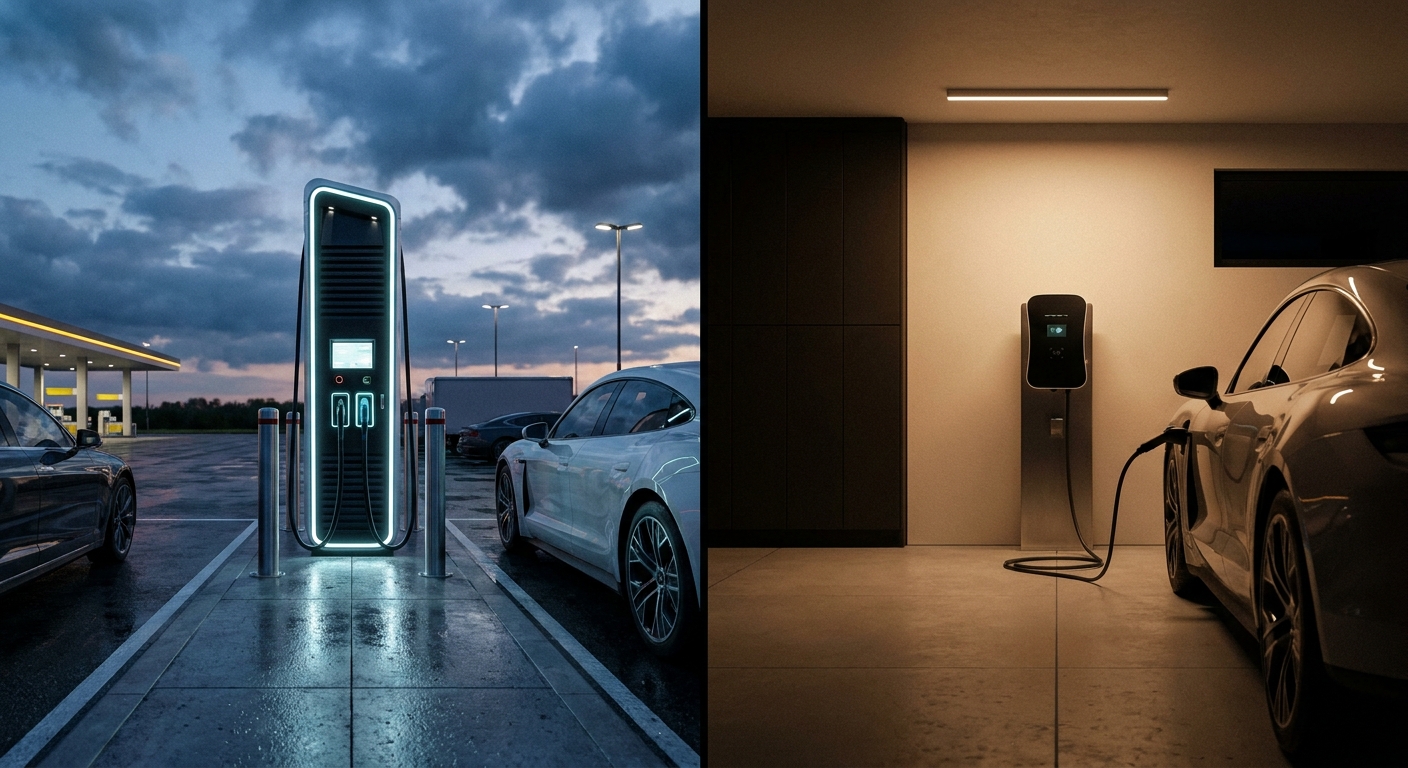
DC fast charging station vs. home (AC) charging station: the complete guide to the right choice for your EV
In short: For most drivers, an AC charging station at home or at work is enough: it fills an average battery within 5 to 9 hours and covers about 95% of everyday driving needs. A DC fast charging station, from 20kW and up, charges the battery from 10% to 80% within 20 to 30 minutes, and suits businesses, parking facilities and fuel stations.
DSGCharge (DSG Charging Solutions) is one of Israel's leading companies in EV charging solutions: active since 2021, with about 20,000 of its chargers and charging stations sold and installed, and it provides installation and service nationwide.
You can compare all the models, from home AC stations to DC fast charging stations, in one place on the EV charging stations from DSGCharge.
Introduction: why is understanding the difference between AC and DC essential for every EV owner?
If you've recently bought an electric vehicle, or you're considering taking this important step, you've surely come across a sea of technical terms. Two of the most prominent are AC and DC. You see them on charging stations, in vehicle specifications and in various guides. On the one hand, there's the convenient outlet in your home parking space, and on the other, the powerful stations at public fuel stations that promise a charge during a coffee break. The dilemma of DC vs. AC charging station is not just a technical matter; it's at the very heart of the EV ownership experience, and it affects convenience, costs and even the lifespan of your battery. A thorough understanding of the differences will let you get the very most out of your vehicle. In this guide, the experts at DSG Charging Solutions will clarify the terms, break the technology down and give you all the tools you need to choose the perfect charging solution for your unique needs.
AC (alternating current) charging: the convenience of your home parking space
When we talk about home EV charging, we almost always mean AC charging. AC stands for Alternating Current, or Alternating current (AC), and that is exactly the type of electricity that flows through the national grid and reaches every outlet in your home. The process itself is fairly simple: the home charging station (also called a wallbox) takes electricity from the home's supply and delivers it to the vehicle. But here's where the real magic happens, and the most critical point to understand: an EV battery can store energy only in the form of direct current (DC). That's why every electric vehicle has an essential component installed called an “onboard charger” (On-Board Charger). This charger's job is to act as a converter – it receives the AC current from the station and converts it to DC current that the battery can absorb and store. Your maximum charging speed at home, then, will always be limited by the power of that onboard charger. Most vehicles on the market come with an 11kW (three-phase) onboard charger, and some premium vehicles offer an upgrade to a 22kW charger. Even if you install the most powerful station, the vehicle will “take” only what its onboard charger can convert.
- Key advantages: The most notable advantage is convenience. You come home, plug in the vehicle, and wake up in the morning to a full battery. There's no need to plan stops at charging stations or wait in line. In addition, the cost of home electricity is significantly lower than the rate at fast public charging stations, which makes everyday driving especially cheap. Finally, slow, controlled charging overnight is considered healthier for the battery in the long run and keeps it in good condition for years.
- Disadvantages: The main disadvantage is, of course, charging time. A full charge of an average battery at an 11kW station takes between 5 and 9 hours. This is an excellent solution for overnight charging, but it is not at all practical for a quick “refueling” stop in the middle of a long trip.
- Ideal target audience: Almost every electric vehicle owner. It is the ultimate basic solution for covering everyday trips – to work, school, shopping and errands.
- DSGCharge expertise: We atDSGCharge specialize in matching and installing safe, standards-compliant AC stations that meet all the strict requirements. Whether it's a private home or complex solutions for apartment buildings that include load management systems to prevent the electrical system from collapsing, we provide an end-to-end solution. You can browse here theOur range of home charging stations.

DC (direct current) charging: the power of fast ‘refueling’ on the road
DC charging, better known as ”fast charging” or “ultra-fast charging”, represents the other end of the scale. DC stands for Direct Current, that is, Direct current (DC), and that, as we've already learned, is the type of electricity the vehicle's battery stores. Here lies the revolutionary difference: at a DC fast charging station, the conversion from AC (which comes from the grid) to DC doesn't take place inside the vehicle but inside the charging station itself. These stations are essentially huge, powerful current converters. They deliver direct current straight to the vehicle's battery, completely ‘bypassing’ the vehicle's limited onboard charger. This is the main reason whyEV charging time can be shortened dramatically. DC station power ratings start at 20kW and climb up to 480kW in modern ultra-fast stations.
- Key advantages: Speed, without a doubt. An average fast station can fill most of the battery capacity (from 10% to 80%) in just 20 to 30 minutes. This advantage makes long, intercity trips easy and simple, and almost completely eliminates “range anxiety”. Instead of planning the trip around long charging hours, you can combine a short refreshment stop with a quick electric “refuel”.
- Disadvantages: Cost is a significant disadvantage. The price per kWh at a public DC station is higher than the home electricity rate. In addition, their availability is limited to dedicated stations along highways, commercial centers and public parking lots. A private installation of a DC station is almost impossible and astronomically expensive. Also, experts recommend not relying on DC charging exclusively and on a daily basis, since transferring so much energy in a short time may, in the very long run (after many years), slightly accelerate battery wear.
- Ideal target audience: Drivers who make frequent long intercity trips, drivers who have no access to private parking and home charging, and commercial vehicle fleets (such as taxis and delivery vehicles) that need high availability and minimal downtime.
- DSGCharge business solutions: As part of the complete package for our customers, DSGCharge supplies and installs advanced DC fast charging stations for businesses, public parking lots, logistics centers and vehicle fleets. We offer advanced management and payment systems that let the business owner manage usage, set rates and enjoy an additional source of income. Discover DC fast charging solutions for businesses and institutions.
Head-to-head comparison: a table of differences between AC and DC
To simplify all the information and present the differences as clearly as possible, we've prepared a comparison table summarizing the key points. This table will help you understand at a glance which charging solution suits each situation.
| Feature | AC charging (home) | DC charging (fast) |
|---|---|---|
| Charging speed | Slow (5-9 hours for a full charge) | Very fast (20-40 minutes to 80%) |
| Typical location | Private parking, apartment building, workplace | Fuel stations, public parking lots, highways |
| Installation cost | Relatively low (for a private customer) | Very high (for commercial use only) |
| Charging cost (per kWh) | The lowest (home electricity rate) | Significantly higher |
| Power conversion process | Inside the vehicle (via the onboard charger) | Inside the charging station (delivers DC directly to the battery) |
| Ideal use | Regular daily charging, mainly at night | Short ‘refueling’ stops on long and intercity trips |
So what's right for you? Recommendations from the professional team at DSGCharge
Now that we understand the technical differences, it's time for the practical question: which charging solution do you really need? The answer depends on your lifestyle, the type of trips you take and where you live. As a leading company in the field, atDSGCharge we've developed expertise in matching the exact solution to each customer. Here are a few common scenarios and our team's recommendations:
For the everyday driver in a private home
If you have private parking and your trips are mostly routine (to work and back, errands in town), our recommendation is unequivocal: installing a home AC charging station. It's the most convenient, efficient and economical solution for you. It will give you peace of mind and a fully charged vehicle every morning, at the lowest possible cost. There's no reason to pay more for expensive public charging for everyday use. Our experts will help you choose the station that suits your home's electrical capacity and your vehicle model.
For a resident of an apartment building
Living in an apartment building poses a unique challenge, but one that has advanced solutions. Installing a private station in the building's parking lot requires careful planning. You need to take into account the shared electrical infrastructure, load management to prevent power outages for all residents, and a separate billing mechanism that ensures you pay only for the electricity you used.DSGCharge has extensive experience leading complex projects in apartment buildings. We offer smart energy management systems that balance the load among the different stations and give every resident personal, accurate billing through a dedicated app.
For a business owner with a vehicle fleet or a customer parking lot
For businesses, the commercial aspect comes into play. If you manage a vehicle fleet, combining AC stations for overnight charging on the company premises with DC stations for fast charging during the workday can maximize fleet efficiency. If you own a parking facility (for example, at a shopping center or office building), installing DC fast charging stations adds significant value for visitors and can become a source of income. We atDSGCharge offer modular solutions for businesses, from single stations to complete arrays that include management software, payment processing and customer service.
Frequently asked questions about AC and DC charging
Does fast (DC) charging damage the vehicle's battery?
This is one of the most common and important questions. The precise answer is: daily, exclusive use of DC charging may somewhat accelerate the battery's natural wear process over many years. The reason is the higher heat and load placed on the battery cells. That said, it's important to emphasize that all modern electric vehicles are equipped with a sophisticated battery management system (BMS) whose job is to protect the battery, monitor its temperature and regulate the charging rate to minimize damage. The across-the-board recommendation of all vehicle manufacturers and experts in the field is to use slow AC charging by default for everyday use, and to save DC fast charging for long trips and situations where you need a quick charge.
Can I install a DC station at home?
Technically, installing a DC charging station in a private home is almost impossible, and definitely not worthwhile. DC stations require a connection to high-voltage industrial electrical infrastructure, which doesn't exist in private homes. Upgrading to such infrastructure, if it's possible at all, involves costs of tens and hundreds of thousands of shekels. The cost of a DC charging station itself is also incomparably higher than an AC station. Therefore, the standard, safe and correct home solution is always installing an AC charging station at home, at a power rating matched to the existing infrastructure.
Why does my vehicle charge slowly at a 22kW AC station?
This is something many new vehicle owners run into. You bought a powerful 22kW station, but the vehicle charges at only 11kW. The reason is the “bottleneck” we talked about – the vehicle's onboard charger. If your vehicle's onboard charger is limited to 11kW (as is the case in most popular models), it physically can't accept more than that, even if the station offers twice the power. It will simply “draw” from the station the maximum power it can convert. So before upgrading a station, it's very important to check the vehicle's technical specifications for the maximum AC charging power it supports.
In summary: the smart choice is the right combination
The world of EV charging isn't black or white, AC or DC. The smartest choice for the vast majority of drivers is an optimal combination of both worlds. The foundation is a reliable private AC station at home or at work, which faithfully serves 95% of your everyday driving needs in the most convenient and cheapest way. DC fast charging is saved for special cases – long vacation trips up north or down south, business meetings out of town, or emergencies when you need a quick range boost. This understanding makes the switch to an electric vehicle smooth, efficient and worry-free. DSGCharge is proud to offer the full range of solutions, from advanced AC stations for the home and the apartment building to powerful DC stations for businesses and public spaces. Our professional team is here to accompany you, understand your needs and tailor the perfect system that will serve you for many years to come.
Not sure which solution is right for you? Talk to the DSG Charging Solutions experts today and get personalized advice on installing the perfect charging station for your vehicle and your home. Contact us now! DSGCharge