
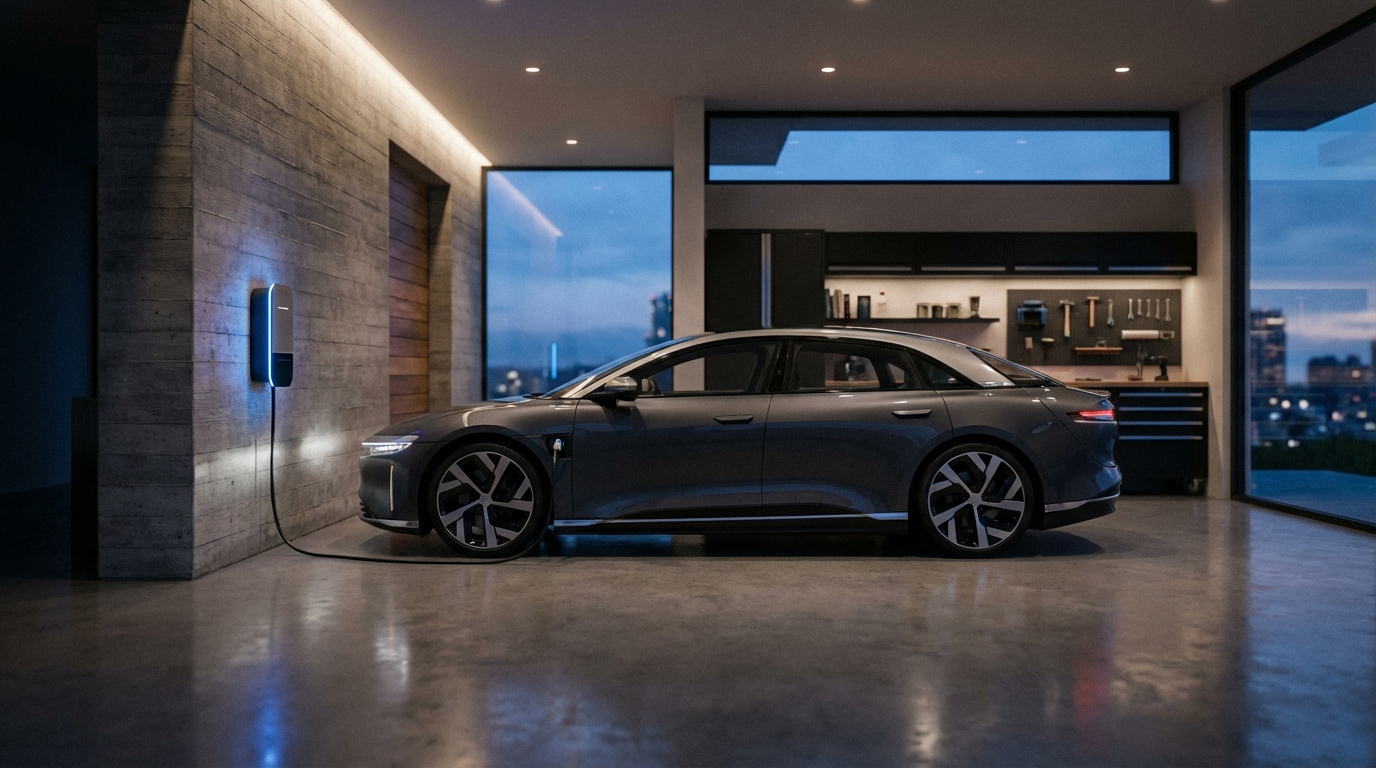
In short: For most homes in Israel with a three-phase connection, a smart home charging station of 11kW is the right choice: it charges most electric cars at the maximum speed they accept on AC, suits a 3X25 amp connection, and costs less. A station of 22kW is worth the extra cost only if the car supports it, if there's a 3X40 amp connection, or if you plan to share it between two cars. In an apartment building, it's worth choosing a Managed station with RFID, communication and billing per user. In any case – a station approved by the Standards Institution of Israel (SII), with built-in DC leakage current protection, installed by a certified electrician and inspected before commissioning.
📊 The recommended station for your situation
- Private house, three-phase connection, one car: Smart charging station 11kW.
- A car that supports 22kW AC, or two cars: 22kW station or Dual station.
- Home with a single-phase connection: a station of up to 7.4kW (or a connection upgrade).
- Apartment building or parking facility: Managed station with RFID and Wi-Fi/LAN/4G communication.
- Backup only, without installation: Portable charger for occasional charging.
5 questions that determine which station is right for you
1. What electrical connection do you have at home?
This is the starting point. With a Single-phase connection (common in apartments and older houses), the maximum power is about 7.4kW. With a Three-phase connection, you can install an 11kW or 22kW station. The connection size also matters: an 11kW station draws about 16 amps per phase, and with a 3X25 amp connection you need to make sure it won't trip the main breaker together with air conditioners and the water heater – or choose a station with load management. More details: Single-phase vs. three-phase station.
2. How fast can your car charge on AC?
Every electric car has an internal charger (On-Board Charger) that limits the AC charging speed. For most cars in Israel the limit is 11kW, for some 7.4kW, and for a few 22kW. A station more powerful than the on-board charger won't charge any faster – so it's worth checking this figure in the car's manual or the importer's specifications before buying.
3. How far do you drive each day?
An average driver covers 40-60 km a day, meaning 7-10 kWh needs to be put back into the battery overnight. An 11kW station does this in less than an hour. Even a 7.4kW station is enough for most drivers – the difference is noticeable mainly after a long drive or when there are two cars.
4. How many electric cars are there – or will there be?
If there is, or will be, a second electric car, it's worth planning ahead: a dual charging station, or a 22kW station that splits the power, and infrastructure that lets you add a station without breaking walls twice. More details: Two electric vehicles at home.
5. Private house or apartment building?
In a private house, a regular smart charging station is enough. In an apartment building, you need a solution that allows identifying each resident, metering and billing by consumption, and later also load management across several stations – in other words, a managed charging station that connects to a management system. Information for buildings: Charging station installation in apartment buildings.
Comparison of DSGCharge charging stations
All the stations below are AC with a Type 2 socket, a 5-meter built-in cable (8-meter option), a 4.3″ screen, built-in AC (30mA) and DC (6mA) leakage current protection, protection against overvoltage, overcurrent, overheating and lightning, and a 24-month on-site warranty at the customer's home. All are approved for use by the Standards Institution of Israel (SII).
| Model | Power | Required connection | Communication and activation | Ingress protection | Price |
|---|---|---|---|---|---|
| DSG-1061 | 11kW | Three-phase 16A | Bluetooth · RFID, app, Plug&Play | IP65 | ₪1,590 |
| DSG-1062 | 22kW | Three-phase 32A | Bluetooth · RFID, app, Plug&Play | IP65 | ₪1,790 |
| DSG-1072 | 22kW | Three-phase 32A | Bluetooth + Wi-Fi · RFID, app, Plug&Play | IP54 | ₪2,390 |
| DSG-6012 managed | 22kW | Three-phase 32A | Wi-Fi, LAN, 4G · RFID, app | IP54 | ₪3,290 |
| DSG-3011 dual | 2 × 11kW | Three-phase 32A | Bluetooth · RFID, app, Plug&Play | IP55 | ₪5,990 |
| DSG-3012 dual | 2 × 22kW | Three-phase 64A | Bluetooth · RFID, app, Plug&Play | IP55 | ₪6,490 |
Prices are for the station only, without installation. How much installation costs and what the total cost is: Charging station and installation price list 2026.
7kW, 11kW or 22kW – which should you choose?
| Power | Connection | Range added per hour of charging* | Suitable for |
|---|---|---|---|
| Up to 7.4kW | Single-phase 32A | About 45 km | Home with a single-phase connection, normal daily mileage |
| 11kW | Three-phase 16A | About 70 km | Most homes and cars – the best balance |
| 22kW | Three-phase 32A | About 135 km (only in a car that supports it) | Cars with a 22kW charger, two cars, businesses |
* Based on consumption of about 16 kWh per 100 km. In practice, also limited by the car's on-board charger.
More details: 11kW vs. 22kW station.
A “regular” station or a smart charging station?
A basic station only delivers electricity to the car. A smart charging station adds what really saves money and prevents problems:
- Charging scheduling – charging starts automatically during the cheapest hours (night plan or TOU tariff), even if you plug the car in during the evening.
- Consumption tracking – how many kWh were charged and when, so you know exactly what charging costs.
- Locking with RFID or the app – in an open or common parking area, only authorized users can charge. This is the solution for anyone asking how to stop neighbors from using the station.
- Current adjustment – reducing the charging rate when the home is consuming a lot, so the main breaker doesn't trip.
- Future readiness – a station with communication (Wi-Fi, LAN, 4G) and support for an open protocol (OCPP) can later connect to the building's management system or to an energy provider.
All DSGCharge AC stations include operation via the app and RFID. More details: Smart charging station · Load management.
Safety and standards: what to check before buying
During 2026, the Electricity Administration guidelines for installing EV charging systems came into effect. Here's what's important to know as a consumer:
- Standard approval – an AC station must be approved according to the IEC 61851-1 standard in an accredited laboratory. Make sure the station is approved for use in Israel.
- Leakage current protection (RCD) – every charging point needs a dedicated 30mA type B RCD – or a type A RCD together with a DC leakage current detector. The detector can be built into the station. DSGCharge stations have built-in DC protection (6mA), so there is usually no need for an expensive type B RCD in the panel – the electrician will confirm this according to the design.
- Dedicated circuit – the station is fed from a separate circuit in the panel, with its own circuit breaker and an isolating switch near the station.
- Ingress protection and placement – outdoors, at least IP44 ingress protection is required (DSGCharge stations are IP54-IP65), and the operating parts must be 0.5-1.5 meters above the ground.
- Charging cable – up to 8 meters. No adapters and no extension cables.
- Pre-commissioning test – an inspecting electrician must check the system before it is first put into operation, and the station owner should test the RCD test button at least once a year.
More information on ingress protection: IP ratings for charging stations.
Where to place the station in the parking space
- Close to the car's charging port – check which side and which part of the car the port is on, and place the station so the cable won't be stretched or cross a walkway.
- As close to the electrical panel as possible – every meter of cable adds to the installation cost.
- Protected from impacts – not in a spot where a car might hit the station while parking. If there's no choice, use a parking stopper or a protective post.
- A sturdy wall or pole – if there's no adjacent wall, it is installed on a Page or atdedicated enclosure that also protects against vandalism.
- A place to store the cable – a holder for the connector and cable protects them from damage and water.
A station from the car importer or from a specialist company?
Many car importers offer a station together with the car. Sometimes this is convenient, but it's worth checking: whether the station will also suit your next car (not just the current model), whether it's smart and supports scheduling and RFID, who installs it, what the warranty is and who provides service after installation. A station with a standard Type 2 socket and open communication will serve you even after you change cars.
What should you check before installing a home charging station?
Before ordering an installation, it's worth gathering a few details that determine the complexity of the work and the cost:
- The parking space: A private parking space, or a fixed space in an apartment building.
- The distance between the electrical panel and the parking space and the route for running the cable (on the wall, in a conduit or underground).
- Connection type and size: Single-phase or three-phase, and how many amps. This information appears on the electrical panel or the electricity bill.
- Household consumption: If air conditioners, the water heater and the oven run together in the evening, it's worth considering a station with load management.
- The vehicle: What AC charging power it accepts, and how many cars will charge at the station.
Before talking to the installer Take photos of the parking space, the electrical panel and the route between them. In an apartment building, check in advance what coordination is required with the building committee.
How much does installation cost? A standard installation by DSGCharge costs ₪2,490 for a distance of up to 20 meters from the panel (DSG-9903), and ₪2,990 for up to 30 meters (DSG-9904), as of November 2026. What the work includes and when it costs more: EV charging station installation.
Common mistakes when choosing a station
- Buying 22kW for a car that charges at 11kW – you pay for heavy infrastructure with no benefit.
- Buying a station before checking the connection – and discovering that you need to upgrade the connection or choose a different station.
- Choosing a station without RFID in common parking – and anyone can charge at your expense.
- Ignoring the length of the built-in cable – 5 meters doesn't always reach the car's port. In that case, order an 8-meter cable.
- Installing without an inspection – the guidelines require an inspection by an inspecting electrician before commissioning, and The insurance company may ask for it as well.
Frequently asked questions
What is the recommended home charging station?
For most homes with a three-phase connection – an 11kW smart charging station with an app and RFID, such as the DSG-1061. If the car supports 22kW or there are two cars – a 22kW station or a dual charging station. In an apartment building – a managed charging station with communication.
A 7kW or an 11kW station – which is better?
If you have a three-phase connection – 11kW, because it charges about 50% faster in a car that supports it, and the price difference is small. If the connection is single-phase – a station of up to 7.4kW is the maximum, and it's enough for most drivers.
Is a type B RCD mandatory?
According to the Electricity Administration guidelines, you can use a type B RCD, or a type A RCD together with a DC leakage current detector – and the detector can be built into the station. DSGCharge stations have built-in 6mA DC protection. The final decision is up to the designing electrician.
Can you install a station in a home with single-phase power?
Yes. With a single-phase connection, you install a station of up to 7.4kW (32 amps), provided the connection size allows it. If you want to charge faster, you need to switch to a three-phase connection with the Israel Electric Corporation (IEC).
How do you stop neighbors from using the station?
Choose a station with RFID or app activation, and configure it to charge only after identification. All DSGCharge AC stations support this.
How long does it take to receive and install a station?
Delivery of the station from DSGCharge – up to 5 business days. The installation itself in a private house usually takes a few hours. In an apartment building, or when splitting from the meter or a connection upgrade is needed, the timeline also depends on approvals and on the IEC.
What is the warranty on the station?
24 months on-site at the customer's home, with an option for a warranty extension Up to 5 years.
Will the station suit my next car?
Yes, if it has a Type 2 socket – the standard for all new electric cars in Israel. An 11kW or 22kW station with open communication will also suit cars arriving in the coming years.
Station data according to the product pages on the DSGCharge website, October 2026. Safety requirements – according to the Electricity Administration's “Guidelines for installing an EV charging system” (25.11.2025). The information is general and does not replace design and inspection by a certified electrician.
How much does it cost to install a home charging station?
A standard installation by DSGCharge costs ₪2,490 for a distance of up to 20 meters from the panel (DSG-9903), and ₪2,990 for up to 30 meters (DSG-9904), as of November 2026. The final price depends on the infrastructure and the cable route.
What do you need to prepare before ordering an installation?
Photos of the parking space, the electrical panel and the route between them, the connection type and size (single-phase or three-phase, and how many amps) and the car model. In an apartment building – also coordination with the building committee.