
The costliest mistake contractors make when planning charging infrastructure (and how to avoid it)
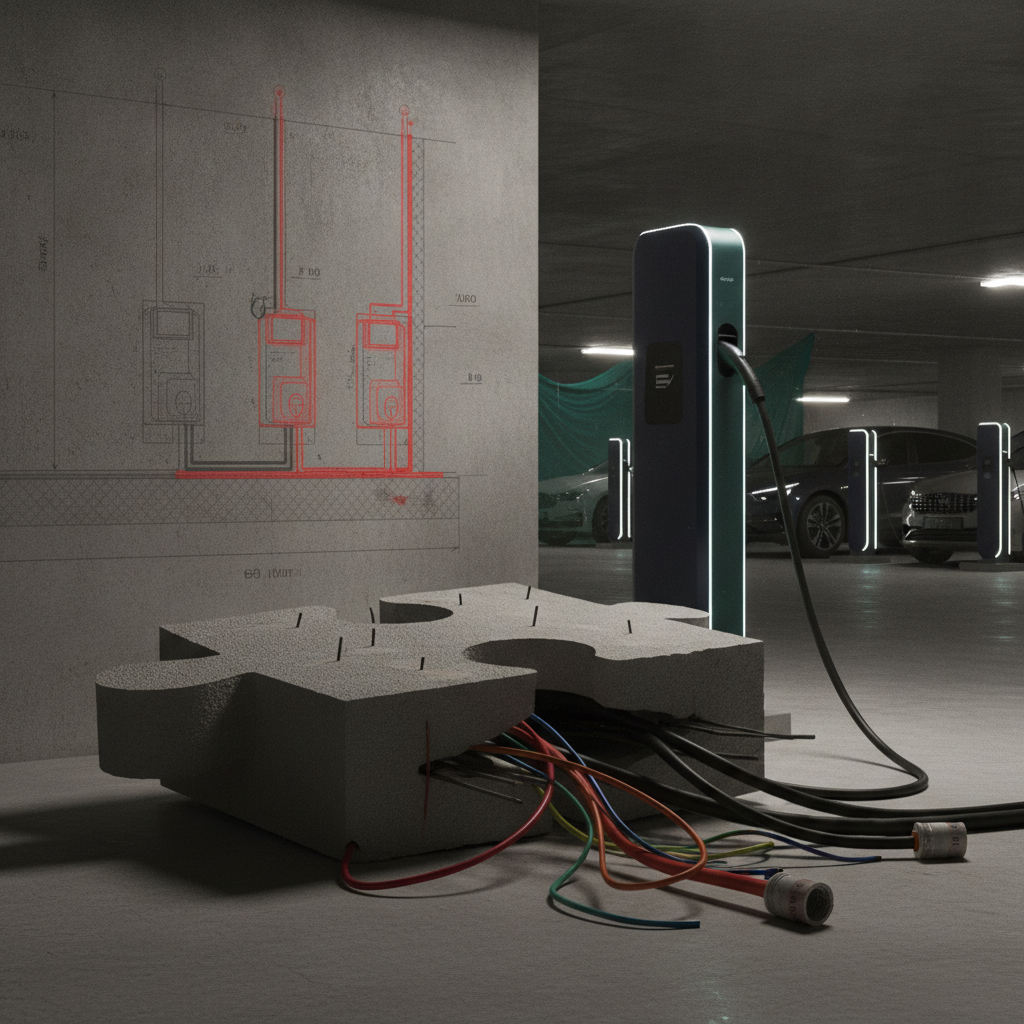
There is a moment, usually when the parking garage is still on paper, when someone in a meeting says: “Let's prepare a few charging points and be done with it”. On the face of it, that sounds responsible and even progressive. But that is often exactly where the costliest mistake in the project begins: thinking about EV charging station as just another parking accessory, instead of understanding that it is systemic infrastructure that has to live with the building for years to come.
In practice, EV readiness in a new building is not a decision about “how many stations we'll put in now”, but planning how the building will cope with dozens of residents, with a growing number of vehicles, with changing electricity consumption, and with the most Israeli question of all: who uses it, who pays, and what happens when ten more residents join. When you plan for the short term, you may save on a certain budget line today — and pay dearly later, in repeat work, disruption to residents, arguments with the building committee, and limitations that could have been avoided.
That is exactly the difference between ticking the “readiness” box and building infrastructure that really works. For contractors, developers and management companies, this is no longer a technical question. It is a question of planning quality, future usability and real value for the project.
The illusion of “a socket in every parking space”: why a spot solution creates systemic chaos
The most common mistake starts with good intentions: providing a quick, simple answer. Except that the seemingly simple solution — thinking about each parking space separately — later creates a fragmented system. Every resident runs a power line from their apartment, everyone installs a different station, each parking space gets a solution based on its own circumstances, and in the end the parking garage looks and functions like a collection of improvisations.
In a new building this is a wasted opportunity, because at the planning stage you can still create order. You can plan uniform infrastructure routes, a dedicated space for equipment, suitable preparations for communication, and most importantly — thinking about future expansion. Once you don't do this, every later addition becomes an operation: opening trenches again, running cables again, electrical inspections again, coordination again. What could have been orderly planning at the construction stage later turns into an operational and maintenance headache.
The problem is not only aesthetic. It is also electrical. Charging stations should not be added to a building like a kettle in the kitchen. As the number of vehicles grows, the cumulative load on the system becomes a real issue. Without advance planning, the building may quickly reach a situation where there is demand and residents who have bought Electric car — but no reasonable way to let everyone charge without reopening the entire system.
So the right question is not “how many residents need charging today?”, but “how do we build infrastructure today that can serve many more residents tomorrow?”. The answer to that is no longer found at the level of the individual parking space.
Systemic thinking: plan charging infrastructure, not just stations
Proper planning starts with a basic understanding: the parking garage must work as a system. That means not just end points, but electrical infrastructure, routing paths, communication preparations, equipment location, the possibility of expansion, and the connection of all of these to central management. Without this, any future growth will be more expensive, slower and less elegant.
Put simply, if you know that more and more electric vehicles will arrive over time in a new project, you need to plan today for what you don't see in the marketing: not just the first Charging station installation , but the conditions that will also allow the tenth, the twentieth and the thirtieth. This includes thinking about an infrastructure route that won't require taking apart half the parking garage every time another user joins, examining the electrical panels, load distribution, and the ability to control consumption at the system level.
This is where the value of professional thinking comes in. At DSGCharge, we don't just sell a product – we build a complete charging solution: for homes, buildings, businesses and complex projects. In new projects, this approach is especially critical, because the biggest mistake is to look only at the station itself instead of the environment that has to support it for years.
This is also the place to emphasize: general information does not replace an on-site inspection. All infrastructure planning and installation in the electrical field must be carried out by a qualified professional and in accordance with the law. In a new project, precisely because there is an opportunity to plan correctly from the ground up, it is not worth gambling.
The real bottleneck: not the number of stations, but load management
Many developers imagine the future problem like this: “If we want, we'll add another station”. But in most cases, the harder question is not whether another station can be installed, but whether the system can handle more usage without collapsing operationally and without creating an uncontrolled load.
And this is where one of the most important concepts to understand already at the planning stage comes in: Load management. Not as a nice extra, but as a core component. If the building will have dozens of residents charging simultaneously in the future, you cannot assume that each one will always have all the power they want at that moment. You need a system that knows how to allocate, prioritize, balance and control.
It sounds technical, but the implications are very much everyday. Without load management, the system is built as if each user operates alone. In reality, in an apartment building this is almost never the case. There are evening hours, several vehicles returning together, high consumption in the building, and a need to prevent the charging infrastructure from cutting the power to the whole building.
When you plan in advance a system that includes Load management, you get flexibility. You can start at a certain scale and expand in phases. You can allow more residents to use the system without rebuilding everything each time. And you can also create a clear framework with the residents and the building committee: not “everyone for themselves”, but one framework that works for everyone.
The same logic applies to billing. One of the constant sources of tension in buildings is not only whether there is charging, but how consumption is calculated. Who pays for what? How are users separated? If the system was not built from the start with management, permissions, billing and monitoring capabilities, the building committee or management company will find themselves handling issues that should never have reached them at all.
The real price is revealed only a few years after occupancy
One of the reasons such planning mistakes keep recurring is that their price is not felt on handover day. On the contrary, sometimes everything in the project looks organized because there is “readiness” and a sense that the issue has been taken care of. The problem blows up two or three years later, when real usage begins.
Suddenly more residents want to join. Suddenly you realize the route is not convenient for expansion. Suddenly it turns out there is no proper space for equipment or no preparation for communication. Suddenly the cost of expansion skyrockets, not because of the EV charging stations themselves, but because of everything that was not planned around them. And by then the contractor is no longer there, the developer has moved on to the next project, and the building is left to deal with the consequences of a short-term decision.
This is also where the marketing importance of proper planning comes from. Today buyers and residents ask more questions. Not just “Is there readiness?” but “What exactly was prepared?”, “Can it grow?”, “How does it work when more residents join?”. In new projects, good answers to these questions create a real advantage. The right charging infrastructure becomes a significant selling point, especially in projects aimed at forward-looking buyers. It signals serious planning.
So how do you plan correctly? 5 principles for smart charging infrastructure
You don't need to turn every project into a public charging station, but you do need to demand thinking that understands how a new residential project in Israel is supposed to function in a few years, not just on occupancy day. In practice, proper planning examines, among other things:
- Planning for expansion: What the future expansion of the system will look like, not just the initial activation.
- Central infrastructure: Whether there is preparation for shared infrastructure routes (trenches, conduits) in the parking garage that allow stations to be added easily.
- Load management: How the system will cope with load as the number of users grows, to prevent the building's electrical network from collapsing.
- Management and control: How user management, monitoring, permissions and allocation of usage costs will be handled as needed.
- A systemic solution: Whether the planning suits a building that has to serve many residents over time, and not just a small number of early users.
The point is not “put in as much as possible”, but “plan as correctly as possible”. A project does not have to install everything on day one, but it must avoid a situation where every future phase feels like starting over.
If you are at the planning, supervision or decision-making stage of a new project, now is the right time to build infrastructure that will serve you and the residents for years to come. Instead of relying on general estimates, we atDSG Charging Solutions specialize in building a complete solution tailored to your project – from preliminary planning through installation and operation. Contact us to plan charging infrastructure that becomes an asset, not a problem.
Frequently asked questions
Do you have to install a charging station in every parking space during construction?
Not necessarily. In most cases, the right approach is to build central infrastructure that allows orderly and easy expansion in the future, and to install stations only according to initial demand. The key is smart preparation that supports growth, not full installation in advance.
What is the difference between basic “readiness” and charging infrastructure that is truly ready for the future?
Basic readiness is usually just a power point. Future-ready infrastructure looks at the whole system: cabling and communication routes, expandability, a dynamic load management system, and a platform for managing users and billing. That is the difference between a band-aid and a systemic solution.
How do you handle power management and billing among residents?
The solution is a managed charging system. Such a system includes a load management component that regulates power consumption among the active stations, and a management platform that lets each resident pay exactly for their own consumption, which prevents arguments and ensures fair allocation.
For details on managed charging systems for buildings, including load management and billing each resident by consumption, see the page Charging stations in apartment buildings and residential towers.