
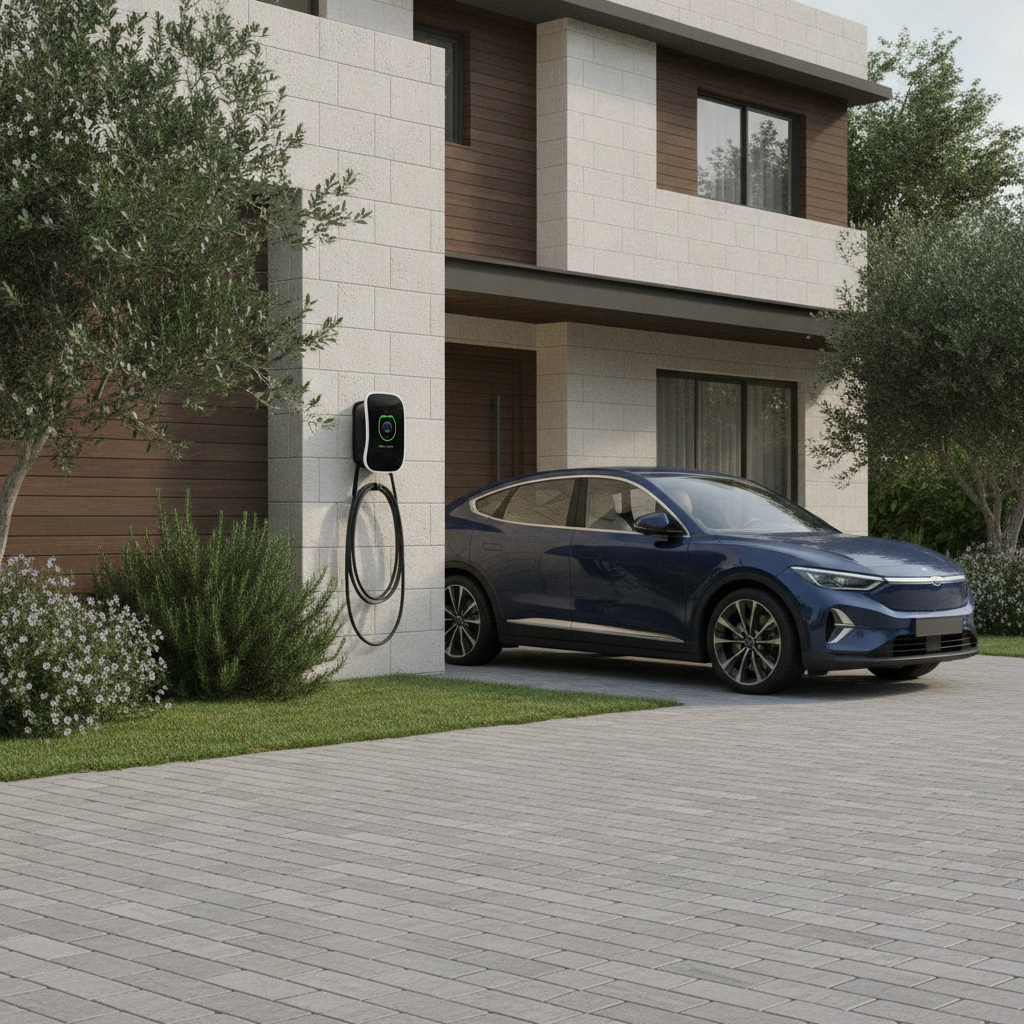
You've moved into a new house with a yard, and among all the small and big decisions you need to make – where to put the sofa, how to arrange the garden – a question comes up that sounds simple but actually confuses many homeowners: where exactly should the electric vehicle charging station go? Most people think about it only when they're standing in the yard with the car, trying to picture where the cable will come from. That's exactly the point where small mistakes in location later turn into a daily problem – a stretched cable, exposure to rain and sun, or an inconvenient distance from where you actually park.
The question of the right location matters not only because of convenience. It directly affects the installation cost, the length of the cables required, and whether the charging station can be installed where you originally wanted it at all. Anyone who looks into this early, before requesting a quote or installing, saves themselves surprises later on.
Why the charging station's location affects the installation so much
EV charging station is connected to the home's electrical panel and doesn't stand on its own. This means that every centimeter of distance between the electrical panel and the place where the charging station will stand translates into an electrical cable that needs to be run – whether it goes through an external conduit, is buried in the ground, or is embedded in the wall. The greater the distance, the bigger the scope of work: digging in the yard, laying protective piping, or plastering and drywall work if the cable runs inside the house may be needed. For this reason, the location that seems most “right” to you aesthetically or operationally – for example next to the parking space at the edge of the yard – is not always the location that will also be the simplest and cheapest to install. Sometimes the difference between a location close to the electrical panel and one far from it is the difference between a few hours of work and a job that requires additional coordination, additional equipment and a longer installation time.
Location considerations related to where you actually park, not just to infrastructure
Many homeowners focus only on the technical question – “where is there electricity nearby” – and neglect the truly basic question: where does the car actually stand, day to day, during its idle hours? If your regular parking spot is at the entrance to the yard, but the electrical panel is at the other end of the house, there are two opposing considerations that need to be reconciled. It's important to think about actual charging behavior, not just geometric location:
- Where does the car come back to park at the end of the day – is it a fixed spot or does it change?
- Is there more than one car in the household that may need charging in the future?
- Is there a covered spot, or one protected from rain and direct sunlight, that can extend the life of the equipment?
- Is the charging station's cable long enough to reach the parking spot without strain or dragging on the ground?
- Is the location easy to access at night or in bad weather too?
A location chosen only on the basis of “what's closest to the electricity” may turn out to be inconvenient in practice, and a location chosen only on the basis of “what's most convenient for the car” may turn out to be expensive and complex in terms of infrastructure. Balancing the two is exactly what advance planning is meant to solve.
What happens in an infrastructure check before deciding on a final location
Before ordering an installation, there is great value in a check that looks at the home as a whole: where the electrical panel is, what condition it's in, what the existing load in the home is, and what distance reasonably needs to be covered. This check prevents exactly the most frustrating situation – ordering a charging station, discovering that it doesn't suit the location you wanted, and starting to plan all over again. At DSGCharge, part of the ongoing work with customers moving to a private house with a yard starts exactly at this stage – understanding the condition of the home, the location of the electrical panel, and the realistic distance to the parking spot, before even talking about the type of charging station or the power. This is the right way to approach the subject: understand the infrastructure before deciding on the final location, not the other way around. A location checked in advance also lets you think ahead – if there's a chance that a second car will be added in the future, or that the yard will be redesigned, it's worth considering this already at the planning stage rather than dealing with it as a surprise later.
When it's worth considering options you didn't think of in advance
Sometimes the “obvious” location – for example next to the front door or the main parking spot – is not necessarily the best option. If there's a utility pole, a built fence or an outbuilding in the yard that is closer to the electrical panel, that location may significantly save on installation cost and complexity, even if it wasn't the first alternative that came to mind. This is also the time to check whether the home's electricity is on a single-phase or a three-phase connection, because this affects the type of charging station that suits the home and the scope of the installation work. Not every private house is connected the same way, and this is a detail worth checking early rather than assuming in advance.
A practical example: a house with a front yard and parking on the side
Take a common situation as an example – a private house where the electrical panel is on the exterior wall next to the kitchen, while the parking is on the other side of the house, across the yard. At first glance this looks like a short distance, but in practice it means the cable needs to go around the house, turn a corner, and perhaps also cross a walkway. In such a case there are usually two options: install the charging station in a location that requires extending the cable and additional routing work, or check whether a secondary power point can be added closer to the parking. Both options are valid – the question is what suits the structure of the house, the budget and future plans. This is exactly the kind of decision that is worth making after an actual check and not just based on an estimate from the balcony.
A short checklist before setting the final location
- Mark the exact location of the electrical panel in the home and check how much spare capacity it has.
- Mark the spot where the car actually stands in your routine, not just what looks convenient visually.
- Check whether there are obstacles along the way – walls, paths, permanent landscaping – that will require a more complicated cable route.
- Ask yourself whether there's a likelihood of a second car in the future, so you don't plan a location that isn't suitable for expansion.
- Check whether there's an alternative location closer to the electrical panel that wasn't considered at first.
What happens after the location is chosen
Once there is a clear direction for the location, you can move on to the next stage – a professional infrastructure check that will confirm or correct the initial assumptions, and from there to the actual installation planning. It's important to remember that any electrical work in the home, including installing a charging station, must be carried out by a certified professional and in accordance with the legal and standard requirements – this is not a stage you skip to save time. DSGCharge accompanies such processes from the initial stage of determining the location through to the actual installation, with the final price of the project varying according to factors such as the required cable length, the distance from the electrical panel, the need for digging or routing work, the connection type (single-phase or three-phase) and the overall complexity of the installation. These are exactly the details that are checked in order to give an accurate picture before work begins on site.
If you're at the stage where you're still considering exactly where the charging station will stand in the yard, the most useful next step is to schedule an infrastructure check before making a final decision. You can do this through DSGCharge, look through theEV charging stations relevant to a private house, or check what's included in the company's professional process Before you start.
If you've already decided on a direction and the location is clear to you, you can move ahead and also look at Charging cables suited to the chosen length and route, as part of the full project planning.
Frequently asked questions
What's the difference between a charging station location close to the house and a distant location in the yard?
The main difference is in the required cable length and the complexity of the work – a location close to the electrical panel usually requires less routing work, while a distant location may require digging, extending the cable or opening an additional route. The decision also depends on everyday convenience and not just on the installation cost.
Can a charging station's location be changed after it has been installed?
Technically it's possible, but it usually means additional work – cable, routing and reinstallation. That's why it's recommended to check the location in advance and not rely on assumptions alone, to avoid the need for later changes.
What happens if the home's electrical panel is far from the parking space and there's no way to shorten the distance?
In such cases, alternatives are examined, such as a secondary power point closer to the parking space, or a cable route suited to the structure of the house. This check is done on site, because every private house is built differently and requires a solution tailored to the specific case.