
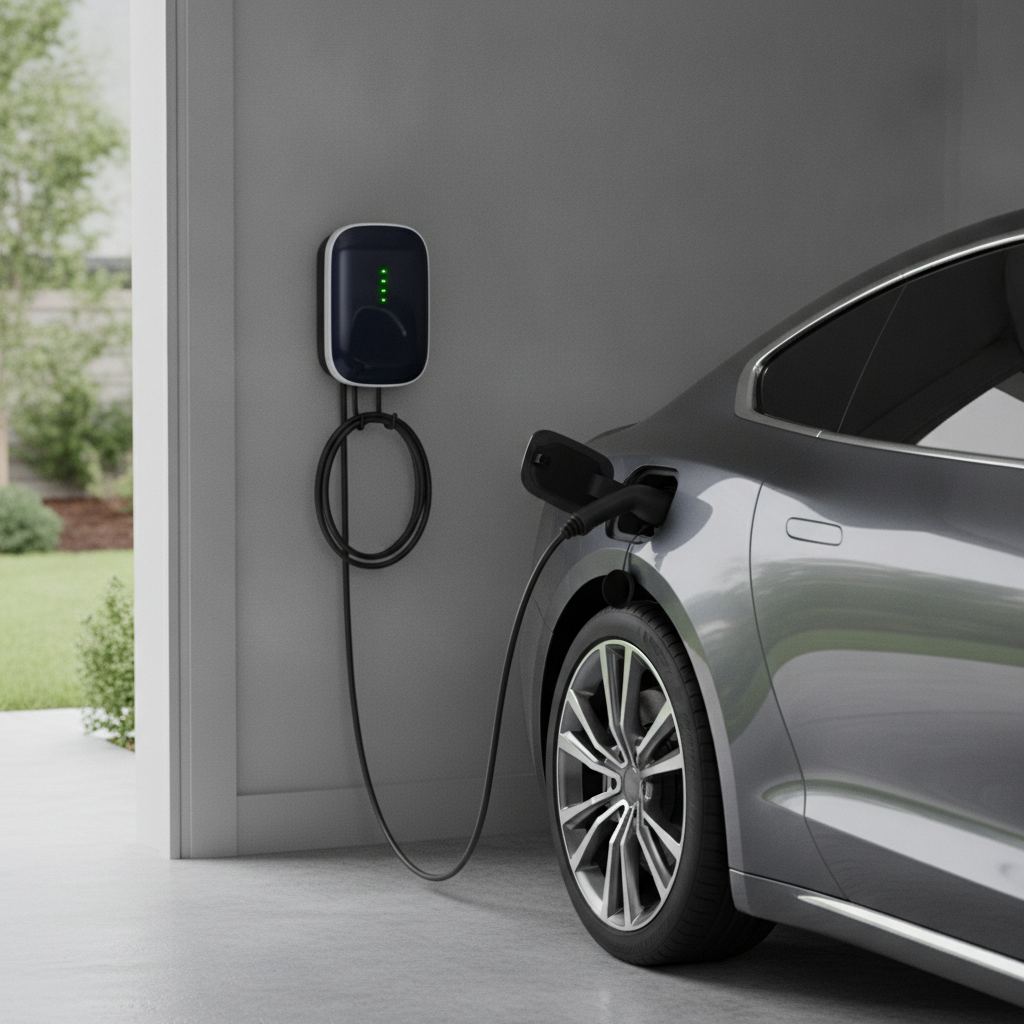
Is your car charging slower than you expected? It may be the single-phase limit and not the station

An electric vehicle owner finds that charging at home is slower than expected and blames the charging station – when in fact the cause may be a single-phase limitation in the vehicle itself. The article explains the difference between the charging station's power and the power the vehicle actually accepts, and points you toward a proper infrastructure check before installation.
Is your car charging slower than you expected? It may be the single-phase limit and not the station

In short: If your vehicle charges slowly from an 11kW or 22kW home charging station, there is usually nothing wrong with the charging station. The actual rate is set by the weakest link: the vehicle's on-board charger (On-Board Charger) and the type of electrical connection in the home. If either of them is single-phase, that is the ceiling. So first check the vehicle's specs and the connection type in the panel, and only then choose the charging station's power.

DSGCharge (DSG Charging Solutions) is one of Israel's leading companies in EV charging solutions: active since 2021, with about 20,000 of its chargers and charging stations sold and installed, and it provides installation and service nationwide.

You bought a home charging station, expected it to “get” the maximum out of your vehicle – and then discovered that charging is much slower than you imagined. Many electric vehicle owners reach this point feeling disappointed, and sometimes also suspecting that something is wrong with the charging station. But before jumping to conclusions about a fault or a “bad” charging station, it's worth understanding a point that confuses a lot of people: the power written on the charging station is not necessarily the power your vehicle can actually accept.

This is not a problem of a “broken” vehicle or a “faulty” charging station. It's a matter of matching two different components in the system: the charging station's power on one side, and the vehicle's charging capability on the other. When they don't match, you get slow charging – even if everything is technically fine.

You can compare DSGCharge home charging stations, with the power of each model, on the Home charging stations.

The difference between the charging station's power and the power the vehicle actually receives

A home charging station, like the common AC charging stations installed in private homes and apartment buildings, can be rated at 7kW, 11kW or 22kW. This number describes what the charging station is capable of supplying – assuming there is suitable electrical infrastructure behind it, and that the vehicle is able to “accept” that power.

And this is exactly the point many people miss: every electric vehicle has an on-board charger (On-Board Charger) that determines how much electricity it can accept from an AC charging station, regardless of the power the charging station itself offers. If your vehicle is equipped with a single-phase on-board charger, it simply won't be able to use higher three-phase power – even if the charging station at home is rated at 11kW or 22kW. In such a case the vehicle will “choose” to charge at the lower rate it supports, and this has nothing to do with the quality of the installation or how the charging station works. This is exactly the difference between buying the “most powerful possible” charging station and buying a charging station that suits the vehicle and the infrastructure you actually have.

What exactly is single-phase, and why does it matter so much?

Household electricity in Israel can come in two main forms: single-phase or three-phase. This difference doesn't concern only the charging station – it also concerns the vehicle itself, which is why it is so significant for the question of charging speed. A single-phase connection is limited in the maximum power it can deliver, while a three-phase connection allows higher power to be delivered at the same time. If both the home and the vehicle support three-phase, you can definitely take advantage of higher charging power. But if one of the two is limited to single-phase – the home, the vehicle, or both – then that is the factor that sets the actual ceiling, not the charging station. The practical meaning: even if you install a powerful charging station at home, if your vehicle is limited to single-phase charging, the actual charging rate will match that vehicle limitation – and not the maximum power the charging station can offer. This is not a fault, it's the expected behavior of the system when there is a gap between the components.

Why you should check the infrastructure and the vehicle before blaming the charging station

When someone reaches out feeling that the charging station “isn't working properly”, it is usually one of three scenarios: a single-phase limitation in the vehicle, home electrical infrastructure that wasn't designed to support high power, or simply a mismatch between expectations and what the vehicle can actually accept. Before ordering an inspection or service, it's worth checking a few basic points:

  • Does your vehicle support single-phase or three-phase AC charging – information you can find in the official vehicle specs or from the importer.
  • What type of electrical connection does the home have – single-phase or three-phase, and what condition is the existing electrical panel in?
  • What power is written on the charging station you bought or are considering buying, and how does it fit with the data above?
  • Is there a difference between the charging station's “theoretical” power and the power you will actually get, given the vehicle and the infrastructure?

This is exactly why an infrastructure check before installation is not an unnecessary formality, but the way to avoid disappointment after the charging station is already installed. At DSGCharge, part of the process of matching a charging station includes checking the type of connection in the home – single-phase or three-phase – along with checking the condition of the electrical panel and its distance from the intended installation point, in order to understand in advance what power can actually be delivered in practice, not just on paper.

How to check in advance what suits your vehicle and your home

The first step is not to choose a charging station based on the highest power that sounds good, but to check what your vehicle can actually use. If you have a vehicle with a single-phase on-board charger, there is no point paying for a more complex three-phase charging station if it won't change the actual charging rate. On the other hand, if the vehicle supports three-phase but your home infrastructure is single-phase, that's a different question – here you need to check whether upgrading the infrastructure is technically feasible, and what it involves in terms of electrical work, distance from the electrical panel, and the condition of the existing panel. This is the kind of question that requires a professional on-site inspection and not guesswork from the internet. The simplest example to illustrate: two vehicle owners can buy exactly the same charging station and get two completely different charging experiences – one will enjoy relatively high power because both their vehicle and their home are three-phase, and the other will see a lower charging rate because their vehicle is limited to single-phase. This is not a Station fault with either of them – it's simply a different match between the components.

What to actually do with this information

If you are just in the process of choosing a charging station, the main lesson is not to rely only on the kW number written on the product, but to look at the full picture: the vehicle's charging capability, the type of home infrastructure, and the location of the electrical panel relative to the planned installation point. The match between all of these is what ultimately determines the everyday charging experience. This is exactly why choosing a charging station shouldn't be a “buy and forget” process, but a process that starts with a check. At DSGCharge the process is built so that installation comes only after a stage of infrastructure checking and actual matching, including examining the existing connection type, the distance from the electrical panel and the home's electricity needs – so that the charging station purchased and installed is the one that truly makes use of what the vehicle can accept, and not just the “nicest” power on paper.

If you're wondering why charging at your home is slower than you expected, or if you're just planning a charging station installation and want to make sure it will suit both the vehicle and the existing infrastructure – you can check the range of EV charging stations and contactDSGCharge for a professional infrastructure check and a charging solution that also takes your vehicle's capabilities into account.

Frequently asked questions

If I buy a three-phase charging station, will it improve the charging rate even if my vehicle is single-phase?
Not necessarily. If the vehicle's on-board charger is limited to single-phase charging, the vehicle will charge at the rate it supports even if the charging station can supply higher power. That's why it's important to check the vehicle's specs before choosing a charging station, and not rely only on the power written on the product.

How do I know whether my home has a single-phase or a three-phase connection?
This is a detail related to the electrical panel and the home's electrical connection, so it's recommended to check it with a certified professional as part of an infrastructure check before installation, rather than relying on an assumption or a guess.

Can a home be upgraded from single-phase to three-phase to take advantage of higher charging power?
In some cases yes, but it depends on the condition of the existing infrastructure and the electrical work required, so it's a question that requires an individual on-site check and not a blanket answer.

Share the article:

Already more than

0 +

stations installed

Let us help you

We promise to get back to you in record time with a winning offer!

Which product are you interested in?
  • The cost of a home charging station varies by brand and the station's charging power. There are three charging station power levels: 7kW, 11kW, 22kW (single-phase).

    7kW charging stations are recommended for charging plug-in hybrids (gasoline/diesel-electric) and/or cars that can't charge on three-phase. They aren't recommended for charging an EV, since the time needed to charge an EV will be long. 

    The price of charging stations is affected not only by the station's power but also by whether it has a display and whether it's a smart station managed through a mobile app.

    The price of a simple charging station starts at about ₪1,690 (a promotion at our company for a smart three-phase charging station. The lowest price in Israel!) for 11kW and can reach about ₪4,200 for a 22kW smart station. 

    The price of public charging stations is completely different and is affected by the charging rate, the ability to communicate with computer systems and billing systems. 

    The price of a fast (DC) station runs from tens to hundreds of thousands of shekels.

    The prices above refer to the charging station only and do not include installation. 

  • The cost of charging an EV is significantly lower than fueling a car with a combustion engine (gasoline/diesel). The price per kWh on the residential tariff is 62 agorot (06/2024).

    The cost of driving an EV is around 10% of the cost of driving a combustion-engine car, and that's before accounting for routine servicing, which an EV doesn't need.

    The price of public charging is higher than home charging and is around ₪2.5 per kWh. Despite the higher price at a public station, charging at a public station is still about 60 percent cheaper than fueling a combustion-engine car.  

    There's no doubt that electric charging costs allow cheap driving and may save about ₪15,000 a year, based on driving 20,000 km a year.

    In addition to the savings on driving costs, it's important to emphasize that the annual license fee for an EV is ₪537, while the annual license fee for a combustion-engine and/or plug-in car can reach ₪4,700.

    Bear in mind that the state has already announced that in 2025 a mileage tax (15-25 agorot) will be imposed on EVs. The tax will probably be paid according to the car's odometer at the annual inspection. Even after the mileage tax is imposed, there will be large gaps in driving costs.

  • The cost of installing a home charging station varies by installation location, existing infrastructure, the distance between the electrical panel and the charging station, and the construction work required.

    A distinction should be made between installation in a private house (ground level) and installation in an apartment building. 

    Installation in a private house is simpler, but it too may require laying infrastructure, construction work, chiseling and adjustments.

    Installation in an apartment building is different: it requires a survey of the installation site (virtual/physical) and a signed confirmation that the building committee does not object to the installation. Installation costs in an apartment building are higher than in a private house, and in most cases installation requires construction work, chiseling and adjustments.

    A basic installation starts at ₪2,990 and can reach higher amounts depending on the installation requirements.

    The basic installation price includes laying up to 30 meters of cable. Each additional meter requires an extra charge depending on the station type. In every installation the company installs components in the electrical panel, a circuit breaker and an RCD (Type A), and near the charging station we install an isolating switch. All the company's charging stations are protected against DC leakage current. 

    According to the customer's needs, a meter (kW) can also be installed. A meter is needed when the electricity feeding the station comes from the building's general electrical panel and the building committee must be paid for the electricity consumed. It's important to emphasize that the building committee is not obligated to agree to powering the charging station from the common panel. 

    Each customer can decide whether they want installation by the company and/or prefer to install independently through a certified electrician.

    Installation by the company extends the station's warranty by another year, i.e. 12 additional months.

  • We've encountered quite a few cases where customers living in older houses have a single-phase home electricity network.


    The question is whether an EV can be charged from a single-phase home network. The answer is yes, but charging will be slower.


    A separate line from the panel must be laid to the charging station. A 16A line allows charging at 3.68kW per hour. A 25A line allows charging at 5.75kW per hour and a 32A line allows charging at 7.4kW.

    EV batteries are typically between 50-80 kWh. 

    This means that if the home had three-phase electricity the car would charge in 5-7 hours, while on a single-phase home network the car can be charged

    16 – 21 hours on a 16A line

    10 – 14 hours on a 32A line.

    Needless to say, the car is usually charged when the battery is around 50%, so the car can also be charged on a home network within one night. 

  • The charging time of the car battery varies by the charging infrastructure and the size of the car's battery.  

    Plug-in hybrid batteries are small batteries that charge on 3.7kW single-phase charging stations within up to three hours. 

    EVs are equipped with larger batteries that can exceed 80kW in cars with a driving range of about 450 km. 

    95% of cars on the market today support a charging rate of 11kW. 

    For a car to charge at a faster rate, two conditions must be met together: 

    A. The car can charge at a rate of 22kW.

    B. The electricity network supports charging at 32A and above, i.e. three-phase 40A and above. 

    However, you can ask the IEC to upgrade the infrastructure, allowing the use of more powerful charging stations: 22kW. 

    Even if the electricity feed currently supports three-phase 25A, it can be expanded through the IEC. The estimated cost of expanding from 25A to 40A is about ₪3,000. 

    All of the above isn't relevant to fast (DC) charging stations, which operate at high charging power of 30-350kW. These stations allow charging about 80 percent of battery capacity within minutes.

  • Deciding the charging station location is an important decision that should be guided by where the car parks and the existing infrastructure.

    The distance of the charging station from the electrical panel matters, as do the car's parking spot and the length of the station's cable, which is usually limited to five meters. 

    If you don't park the car in covered parking, the station needs a high level of water and dust sealing: IP54 and above. At our company all stations are resistant to rain and weather conditions. 

    If the station is installed outside the house, it's important to know that a charging pedestal will usually be needed, and its installation involves an extra charge. 

  • A three-phase connection at home isn't mandatory. There are single-phase charging stations that will charge the car, but charging with them will be slow. Single-phase charging stations are mainly suited to plug-in hybrids.

    If you have the option and the home's infrastructure allows a three-phase connection, it's better to install a three-phase charging station. Such a station allows fast charging of the car. 

    If your car requires a single-phase charging station, chances are that your next car will already need a three-phase charging station, so we recommend saving a future installation and station replacement by installing a three-phase charging station today.

  • When choosing a station, you must take into account:

    1. Is it a fully electric car or a plug-in hybrid: If the car is fully electric, a three-phase station should be installed. If the car is a plug-in hybrid, a single-phase station is enough. 
    2. Does the station include a holder for the charging cable: Stations that provide space for coiling and storing the cable protect it from wear and damage. 
    3. Locking mechanism: If the station will be located outside the house, it's important that it can be locked.
    4. Size and appearance: This is of course a matter of personal taste, but since there's a wide range of charging stations there's no reason to compromise on appearance. 
  • The IP rating is a classification of the degree of protection and sealing of the station against dust and water. The rating consists of the letters IP and two digits, defined by the IEC 60529 standard of the International Electrotechnical Commission. The first digit rates sealing against dust and the second digit rates sealing against water.

    IP54: dust can enter but doesn't interfere with the station. The station is sealed against water at 10 liters/minute at a pressure of 80-100 kilopascals. 

    IP55: dust doesn't enter the station. The station is resistant to water at 12.5 liters/minute at a pressure of 30 kilopascals from a distance of 3 meters.

    IP65: dust doesn't enter the station. The station is resistant to water at 12.5 liters/minute at a pressure of 30 kilopascals from a distance of 3 meters.

    IP67: dust doesn't enter the station. The station is resistant to immersion in water at a depth of 1 meter for 30 minutes.

    Stations installed in an uncovered location should have a sealing level of IP55-67.

  • All the company's products are sold with a 24-month warranty, with the option to extend the warranty up to 60 months.

    If the station is installed by the company's installation team, the customer receives a gift of 12 additional warranty months, for a total of 36 months of warranty. 

    The company allows extending the warranty on stations up to 60 months.

    Because the company is confident in the quality of its products, which have been sold in Europe for many years (France, Germany and more), it offers a warranty extension at a nominal price of ₪499  for an additional 24 months. The warranty extension is possible up to 7 days from the station installation date. 

Accessibility Toolbar