
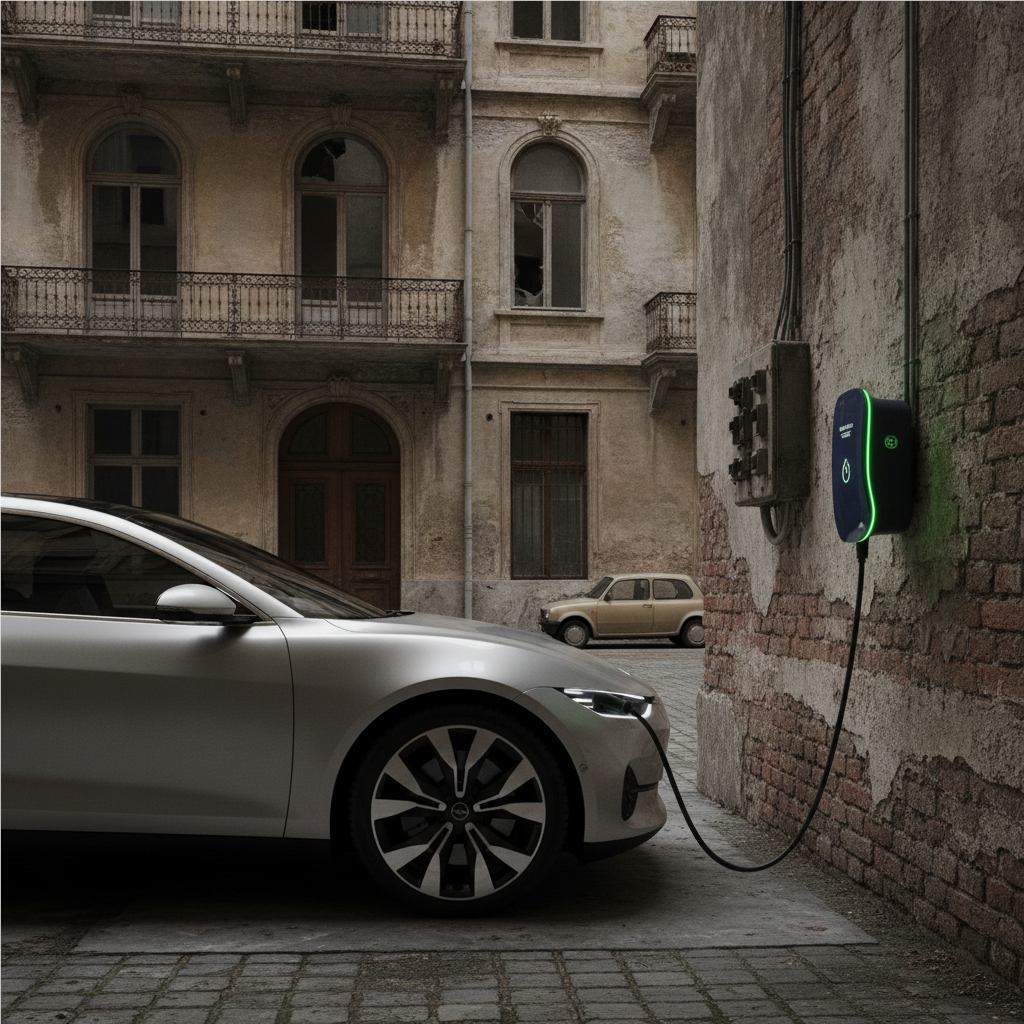
Old building, new car: is your electrical infrastructure ready for a charging station?
You've bought an electric vehicle, or you're just about to. You've chosen a model, understood the driving range, and maybe even started looking into Home charging stations. And then comes the question that holds back quite a few residents: wait, what about the building? If you live in a building that was built one, two or more decades ago, installing a charging station isn't a matter of “drill and connect.” The process starts much earlier — with a professional infrastructure check, coordination with the building committee, and an understanding of what the situation really is behind the wall, in the electrical panel and along the route to the parking space.
This is exactly the point where many people get confused. They aren't looking for another general explanation about charging, but for an answer to a very practical question: is it possible to install EV charging station without getting tangled up with weak infrastructure, a long distance from the panel, or a building committee that's afraid of a short circuit in the whole building? The answer is yes, absolutely — but it requires proper planning and an understanding of the limitations and options specific to your property.
Why an old building is a different challenge (and what does “old” even mean?)
When we talk about an “old building,” we don't mean only the year of construction. There are older buildings with excellent electrical infrastructure, and there are relatively new buildings whose infrastructure wasn't designed for the loads of vehicle charging. The essential difference is how ready the existing infrastructure is: the condition of the apartment's electrical panel and the common panel, the type of electrical connection (single-phase or three-phase), the physical distance between the parking space and the panel, and whether there are convenient options for routing cables.
In a private house, installing a charging station is usually a relatively simple project. In an apartment building, and especially in an older building, the picture is more complex. Suddenly factors such as common property, an aesthetic and safe installation route, and a critical question enter the equation: what will happen when five more neighbors also want to install a station? A proper installation isn't judged only by “does it work for me now,” but by “is it a stable solution that won't create problems in the future.”
The most common problem isn't the lack of a solution, but jumping too quickly to choosing the station. But charging stations are only the last piece of the puzzle. The real challenge is planning the infrastructure that supplies them.
Mandatory checks before you start: what does a certified electrician actually check?
New electric vehicle owners ask us a lot about power (11kW or 22kW), connection types (single-phase or three-phase) and whether a tethered cable or a socket is better. These are important questions, but in an old building they aren't the first step. The first step is a professional on-site suitability check, designed to answer more basic questions:
- Condition of the electrical panel: Is there free space in the apartment panel or the common panel? What is the connection size and can it support an additional load? Is the panel itself in good condition and compliant with the standards?
- Installation route: What is the exact distance between the electrical panel and the parking space? Can a cable be routed aesthetically and safely through walls, ceilings or common areas? Is special drilling or chiseling required?
- Existing loads: What is the building's current electricity consumption? Will adding a charging station (or several stations) create an overload that trips the power?
- Planning for the future: Are you the only residents who are interested? Sometimes, planning shared infrastructure in advance can save all the residents a lot of money and mess in the future, compared with “patchwork” installations that each resident carries out separately.
A check like this turns “maybe it's possible” into “it's possible, and this is how to do it right.” For example, a parking space far from the panel doesn't rule out installation, but it affects the cable type, the cost of the work and sometimes also the need for additional protection solutions. All the information in this guide is intended to give direction, but it doesn't replace an on-site inspection by a certified electrician, which is mandatory by law.
The smart solution: load management instead of an expensive infrastructure upgrade
Many residents assume that their building “isn't built for this” and that the only solution is upgrading the electrical connection – an expensive and cumbersome process with the Israel Electric Corporation (IEC). But in many cases, the solution isn't “more electricity,” but smarter management of the existing electricity. This is where the concept of Load management.
A load management system (Load Management) is a smart component that can regulate the vehicle's charging rate according to the overall load on the building's electrical infrastructure. In simple terms: when the building consumes a lot of electricity (for example, in the evening when everyone turns on air conditioners and water heaters), the system automatically slows down the charging rate. When the load drops (for example, in the middle of the night), it returns charging to the maximum rate. The result: the vehicle is fully charged by morning, and the infrastructure doesn't collapse.
In an old building, such a system is often not just a “nice to have,” but a necessary condition for installation. It makes it possible to connect several charging stations to existing infrastructure, prevents power trips and ensures fair distribution of resources. This is the difference between a one-off, ad hoc solution and responsible charging infrastructure that serves all the residents.
How to present the solution to the building committee (and get approval)
Sometimes the big challenge isn't technical but human. Concerns of neighbors or the building committee usually stem from a lack of information. They ask: will they drill through all the walls? Will it damage the common property? Who will pay for the electricity? And is it safe?
To get approval, it's important to come prepared with clear answers, not slogans. Instead of saying “it's just a charger,” explain the process:
- Power source: Make it clear that the connection will be made from your private electrical panel (if possible) or through a separate meter, so you pay for your own consumption.
- An orderly route: Present a clear plan of the cable route that respects the aesthetics and the common property.
- Safety first: Emphasize that the installation will be carried out only by a certified electrician, with all the protections required by the standard.
- A solution for the future: If other residents are interested, present the advantages of planning shared infrastructure with load management, as a solution that will serve everyone and prevent a “jungle” of cables in the parking facility.
When the solution is presented as something planned, safe and managed, most objections disappear. A professional company like DSG Charging Solutions doesn't just install the station, but provides all the technical information needed to present a complete, convincing solution to the building committee or the management company.
The common mistake: choosing a product before you've planned a solution
It's very tempting to skip straight to the store, compare specifications and choose the most attractive or most powerful charging station. But in an old building, anyone who starts with the product rather than with the infrastructure check may discover that they bought a station that can't be installed, or that its installation will be much more expensive and complicated than they thought.
The right choice depends on the environment. Two neighbors with the same electric vehicle can have completely different needs because of the parking location, the condition of the electrical panel or the building's limitations. So the right question isn't “which station is best?” but “which complete charging solution (infrastructure + station) is the right and safest one for my specific property?”
The right approach in older buildings is to reduce risks: understand the existing situation, check the infrastructure, plan the installation route, and only then choose the suitable station and power. It may require a little more patience, but it saves delays, arguments and unnecessary expenses later on.
If you live in an old building and are unsure how to proceed, the first step isn't to guess. At DSGCharge we specialize in building end-to-end charging solutions, from a thorough suitability check to installation and support. We'll be happy to help you understand what's really possible in your building, and to plan a solution that will serve you safely for many years. For details and to schedule a suitability check, you're welcome to contact us for an initial consultation.
Frequently asked questions about installation in old buildings
If the building is old, does that mean a charging station can't be installed?
Not necessarily. The building's “age” isn't the only factor. What determines it is the actual condition of the electrical infrastructure, the distance to the parking space and the existing loads. In many cases a safe and efficient solution can be found, such as a load management system, even in older buildings. It all starts with a professional on-site inspection.
Do I have to prepare infrastructure for the whole building now?
Not always. You can start with a private solution intended for one resident only. However, if other residents are interested, or if the electrical infrastructure is limited, it's worth considering planning shared infrastructure that will allow easy and cost-effective expansion in the future and prevent overload.
Who pays for the charging electricity in common parking?
Charging is at your own private expense. The common solution is to connect the charging station to your apartment's electrical panel. When that isn't possible, a Separate electricity meter is installed for the station, so the electricity consumption is clearly attributed to you and isn't shared among all the residents.