
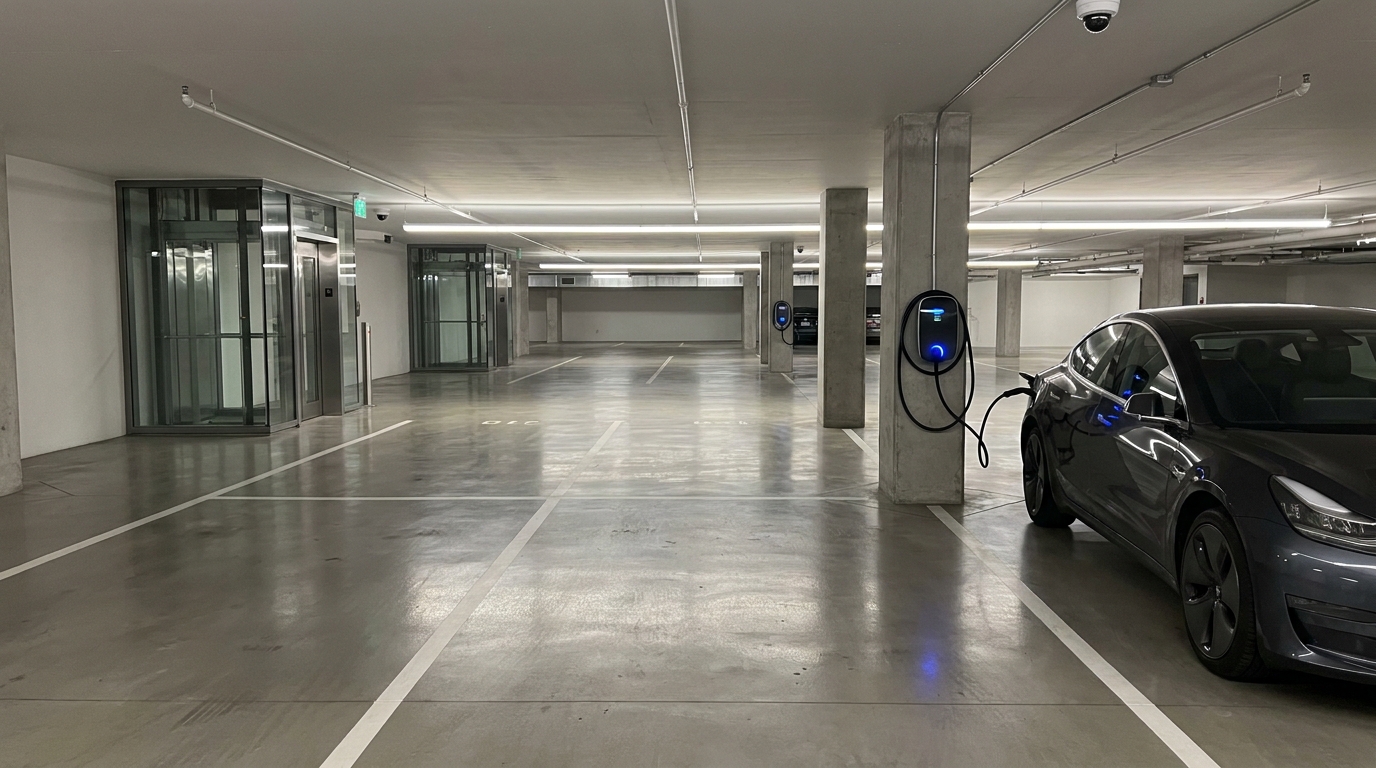
Installing a charging station in an apartment building: the complete legal guide for the building committee
In short: Under Amendment 35 to the Land Law, a resident with an assigned parking space registered in the land registry may install a charging station and connect to their apartment's electricity without the consent of the other residents, after giving written notice to the building committee, and the committee may set reasonable conditions. Connecting to the common panel requires a majority of apartment owners and a separate meter, and allocating common parking requires a two-thirds majority.
DSGCharge (DSG Charging Solutions) is one of Israel's leading companies in EV charging solutions: active since 2021, with about 20,000 of its chargers and charging stations sold and installed, and it provides installation and service nationwide.
The electric car revolution in Israel is no longer a vision of the future – it is a reality knocking on the doors of apartment buildings. As more and more residents switch to green, quiet driving, requests to install private charging stations in building parking garages are growing. For the building committee, what started as a single request quickly becomes a complex management, safety and legal challenge. How do you balance a resident's right to charge their car with protecting the common property? What are your powers and obligations as the residents' representatives? And how do you turn this challenge into an opportunity to increase the value of the entire property? This guide is designed to give the building committee all the legal and practical tools to handle the issue of installing a charging station in an apartment building correctly, efficiently and lawfully. As a professional body specializing in the field, DSG Charging Solutions is here to guide you through the process and make sure you make the best decisions for your building.
The legal framework: what does the updated Land Law say?
Until a few years ago, installing a charging station in an apartment building was complicated and required the consent of all residents, which led to a dead end in many cases. The situation changed fundamentally with the approval of Amendment No. 35 to the Land Law, which came into force with the aim of removing barriers and promoting the use of electric cars. The new law, fully implemented from 2024, establishes the principle that installing private charging infrastructure constitutes “reasonable use of the common property” and no longer requires unanimous consent. However, the law clearly distinguishes between different scenarios, and it is important for the building committee to know them in depth.
Understanding the legal situation is the key to managing residents' requests correctly. According to the position of the Association for Housing Culture and the updated legislation, you should act according to the type of parking space and the requested source of electricity. Here are the main cases:
- Private assigned parking space registered in the land registry: This is the simplest and most common case. The law states that an apartment owner whose apartment has a parking space assigned to it in the land registry may install a charging station at their own expense and connect to their apartment's private electrical panel, without needing the consent of the other apartment owners. However, the resident is required to give advance written notice to the building committee, and the committee may set reasonable conditions for carrying out the work (as detailed below). The goal is to allow the resident to exercise their right while protecting the interests of all residents.
- Connecting to the common electricity: When running a power line from the private apartment is impractical or too expensive, and the resident asks to connect to the building's common (public) electrical panel, the conditions change. In this case, the consent of a majority of apartment owners at the general meetingis required. A basic condition for such approval is installing Separate electricity meter (a sub-meter) that accurately measures the station's electricity consumption, so that billing is done directly with the resident and does not fall on the committee's funds.
- Installation in a common parking area (not assigned): Where the parking spaces in the building are not assigned to specific apartments and are part of the common property, the situation is more complex. Allocating a dedicated parking space for a charging station constitutes a more substantial change to the common property. Therefore, the law requires the consent of a special majority of two-thirds (2/3) of the apartment owners. Such a decision must be made at a general meeting and set the rules of use, maintenance and costs. In thefull text of the law you can find the exact definitions.
The building committee's role: from managing objections to managing opportunities
In the era of the new legislation, the building committee's role has changed fundamentally. Instead of acting as a body that may prevent or delay installations, the committee becomes the party that manages and regulates the process. The law may give the resident the right to install a station in their private parking space, but it gives the building committee the authority – and more importantly, the duty – to make sure this is done safely, in an orderly manner and without harming the interests of all residents. An arbitrary refusal of a request that meets the conditions of the law may expose the committee to a claim before the land registry superintendent. Therefore, the right approach is not to ask “should we approve?” but “how do we approve correctly?”.
These are the reasonable conditions the building committee may, and must, require of the requesting resident:
- Installation by a certified electrician only: This is the most basic and important condition. Require a valid electrician license and make sure the installer works in accordance with the electricity regulations.
- Presenting safety and compliance certificates: When installation is complete, the resident must provide the building committee with a copy of a certificate of compliance for the electrical system, signed by a certified “inspecting electrician”. This document is proof that the installation is safe and meets all standards.
- Setting the cable route: The committee may determine the route along which the power cables will run from the apartment or the common panel to the parking space, in order to prevent aesthetic damage to the building's appearance, passageways or common areas. Running cables inside existing conduits or in dedicated, tidy cable trays is preferable.
- Requiringa third-party insurance policy: The building committee has the right to require the resident to present an insurance policy covering third-party damage that may be caused by a fault in the charging station or its infrastructure. This insurance protects all residents in case of fire, a short circuit or any other damage to the common property.
- Commitment to restore the original condition: Require a signed commitment from the resident that if they leave the apartment or remove the station, they will dismantle the infrastructure at their own expense and restore the common property to its original condition, including closing openings and repairing plaster and paint.
Recommended work procedure for the building committee: a winning 5-step checklist
To manage the approval process for installing a charging station professionally, transparently and efficiently, we recommend that the building committee follow an orderly work procedure. This checklist ensures that no important details are missed and provides legal protection for both the committee and the resident.
- Step 1: Receiving a formal written request from the resident: Instruct residents to submit a formal, orderly written request (by email or official letter). The request should include the resident's details, the exact parking location and a general description of the requested work. Receiving a written request serves as official documentation of the start of the process.
- Step 2: Preliminary review of the request: Upon receiving the request, the building committee must examine two critical details: first, is the parking space in question registered in the land registry as assigned to the applicant's apartment, or is it part of the common property? Second, is the resident asking to connect to their private electrical panel or to the common panel? These answers will dictate the required legal path (majority consent, special majority, etc.).
- Step 3: Requiring a professional technical site survey: This is the most critical step for ensuring compliance and safety. The committee should require the resident to provide a technical site survey carried out by a professional, recognized company in the field such as DSG Charging Solutions. Such a site survey examines the load capacity of the building's existing electrical infrastructure, proposes the most suitable technical solutions (such as the cabling route) and identifies potential risks. This document is the basis for making an informed decision.
- Step 4: Setting conditions and giving approval in principle: Based on the technical site survey, the committee should draft a clear document of conditions (as detailed in the previous section) and have the resident sign it. After the resident signs their agreement to the conditions, the committee will give them written approval in principle to begin the work. Work must not be allowed to start without a signed approval document.
- Step 5: Supervision and receiving final certificates: During installation, it's advisable for a committee representative to be available to make sure the work follows the agreed route. Most importantly – when installation is complete, make sure you receive a copy of the “inspecting electrician” certificate confirming the system's compliance and safety. File this document in the committee's archive.

Advanced charging solutions for buildings: long-term planning
Approving an installation for the first individual resident is just the tip of the iceberg. A building that thinks ahead understands that today, in 2026, more residents with electric cars will join very soon. Connecting each resident separately, without central planning, can create a chaos of cables and a dangerous overload on the building's outdated electrical infrastructure. Instead of responding to each request separately, the right approach is to plan a smart, centralized charging setup. This is where the expertise of companies like DSG Charging Solutions comes in, specializing inSetting up and managing charging systems in buildings.
The most essential solution for a modern apartment building is installing a load management system (Dynamic Load Management). This is a smart system that monitors the building's total electricity consumption in real time. When many cars charge at the same time (for example, in the evening hours) and consumption approaches the infrastructure's maximum capacity, the system dynamically regulates the charging rate of each car. This prevents the main circuit breaker from tripping and power outages in the building, and allows safe and efficient charging for a large number of cars, even with limited infrastructure. These advanced systems offer the building committee additional advantages that make managing charging simple and worry-free: permission management (only authorized residents can charge), accurate consumption monitoring for each station, and automatic billing reports, completely removing the administrative headache from the building committee.
Frequently asked questions for the building committee
Do we have to approve every resident?
When it comes to a resident with a private assigned parking space registered in the land registry who asks to connect to their private electricity, the law states that their request cannot be refused without a justified and proven safety or technical reason. An arbitrary refusal is not lawful. Your role as a building committee is to regulate the process and set reasonable conditions, not to prevent it.
Who bears the cost of upgrading the building's electrical infrastructure?
As a rule, the cost of installing a private station falls on the requesting resident. If an upgrade of the common electrical infrastructure is required (for example, increasing the building's electrical connection) to support multiple stations, the cost is shared among the residents who want to use the upgraded infrastructure. A financial mechanism can be created in which residents who join the system in the future contribute retroactively to the cost of the initial investment. DSG Charging Solutions can help you build a fair economic model tailored to your building.
What about a tenant who wants to install a station?
The process with the building committee is exactly the same, but it requires a preliminary step: the tenant must obtain explicit written approval from the apartment owner. It's important for the committee to make sure this approval has been received. In addition, it's recommended that the committee require the lease agreement, or an appendix to it, to address responsibility for removing the station and restoring the original condition at the end of the lease, to prevent future disputes.
What do you do if the resident has no private parking space?
This is the most complex case, since it requires the use and allocation of common property. As explained, it requires a decision at a general meeting by a special majority of two-thirds of the apartment owners. The decision should define which area is allocated, who may use it (will the station be shared?), how the costs will be divided and how day-to-day use will be managed. In such a case, it's highly recommended to seek legal and professional advice in order to reach an arrangement that will be accepted by most residents and stand the test of reality.
In summary: turn the challenge into added property value with DSG Charging Solutions
EV charging station installation in an apartment building is no longer a matter of choice but a necessity arising from unstoppable technological progress. This guide makes clear that the law is on the side of residents who want to install a station, but at the same time gives the building committee the power and responsibility to make sure the process is carried out safely, in an orderly manner and fairly toward all residents. Managing the issue correctly, while preparing for the future and implementing smart solutions such as load management systems, not only solves specific problems but also makes the building more attractive and modern, thereby increasing the value of all the apartments in it.
The issue is complex and requires technical and legal knowledge. You don't have to face the challenge alone. We invite you, building committees and residents' representatives, to contact us. The experts at DSG Charging Solutions will be happy to provide you with full professional advice and support, starting from carrying out a professional installation site survey through to planning and building a complete, smart charging setup for all the building's residents. Contact the DSGCharge experts today and make sure your building enters the future of electric transportation in the smoothest and safest way.