
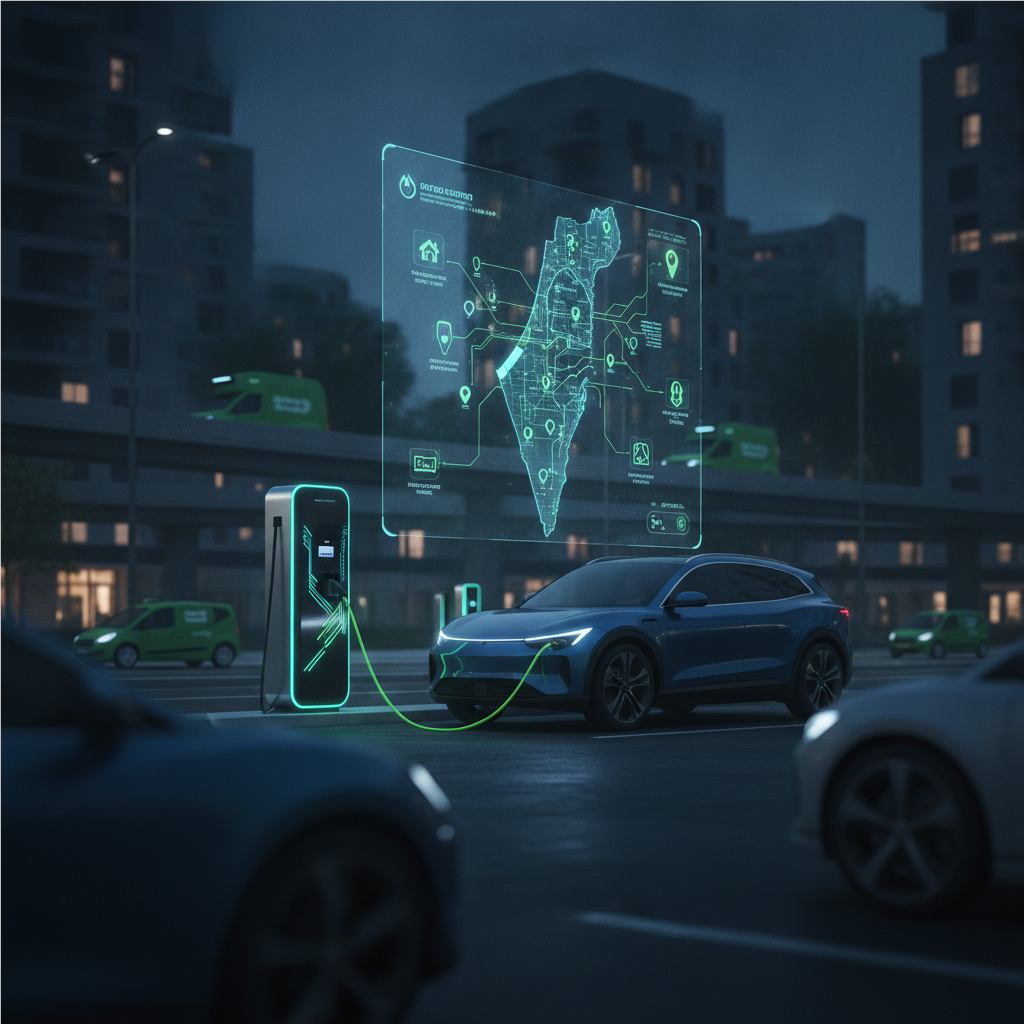
EV charging stations in Israel: DSGCharge's comprehensive guide to finding a professional charging solution

DSGCharge is a leader in EV charging solutions in Israel, with home and public charging stations, advanced DC fast charging solutions and a range of accessories. This guide will help you understand where and how to choose a suitable charging station, the types of charging and the benefits of professional solutions.

EV charging stations in Israel: DSGCharge's comprehensive guide to finding a professional charging solution

With the steady rise in the use of electric vehicles in Israel, the demand for quality, reliable and tailored charging stations keeps growing. DSGCharge, a leading company in the field, provides advanced charging solutions tailored to customer needs – whether for home charging, public charging or complex projects.

In this article, we review the world of EV charging stations in Israel, look at the types of stations, learn how to choose the right solution and present the advantages of working with DSGCharge.

You can compare all the models – from smart home charging stations to managed charging stations for buildings and parking facilities – on the EV charging stations from DSGCharge.

Where are EV charging stations installed in Israel?

Charging stations fall into two main categories: home charging stations and public charging stations. Home charging stations are installed in houses, private garages, private parking lots or yards, and allow convenient and safe charging of the car. Public charging stations are placed in public parking facilities, shopping centers, fuel stations and other public areas.

DSGCharge provides customized solutions for every environment, with an emphasis on safety, convenience and efficiency. The station is matched according to the existing infrastructure and the user's needs.

Types of charging stations: AC and DC – what are the differences?

EV charging stations fall into two main types: AC charging (alternating current) and DC charging (direct current). AC charging is common for home charging, with power levels of 11kW, 7kW and 22kW, and offers slow, convenient charging for everyday use. DC charging enables especially fast charging, with high power levels of up to 480kW, and is mainly suited to public charging and large projects.

DSGCharge specializes in providing solutions in both areas and offers professional advice on choosing the right technology based on the vehicle type, the place of use and the customer's needs.

Advanced charging systems and special requirements

Choosing a suitable charging station also depends on the different applications and requirements. Home charging requires a simple, safe and easy-to-operate solution, while public or industrial stations require systems with remote management, security and communication capabilities (OCPP).

DSGCharge provides advanced charging systems with monitoring and control, protection against unauthorized charging, and compliance with Israeli standards and legal requirements. All installations are carried out by certified electricians, in accordance with the strictest standards.

Tips for choosing a safe and efficient home charging station

When choosing a home charging station, focus on key parameters: station power, compatibility with the vehicle type, product quality and durability, ease of use and professional installation. It's important to make sure the station supports advanced communication technologies and allows flexibility for future expansion.

DSGCharge offers a range of quality home charging stations – from simple charging cables to smart charging systems with ongoing technical support. All products come with a warranty and professional service, and are installed by a skilled team that ensures safety and compliance with standards.

Comprehensive charging solutions for public and business projects

DSGCharge provides advanced DC charging solutions with the highest power levels, enabling fast and convenient charging for all types of electric vehicles. The company offers comprehensive solutions – from simple home charging stations to complex projects that include fast charging stations, management and control systems, advanced accessories and ongoing technical support.

The price of the solutions varies depending on the station type, power, installation complexity and site infrastructure. For an accurate, personalized quote, we recommend contacting the DSGCharge professional advisory team.

For professional advice and a charging solution tailored to your home or project, we'll be happy to help and offer the best products and services on the market. Contact us through the company website or schedule a meeting with our experts.

Frequently asked questions about EV charging stations

How do you choose a home charging station that suits your EV?

The choice depends on the vehicle type, the electrical power available at home and your usage preferences. We recommend consulting a DSGCharge expert for an exact match to your needs and electrical infrastructure.

What is the difference between AC charging and DC charging?

AC charging is slow and mainly suitable for home charging, while DC charging is faster and used for public charging and large projects. DSGCharge offers tailored solutions for every need.

Can you install a charging station yourself, or do you need an electrician?

A charging station must be installed only by a certified electrician, in accordance with the standards and legal requirements, to ensure safety and compliance with electrical requirements.

Share the article:

Already more than

0 +

stations installed

Let us help you

We promise to get back to you in record time with a winning offer!

Which product are you interested in?
  • The cost of a home charging station varies by brand and the station's charging power. There are three charging station power levels: 7kW, 11kW, 22kW (single-phase).

    7kW charging stations are recommended for charging plug-in hybrids (gasoline/diesel-electric) and/or cars that can't charge on three-phase. They aren't recommended for charging an EV, since the time needed to charge an EV will be long. 

    The price of charging stations is affected not only by the station's power but also by whether it has a display and whether it's a smart station managed through a mobile app.

    The price of a simple charging station starts at about ₪1,690 (a promotion at our company for a smart three-phase charging station. The lowest price in Israel!) for 11kW and can reach about ₪4,200 for a 22kW smart station. 

    The price of public charging stations is completely different and is affected by the charging rate, the ability to communicate with computer systems and billing systems. 

    The price of a fast (DC) station runs from tens to hundreds of thousands of shekels.

    The prices above refer to the charging station only and do not include installation. 

  • The cost of charging an EV is significantly lower than fueling a car with a combustion engine (gasoline/diesel). The price per kWh on the residential tariff is 62 agorot (06/2024).

    The cost of driving an EV is around 10% of the cost of driving a combustion-engine car, and that's before accounting for routine servicing, which an EV doesn't need.

    The price of public charging is higher than home charging and is around ₪2.5 per kWh. Despite the higher price at a public station, charging at a public station is still about 60 percent cheaper than fueling a combustion-engine car.  

    There's no doubt that electric charging costs allow cheap driving and may save about ₪15,000 a year, based on driving 20,000 km a year.

    In addition to the savings on driving costs, it's important to emphasize that the annual license fee for an EV is ₪537, while the annual license fee for a combustion-engine and/or plug-in car can reach ₪4,700.

    Bear in mind that the state has already announced that in 2025 a mileage tax (15-25 agorot) will be imposed on EVs. The tax will probably be paid according to the car's odometer at the annual inspection. Even after the mileage tax is imposed, there will be large gaps in driving costs.

  • The cost of installing a home charging station varies by installation location, existing infrastructure, the distance between the electrical panel and the charging station, and the construction work required.

    A distinction should be made between installation in a private house (ground level) and installation in an apartment building. 

    Installation in a private house is simpler, but it too may require laying infrastructure, construction work, chiseling and adjustments.

    Installation in an apartment building is different: it requires a survey of the installation site (virtual/physical) and a signed confirmation that the building committee does not object to the installation. Installation costs in an apartment building are higher than in a private house, and in most cases installation requires construction work, chiseling and adjustments.

    A basic installation starts at ₪2,990 and can reach higher amounts depending on the installation requirements.

    The basic installation price includes laying up to 30 meters of cable. Each additional meter requires an extra charge depending on the station type. In every installation the company installs components in the electrical panel, a circuit breaker and an RCD (Type A), and near the charging station we install an isolating switch. All the company's charging stations are protected against DC leakage current. 

    According to the customer's needs, a meter (kW) can also be installed. A meter is needed when the electricity feeding the station comes from the building's general electrical panel and the building committee must be paid for the electricity consumed. It's important to emphasize that the building committee is not obligated to agree to powering the charging station from the common panel. 

    Each customer can decide whether they want installation by the company and/or prefer to install independently through a certified electrician.

    Installation by the company extends the station's warranty by another year, i.e. 12 additional months.

  • We've encountered quite a few cases where customers living in older houses have a single-phase home electricity network.


    The question is whether an EV can be charged from a single-phase home network. The answer is yes, but charging will be slower.


    A separate line from the panel must be laid to the charging station. A 16A line allows charging at 3.68kW per hour. A 25A line allows charging at 5.75kW per hour and a 32A line allows charging at 7.4kW.

    EV batteries are typically between 50-80 kWh. 

    This means that if the home had three-phase electricity the car would charge in 5-7 hours, while on a single-phase home network the car can be charged

    16 – 21 hours on a 16A line

    10 – 14 hours on a 32A line.

    Needless to say, the car is usually charged when the battery is around 50%, so the car can also be charged on a home network within one night. 

  • The charging time of the car battery varies by the charging infrastructure and the size of the car's battery.  

    Plug-in hybrid batteries are small batteries that charge on 3.7kW single-phase charging stations within up to three hours. 

    EVs are equipped with larger batteries that can exceed 80kW in cars with a driving range of about 450 km. 

    95% of cars on the market today support a charging rate of 11kW. 

    For a car to charge at a faster rate, two conditions must be met together: 

    A. The car can charge at a rate of 22kW.

    B. The electricity network supports charging at 32A and above, i.e. three-phase 40A and above. 

    However, you can ask the IEC to upgrade the infrastructure, allowing the use of more powerful charging stations: 22kW. 

    Even if the electricity feed currently supports three-phase 25A, it can be expanded through the IEC. The estimated cost of expanding from 25A to 40A is about ₪3,000. 

    All of the above isn't relevant to fast (DC) charging stations, which operate at high charging power of 30-350kW. These stations allow charging about 80 percent of battery capacity within minutes.

  • Deciding the charging station location is an important decision that should be guided by where the car parks and the existing infrastructure.

    The distance of the charging station from the electrical panel matters, as do the car's parking spot and the length of the station's cable, which is usually limited to five meters. 

    If you don't park the car in covered parking, the station needs a high level of water and dust sealing: IP54 and above. At our company all stations are resistant to rain and weather conditions. 

    If the station is installed outside the house, it's important to know that a charging pedestal will usually be needed, and its installation involves an extra charge. 

  • A three-phase connection at home isn't mandatory. There are single-phase charging stations that will charge the car, but charging with them will be slow. Single-phase charging stations are mainly suited to plug-in hybrids.

    If you have the option and the home's infrastructure allows a three-phase connection, it's better to install a three-phase charging station. Such a station allows fast charging of the car. 

    If your car requires a single-phase charging station, chances are that your next car will already need a three-phase charging station, so we recommend saving a future installation and station replacement by installing a three-phase charging station today.

  • When choosing a station, you must take into account:

    1. Is it a fully electric car or a plug-in hybrid: If the car is fully electric, a three-phase station should be installed. If the car is a plug-in hybrid, a single-phase station is enough. 
    2. Does the station include a holder for the charging cable: Stations that provide space for coiling and storing the cable protect it from wear and damage. 
    3. Locking mechanism: If the station will be located outside the house, it's important that it can be locked.
    4. Size and appearance: This is of course a matter of personal taste, but since there's a wide range of charging stations there's no reason to compromise on appearance. 
  • The IP rating is a classification of the degree of protection and sealing of the station against dust and water. The rating consists of the letters IP and two digits, defined by the IEC 60529 standard of the International Electrotechnical Commission. The first digit rates sealing against dust and the second digit rates sealing against water.

    IP54: dust can enter but doesn't interfere with the station. The station is sealed against water at 10 liters/minute at a pressure of 80-100 kilopascals. 

    IP55: dust doesn't enter the station. The station is resistant to water at 12.5 liters/minute at a pressure of 30 kilopascals from a distance of 3 meters.

    IP65: dust doesn't enter the station. The station is resistant to water at 12.5 liters/minute at a pressure of 30 kilopascals from a distance of 3 meters.

    IP67: dust doesn't enter the station. The station is resistant to immersion in water at a depth of 1 meter for 30 minutes.

    Stations installed in an uncovered location should have a sealing level of IP55-67.

  • All the company's products are sold with a 24-month warranty, with the option to extend the warranty up to 60 months.

    If the station is installed by the company's installation team, the customer receives a gift of 12 additional warranty months, for a total of 36 months of warranty. 

    The company allows extending the warranty on stations up to 60 months.

    Because the company is confident in the quality of its products, which have been sold in Europe for many years (France, Germany and more), it offers a warranty extension at a nominal price of ₪499  for an additional 24 months. The warranty extension is possible up to 7 days from the station installation date. 

Accessibility Toolbar