
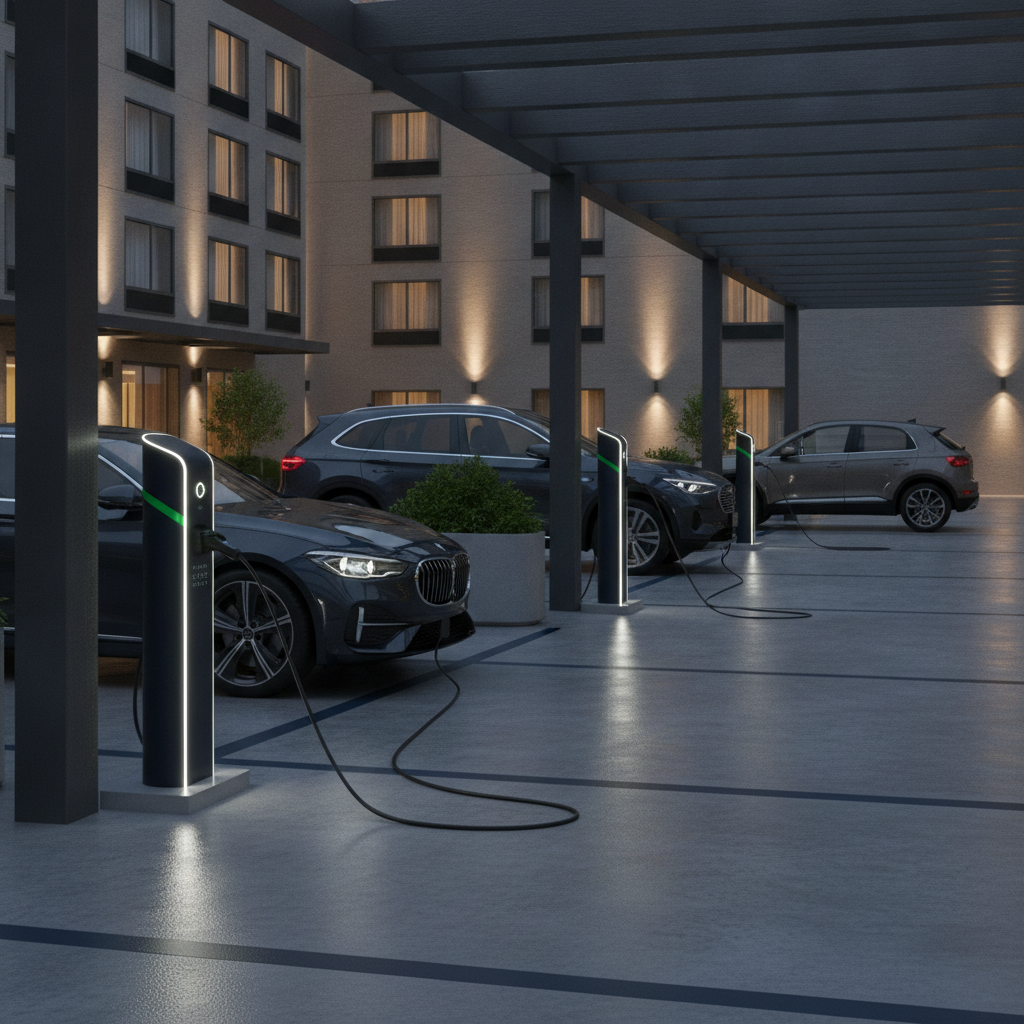
A guest arrives at six in the evening with an electric vehicle that has twenty percent charge left, and leaves the next morning by car. Another guest arrives for a whole week and expects a full charge without giving it a second thought. The challenge for a hotel or guesthouse isn't the same as for a private house or residential building: here there's no permanent resident who knows the station, but a changing stream of guests with different vehicles, short stays, and sometimes an expectation that charging will be a natural part of the service they're paying for.
Hotel and guesthouse managers who look into a charging station quickly discover that the main question isn't “how much does a station cost,” but “how do I plan a number of stations that fits the size of my property, without the electricity facing an unexpected load, and without creating a situation where one guest occupies a station for two days because they forgot their car is already full.” This is exactly the point where proper planning makes the difference between a service that adds value for the guest and a source of complaints and unmanaged load on the property's electrical system.
Why a hotel parking facility is different from a residential building or a private parking lot
In a residential building there's usually a known number of residents, each with one or two vehicles, and a charging pattern that repeats itself: arrive in the evening, charge overnight, leave in the morning. In a hotel parking facility the situation is the opposite. A guest who arrives today won't be here in a week. A vehicle that charges tonight will be replaced tomorrow by another vehicle, sometimes with a completely different power requirement. This means the hotel needs to plan not only by the number of parking spaces, but for high guest turnover and stays that can be relatively short.
Another point that distinguishes a hotel from an office or a commercial building is the hours of use. In an office, most charging happens during the day while employees are at work. In a hotel, charging is concentrated mainly in the evening and night hours, when all the guests return at roughly the same time window and look for an available station. This creates a predictable peak load which, if not taken into account when planning the infrastructure, can lead to a situation where two or three stations simply aren't enough, or the existing electricity on site isn't built to supply several stations operating at the same time.
How many stations do you really need, and what determines it
There's no uniform number that suits every hotel or guesthouse. The right size is derived from several factors: the number of guest rooms and the size of the parking facility, the percentage of guests arriving by private car, and the character of the hotel (a business hotel in the city versus a rural guesthouse, for example, can generate completely different demand). A small hotel with limited parking can start with one or two stations and test the actual demand, while a large hotel or hospitality center with many parking spaces may need broader planning from the start, so as not to have to dig and reinstall a year from now.
The important question at this stage isn't just “how many stations,” but also “what power for each station.” An AC charging station with power suited to home charging may be enough for a guest staying a whole night, but not necessarily for a guest arriving for a short visit who needs a significant top-up in a short time. Planning that takes into account the average length of stay of the hotel's guests is the basis for choosing the stations' power, not just their number.
Electrical infrastructure: what to check before deciding how many stations
Before you start talking about the number of stations and power, there's a question that comes before all the others: what is the condition of the hotel's existing electrical infrastructure. An infrastructure check before installation examines how much load can be added to the existing electrical panel, what the distance is between the electrical panel and the parking facility, and whether conduits, excavation or infrastructure expansion will be needed to connect the stations. In an older building that wasn't originally designed for the power consumption of several charging stations at once, components in the electrical panel itself sometimes need to be upgraded as well.
This check is exactly where DSGCharge comes into the picture already at the planning stage, not just at the installation stage. At DSGCharge, a professional infrastructure check before installation is a built-in step in the process, so the hotel knows in advance whether the existing infrastructure is sufficient for the planned number of stations, or whether an upgrade needs to be planned before moving forward. Skipping this step is one of the common mistakes: a hotel that orders stations without checking the infrastructure may end up in a situation where the stations are installed but not all of them can operate at the same time at full load.
Load management when all the guests return at about the same time
One of the issues hotel managers don't necessarily think about in advance is what happens when five guests return from a day trip between six and eight in the evening, and they all want to plug in at the same time. If the infrastructure and the system weren't designed to support this load, the result can be lower charging power at each station, or even a practical limit on the number of stations that can operate together.
A managed charging system with load management solves this problem smartly: it distributes the available power among the stations that are active at any given time, so if there are five stations but the infrastructure allows a load suited to three stations at full power, the system will divide the power among all the stations actually in operation, rather than overloading the panel or causing a disconnection. This is exactly one of the reasons hotels and guesthouses, like apartment buildings and shared parking facilities, use managed charging systems rather than individual stations connected directly without coordination between them.
Payment and processing: what happens when the guest doesn't know the station
In a residential building, the resident knows which station is theirs and how to use it. In a hotel the situation is fundamentally different: the guest usually arrives for the first time, doesn't know the system, and isn't sure whether charging is included in the room service, billed separately, or requires registration. This is where payment processing and billing come into the picture, an integral part of planning a charging station at a place that hosts a changing clientele.
Some hotels choose to offer charging as an included service, and some prefer separate billing by consumption, similar to the way public parking facilities and commercial centers operate. The choice between the models depends on the business itself, but in both cases you need a system that enables consumption tracking, user identification (whether via an app, an RFID card or coordination with the reception desk staff), and permission management that doesn't depend on a staff member's memory of who charged and when. This is exactly the kind of solution DSGCharge builds for customers with a changing user base: an end-to-end solution that includes the station itself, together with a management system, an app, support forOCPP and payment processing, so the hotel doesn't have to figure out on its own how to bill a guest who will never return to the same station.
What can go wrong without proper planning
- One available station that a guest “forgets” their car at after charging has finished, blocking another guest who is waiting
- Unscheduled load in the evening hours that slows down the power at all the stations
- Lack of clarity for the guest about whether charging is included in the price or billed separately
- Infrastructure that wasn't checked in advance and doesn't support the number of stations the hotel wanted to install
- AC power that's too low for guests staying just one night who need faster charging
Each of these points seems easy to solve in hindsight, but it usually stems from a decision made without sufficiently early planning, before the expected scope of use was understood.
What's worth checking before choosing stations for a hotel
- The size of the parking facility and the percentage of guests arriving by private car, as a basis for estimating the number of stations
- The condition of the existing electrical infrastructure and the distance between the electrical panel and the parking facility
- The average length of stay of guests, as a basis for choosing the station's power
- Which payment model suits the business – included in the service or billed by consumption
- Whether a load management system is needed to support several stations at peak load
A hotel or guesthouse that goes through this process arrives at a consultation meeting with a clear picture of its needs, and not just with the question “how much does a station cost.” This makes it possible to plan a type of infrastructure suited to the character of the property and the actual guest traffic, instead of installing individual stations and discovering later that they don't meet demand at peak hours. DSGCharge specializes in exactly these kinds of projects: planning charging stations for buildings with a changing user base, including infrastructure checks, power matching, a load management system and payment processing, so the hotel gets a solution that works both when all the guests return at the same time and when the mix of guests changes every day.
The total price of such a project varies depending on the number of stations, the type of station chosen, the distance from the electrical panel, whether conduits or excavation are needed, whether it's a single-phase or three-phase connection, and whether a load management system and communication between the stations are required. In any case, the installation itself must be carried out by a certified professional in accordance with the requirements of the law and the standard, and not as a DIY solution based on assumptions.
For anyone managing a hotel or guesthouse who is starting to look into the subject, the first step isn't to choose a station from Charging stations and accessories store in isolation, but to schedule an infrastructure check and a consultation that will examine the property's specific needs: the size of the parking facility, guest traffic and the project budget. That way you can reach a decision that suits the hotel itself, rather than a decision based on what suited another place.
Frequently asked questions
How many charging stations does a small hotel with twenty parking spaces need?
There's no fixed number that suits every hotel, because it depends on the percentage of guests arriving by private car and their average length of stay. It's recommended to start with an infrastructure check and a realistic demand estimate, not a sweeping assumption.
What's the difference between a charging station for a hotel and a station for a residential building?
In a residential building there are permanent residents with a recurring charging pattern. In a hotel there's high guest turnover, each with a different vehicle and a different length of stay, which requires load management and a payment processing system suited to a changing stream of users rather than a fixed group of users.
Is load management needed even in a small hotel with one or two stations?
If there are only one or two stations, load management between stations is less critical, but an infrastructure check is still important to make sure the existing electricity supports the power of the chosen station. As the number of stations grows, the need for load management grows accordingly.