
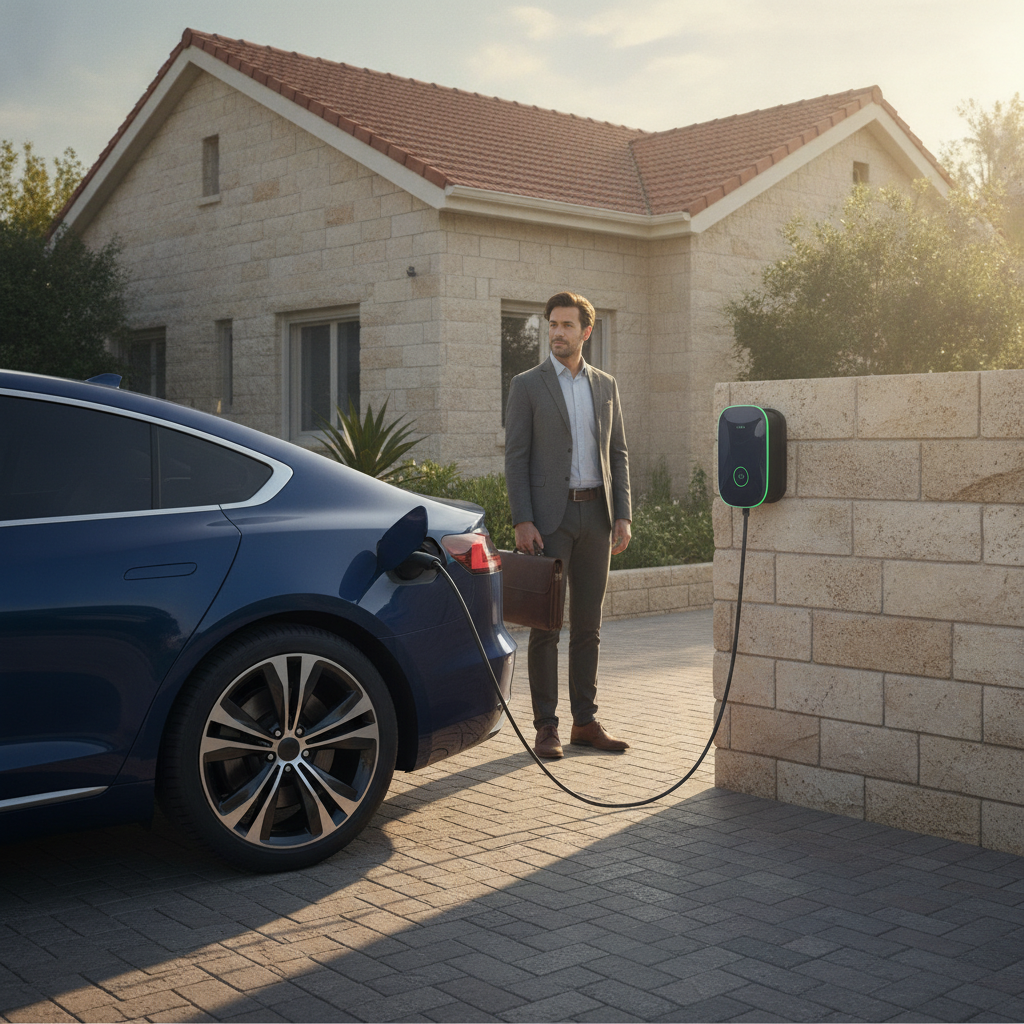
Tuesday morning, a meeting at nine, and before that another stop at a public charging station because last night you didn't manage to get home in time. Sound familiar? It isn't a one-time glitch. It's the pattern that repeats itself every week for self-employed people and small business owners whose electric vehicle is a work tool, not just a way to get to the beach on the weekend.
The difference between those who charge at home and those who depend on public charging stations isn't just a matter of convenience. It affects how you plan a workday, how much time you're willing to devote to distant meetings, and even the decision whether to take a certain trip or postpone it until tomorrow.
The real problem: not a lack of stations, but a lack of control over your time
Israel today has quite a lot of public charging infrastructure, and it's true that the situation improves over the years. But a self-employed person who relies on a public charging station is constantly dependent on something they don't control: a line at the station, an occupied station, an extra drive just to charge, or scheduling an entire set of meetings around the location of a charging station rather than around actual business needs.
In contrast, someone who has a home charging station solves the problem at its root: the car sits and charges while they sleep, while they work from home, or between meetings when they come back to pick up documents. No dependence on outside availability, no line, and no need to plan the day around a station's location.
When do you actually feel the difference in your work routine
Take a self-employed sales agent who travels between clients in central Israel. A typical workday includes three to four meetings, drives between cities, and sometimes a return to the office or warehouse along the way. If the car wasn't charged overnight at home, every additional km during the day takes a little more off the available range – and at some point another consideration enters the planning: “where is there a charging station on the way, and how long will it take.” This is a consideration that a gasoline car owner simply doesn't know, and that a self-employed person with a home charging station doesn't have to deal with either – the car leaves in the morning with a full range, without depending on anything external.
The difference is even more pronounced for small business owners who use the vehicle for transporting goods, for meetings and for deliveries. Every hour spent on tasks that aren't the core of the business is an hour that doesn't generate income. When charging happens at night at home, the daytime hours remain free for what really matters.
What's actually checked at home before installing a station
Before making a decision, there are a few points that are important to understand – and this is true for both a private house and an apartment in an apartment building:
- The type of connection in the electrical panel – single-phase or three-phase, because it directly affects the possible power of the charging station.
- The distance between the parking space and the electrical panel, which affects the required cable length and the scope of the required work – whether conduits, drilling or excavation are needed.
- The existing electrical load in the home, to make sure that adding a charging station doesn't create a load that requires special attention.
- The actual parking location – whether it's a private parking space, a shared parking facility, or a place that requires coordination with a building committee.
These are all points that are checked in a preliminary infrastructure check, not something you can estimate at a quick glance. That's why at DSGCharge the matching process starts with checking these details, not with a generic quote that doesn't take the specific home into account.
Relying on public charging stations – an advantage and a limitation at the same time
It's important to say clearly: public charging stations and public charging are a legitimate and useful solution, mainly for long trips or when it's not possible to install a home charging station. But relying on them as the only solution for a regular workday creates dependence on a variable that isn't under your control – availability, location and lines. A self-employed person who needs to arrive at a meeting at an exact time can't afford to wait for an occupied station. This is the main difference: a home charging station is infrastructure you control, when it's convenient for you, and not when someone else is using it first.
What this actually means for choosing a station
Self-employed people and small business owners usually don't need the highest possible power, but a station that suits their driving routine and the existing electrical infrastructure at home. Some customers choose a station with medium power that suits a full overnight charge, and some choose a station with management and communication options, to know when the car is charging and to make sure charging finishes before they head out. In any case, the right choice starts with understanding the routine – how many km you drive per day, how many hours the car is parked at home, and what condition the infrastructure is in – and not with an arbitrary choice of power “because it's the most powerful there is.”
A short checklist before scheduling a consultation
- How many km you drive on average on a workday, and how many hours the car is parked at home between trips
- Whether your parking space is private, shared, or requires coordination with a building committee
- What type of connection your electrical panel has – single-phase or three-phase
- What the distance is between the parking space and the electrical panel
- Whether there's a need for a management solution or communication with the station, for example tracking charging times
Once you have answers to these points, the conversation with a professional becomes much more focused and faster – rather than a general guess.
How this actually connects to a solution
atDSGCharge The approach isn't to sell a station and be done, but to understand the driving routine and the home infrastructure before recommending a solution. There's a real difference between a charging station chosen correctly for your needs and a station chosen because it's the most popular one at the moment. Before installation, the existing infrastructure is checked, the location of the panel and the parking space is examined, and a solution is offered that suits how often you're on the road and how long the car is parked at home. Anyone who wants to start the process can browse the availableEV charging stations , or also check out accessory charging cables if a special cable length is needed depending on the distance from the panel. If you prefer to understand the process first and only then choose a product, you can also get an impression ofAbout DSGCharge and of the way the company tailors charging solutions to different projects.
It's important to remember that even after choosing the right charging station, the installation itself must be carried out by a certified electrician in accordance with the requirements of the law and the standard, since every installation involves connecting to the home's electrical panel and working with electrical voltage.
In summary: time is worth more than price
For a self-employed person or small business owner, the electric vehicle is a work tool, and every minute wasted looking for a charging station or waiting your turn is a minute that doesn't come back. A home charging station doesn't just solve a technical problem – it gives you back control over your day, and lets you plan meetings and trips according to business needs, not according to the location of a public charging station. If you recognize yourself in this description – the next step isn't to pick a station off the shelf, but to get a recommendation based on your home infrastructure and your driving routine. You can start by requesting advice and a tailored charging solution, and check what exactly suits your home and electrical situation.
FAQ
Does a home charging station really save significant time for a self-employed person who drives a lot?
It depends on your driving routine, but in most cases charging at home while the car isn't in use – for example at night – eliminates the need to plan dedicated charging stops during the workday, which leaves more free time for meetings and actual work.
What What if my parking space is in an apartment building and not in a private house?
In this case too a charging station can be installed, but the process includes an infrastructure check and in some cases coordination with the building committee, to make sure the installation suits the structure of the parking facility and the shared electrical infrastructure.
How do I know which station power suits me as a self-employed person?
The suitable power is derived from how many hours the car is parked at home and how much charging it needs on an average day, not just from the vehicle itself. A consultation with a professional checks this data before recommending a specific station.