
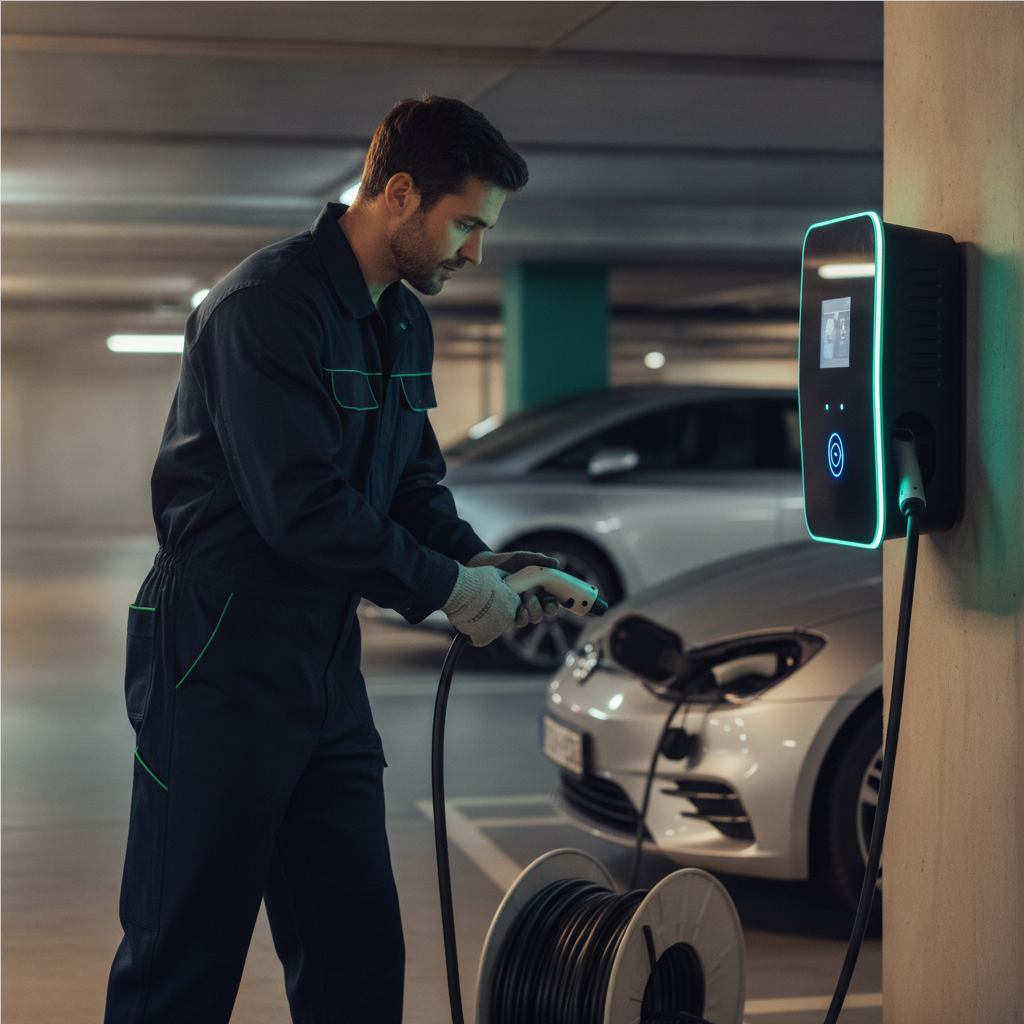
Hassle-free charging station installation: how to spot professional work (and avoid costly mistakes)
You bought an electric car, or one is already on the way, and suddenly a question that sounded simple becomes complicated: where exactly do you install the station? Where do you run the power line from? How will it look on the wall, and will this whole thing turn your parking space into a makeshift construction site? Many people think all you need to do is choose a EV charging station and connect it to the power. In practice, it's the installation that determines whether use will be convenient, safe and hassle-free for years, or whether you'll end up with a solution that works “more or less”.
A proper installation involves safety, appearance, compatibility with the electrical panel, the distance from the parking space, the way you use it, and sometimes also what will happen in two years when you replace your car, add a second car, or find out the neighbors want to charge too. So the difference between a professional installation and an amateur one isn't found in slogans, but in the small details you feel every day.
The most expensive mistake: thinking it's “just connecting a station”
There's a tendency to think the station is the main product and installation is just an accompanying service. But in the world of electric vehicles, the opposite is almost closer to the truth: you can choose an excellent station, but if the installation isn't planned properly, the whole experience suffers. Not because of some big drama, but because of a chain of small decisions that weren't checked in time.
For example, the parking location seems obvious until you discover the electrical panel is at the other end of the building. Or you choose a home charging station with an impressive-sounding power rating but don't check whether the home's electrical infrastructure can really support it. Sometimes the existing connection is single-phase rather than three-phase, sometimes there are existing loads in the home (air conditioner, water heater, cooktop), and in an apartment building the challenge is to avoid a “mess” in the common parking.
That's also why a term like Load management sounds “too technical”, but in practice it's critical. If several large electrical consumers run at the same time, you need a system that can manage the load to prevent the power from tripping. This is exactly where a professional company proves itself: it doesn't just sell a station, it builds a complete charging solution that starts with the infrastructure, continues with professional installation and ends with ongoing management. Keep in mind: a charging station must be installed only by a certified electrician, in accordance with the law and the standards in Israel.
Before drilling into the wall: what a professional preparation checks
The first sign of a professional installation isn't the drill but the questions you're asked before work begins. Where is the electrical panel? What's the distance between it and the parking space? Is it a private home, a covered parking space, an underground parking garage or an apartment building? Is it one station, or do you need to think about future expansion right now?
The second sign is the ability to explain things simply. Not every EV owner needs to know the difference between 11kW, 7kW and 22kW in depth, but they do need to understand what really suits them. Someone who charges mainly at night doesn't always need the same solution as a business or a Vehicle fleet. Nor does every home need the same charging station, even if two neighbors have the same car model.
A professional preliminary check includes, among other things:
- Checking the electrical infrastructure: What type of connection it is (single-/three-phase) and what its capacity is.
- Planning the cable route: How to run the cable from the panel to the station in a safe, concealed and aesthetic way.
- Distance and location: Measuring the physical distance between the panel and the intended station location.
- Required protections: Fitting suitable protective components in the electrical panel to ensure full safety.
- Usage profile: Is it one car or two? A private home, a building, a parking facility or a business?
- Need for a smart solution: Whether an app for control, load management or user billing is required.
None of these items sounds “glamorous”, but each of them affects the price, the complexity of the work and the quality of the result. So when people ask “How much does charging station installation cost?”, the serious answer will always depend on these factors. If someone gives you a final price before checking the site, that's usually a sign to stop and ask a few more questions.
This is especially true in apartment buildings. There, the real questions are: how do you run infrastructure without damaging common property, how do you keep things looking tidy, how do you divide electricity consumption among the residents, and how do you plan a system that won't collapse when the building goes from two electric cars to ten? In situations like these, charging stations aren't just a product – they're a complete system.
You can see a good installation with your own eyes, even before the first charge
There are jobs whose quality you can recognize in a second. Not because you're an electrician, but because the eye immediately understands whether thought went into it. A professional charging station installation looks tidy. The cable route makes sense, the station is positioned for convenient use, the finish is clean, and the station wasn't just “slapped” on the wall wherever it was easiest to drill.
This may sound like an aesthetic matter, but it's much more than that. You encounter your charging station almost every day. If the cable is too short, if you have to maneuver the car every time you park, if the charging handle hangs awkwardly, or if the installer left a protruding conduit in the middle of the walkway – you'll quickly feel that this isn't a solution designed for you.
A clean installation considers several layers at once:
- Safety: A proper route, suitable components, execution according to the standard.
- Usability: Comfortable height, easy access, the right position relative to the vehicle's charging port.
- Visibility: Blending aesthetically into the wall, the parking space or the parking garage, without feeling like a compromise.
In a private home, this can mean cleverly routing the infrastructure so it doesn't “wander” across the entire facade. In an apartment building, it's the difference between a solution residents can live with peacefully and a series of “pirate” installations that create a permanent mess. In a business, it also affects the customer and employee experience: charging stations that aren't positioned correctly convey disorder and make operations harder.
The choice between a station with a built-in cable or a socket only, or the need to buy Charging cables separately, should also tie into the installation planning. A clean installation doesn't necessarily mean a “complicated” or “expensive” installation. It means someone thought ahead, so you don't have to fix things after the fact.
Real peace of mind starts after the installer leaves
Most people aren't just looking for an installation; they're looking to stop dealing with it. To know the station was installed correctly, that using it is straightforward, and that if a question or fault comes up in the future – there's someone to turn to. It's a point people don't always think about when first comparing prices, but it directly affects your satisfaction later on.
When you install a home charging station, the goal is for charging to become a quiet habit: you arrive, plug in, and that's it. No fiddling, no question marks. In an apartment building or a business, this peace of mind is even more important, because it involves several users, varying loads and sometimes also a need for control, permissions or billing.
So when you evaluate a supplier, don't settle for asking “what do you install?”. Also ask “how do you support us?”. Do they look only at the station, or also at the infrastructure? Can they provide a solution both for a private home and for a managed charging system in a building? Can you start with one solution and expand it in the future without rebuilding everything?
A good solution is one that stays relevant after the purchase. Sometimes that means preparing future infrastructure, integrating load management, or simply understanding that what suits one car today needs to suit two tomorrow. Someone who explains this to you clearly, without turning every conversation into a technical show, is probably the right professional.
In the end, this may be the best definition of professional work: not necessarily the most complex job, but the one that minimizes your headaches. One that doesn't force you to compromise on safety, doesn't leave question marks, and doesn't create a “we'll manage” situation every time you pull into your parking space.
If you want to understand what really suits you – in a private home, an apartment building, a distant parking space or a business – the first step is proper planning. At DSGCharge we specialize in building a complete charging solution, from the initial check to ongoing operation. Talk to us for advice and a tailored solution, and we'll make sure your solution serves you faithfully from day one and for years to come.
Quick questions about installing charging stations
Can a charging station be installed in an apartment building too?
Absolutely. In many cases it's possible, but it requires careful planning. The solution depends on the existing infrastructure, the parking location, the distance from the electrical panel and the need for a load management system and cost sharing among several residents.
What matters more: the type of station or the quality of the installation?
Both matter, but an installation that is incorrect, unsafe or poorly planned can make even the best station inefficient. The best solution is a combination of a quality station and a professional installation tailored to your needs and infrastructure.
Is load management required for every installation?
Not always. It depends on the electrical connection size, the desired charging power and the other electrical consumers in the home or building. A professional preliminary check can assess whether load management is needed to ensure the electrical system runs stably.