
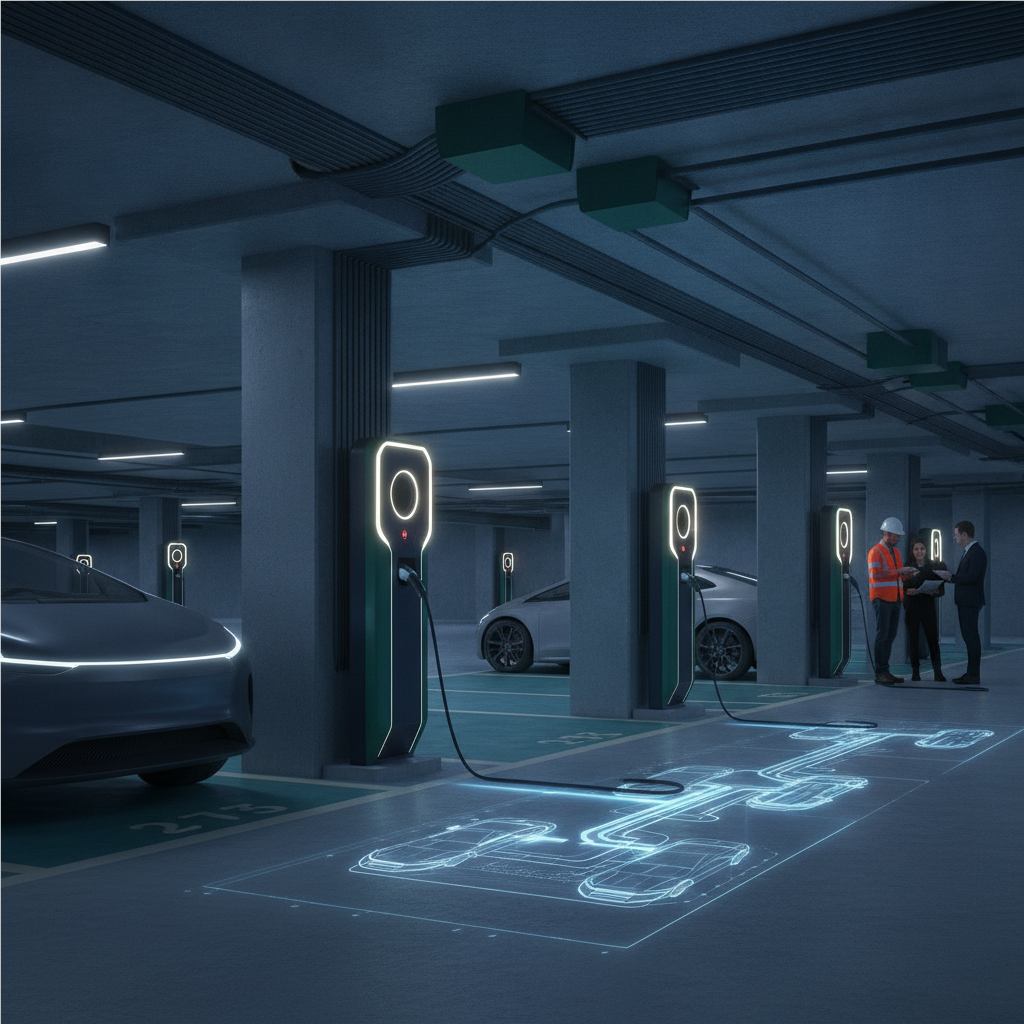
EV readiness in a new building: the developer's guide to avoiding costly mistakes down the road
At the frame stage of a new construction project, when everything is still open and accessible, it's easy to postpone decisions. Another conduit, another cabinet, another small “provision” in the parking garage — it seems we'll sort it out later. But in EV charging especially, the decisions that get postponed are the ones that come back as the most expensive mistake. As soon as the first resident asks to install EV charging station, the conversation is no longer about a single power point, but about infrastructure, load distribution, management, and the building's ability to expand without tearing up half the parking garage.
The need is already here. The question isn't *if* residents will need to charge, but *when* and how many of them will want to do so at the same time. Projects that treat charging as an “extra” rather than an integral part of infrastructure planning build themselves a limitation that will surface exactly when demand starts to rise. Proper planning in advance, on the other hand, saves not only money on future infrastructure work, but also disputes between residents, dangerous improvisations, and an electrical bottleneck that will limit the property's value.
Beyond an empty conduit: what is real “provision” for electric cars?
One of the most common mistakes in planning new parking garages is thinking that leaving empty conduits or a basic pass-through point solves the issue. On paper it sounds reasonable, but in the field it's a recipe for chaos. Charging stations are not standalone devices; they are the endpoint of a system that needs to receive electricity, distribute it correctly, prevent overloads, and allow more users to connect in the future.
When you leave only a general “option”, without planning the full route from the main electrical panel, through sub-panels and to each parking space, the building gets only a partial foundation. The result? When residents start requesting installations, each one becomes a separate project. One installer drills here, another runs a cable tray there, and soon the new parking garage fills up with a “spaghetti” of cables, with no central logic and no ability to manage it. In a modern parking garage, it simply isn't supposed to work like that.
The important question isn't whether there will be Home charging station one or ten, but whether the building's infrastructure was planned so it can support orderly growth. In a building intended for residents who are expected to own Electric (and in the future perhaps two per family), “leaving room” isn't enough. You need to decide in advance *how* the building will manage its charging setup, not just how it will run a single cable.
This is exactly where systemic solution thinking comes in. A company like DSGCharge doesn't just sell equipment, but specializes in planning end-to-end charging solutions – from infrastructure planning, through Charging station installation to advanced management systems. This approach is especially essential in new projects, where the foundations can be built correctly from the start.
Load planning: the key to a parking garage that won't “crash” electrically
Every discussion about charging in a new building eventually comes down to the key question: how much electricity really needs to be allocated? The tendency is to look for a magic number, but that approach leads to planning that is expensive or insufficient. The answer depends on the nature of the project, the number of parking spaces, and the expected rate of expansion.
The common mistake is to calculate as if every parking space needs to receive a fixed maximum power all the time. In reality, not all cars charge together, not all need the same rate, and not every resident comes home with an empty battery. So the right conversation isn't just “how many kilowatts to allocate”, but how to implement a Load management system that will use the existing infrastructure in the most efficient way.
System Load management that is dynamic works like air traffic control for electricity. Instead of allocating a separate, fixed “lane” to each car, it manages the available power and distributes it in real time between the active charging stations. This way, even if the building's electrical connection is limited, the system can efficiently serve a large number of cars without causing the system to crash or exceeding the allocated power.
For contractors and developers, the advantage is twofold:
- Savings on infrastructure costs: Instead of upgrading the main electrical connection at high cost, you can maximize what already exists.
- Future flexibility: The system makes it possible to keep adding more Charging stations in the future on the basis of the same central infrastructure, without complex work.
Poor load planning doesn't just harm the future – it also complicates the present. An electrical cabinet that wasn't prepared properly or feeder lines that weren't designed for growth turn every additional station into an expensive project. This is where a small saving today becomes a large, cumulative expense tomorrow.
A central system vs. individual provisions: a decision that determines the building's future
At first glance, an individual provision for each resident sounds simple: everyone will install whatever they want in the future, whenever they want, and connect to their private meter. The problem is that in a residential building, this simplicity falls apart very quickly. Once there are ten residents with ten stations, ten different installers and ten improvised cable routes, the parking garage becomes impossible to manage, maintain or expand.
By contrast, planning a central system in advance changes the whole picture. Instead of each resident “inventing a solution”, there is a single infrastructure logic:
- Orderly feeder routes from a dedicated electrical panel.
- Planned connection points that make it easy to add stations.
- Management and control of total electricity consumption.
- The option of orderly billing of residents by consumption, which prevents disputes over the common electricity bill.
This doesn't mean every building has to set up a full system for 100% of the parking spaces on day one. But it does mean that the central framework must be planned already at the construction stage. The real value of a new project lies in its ability to grow. A well-planned system gives the building management peace of mind, increases the property's value, and solves not only the charging question but also the question of control and order.
Choosing the right equipment: how do you make sure the infrastructure is still relevant in 10 years?
Once we understand the infrastructure, the equipment selection stage comes. Here too, it's easy to fall into the thinking of “we'll choose a powerful station and that's it”. But EV charging station needs to suit not only the car, but also the building's infrastructure, the type of use and the management system.
In a new project, it's important to choose equipment that will be “future-proof”. For example, choosing charging stations that support an open communication protocol (such as OCPP) ensures that the building won't be “locked” into a single service provider. This allows the flexibility to replace the management system or add equipment from different manufacturers in the future.
The right equipment is the one that fits the building's growth plan. Not necessarily the most powerful or the most expensive, but the one that can be integrated into a central management system, that provides reliable data, and that offers residents a convenient user experience. The same principle applies to complementary accessories. Smart planning also takes into account details such as how to store The charging cables to keep the parking garage tidy and safe.
And above all, the critical stage is the installation itself. Charging station installation or the infrastructure preparation must be carried out by a qualified professional, in a compliant, orderly and documented manner. In a new building, this is the difference between a system that can be easily managed and maintained, and layers of improvisations that accumulate over the years and endanger the building.
What to do now, before the concrete is poured
If you are developers, contractors, project managers or a management company overseeing a new project, this is exactly the time to ask not “how do we check the provision box”, but “which charging solution will best serve the building and its residents in five and ten years?”.
Instead of postponing the decision until the first resident asks for a station, it's worth examining now what's right for your specific project: what scope of provision is required, how to plan the infrastructure routes, whether a central system is the right choice, and how to create a foundation that allows stations to be added in the future without turning every request into expensive infrastructure work all over again.
Proper planning isn't an expense – it's a direct investment in the property's value and residents' satisfaction. If you want to build an orderly plan for your project – not a general estimate, but a solution tailored to the building, the parking garage and the expected expansion – we at DSGCharge will be happy to help. Contact us today and let's plan the charging infrastructure for your next project together.
Questions that come up in almost every new project
Is it enough to prepare an empty conduit for each parking space?
In most cases, no. Conduits are only a small part of the picture. Real provision includes planning feeder routes from a dedicated electrical panel, allocating space for communication and electrical cabinets, and planning a load management system in advance. Without these, the conduits are only a partial solution that will complicate expansion in the future.
Does every new building need a central charging system from day one?
You don't necessarily need to install stations in every parking space from day one, but it's highly recommended to plan the central *infrastructure* in advance. You can start with a limited number of stations and expand in stages, as long as the foundation (feeder lines, cabinets, provision for load management) was planned to support future growth.
How do you plan for future electricity consumption if you don't know how many electric cars there will be?
That's exactly why a dynamic load management system is critical. Instead of allocating huge, expensive electrical power based on an extreme scenario, the system smartly manages the existing power and distributes it between the active users. This way, a growing number of electric cars can be supported on relatively limited electrical infrastructure.