
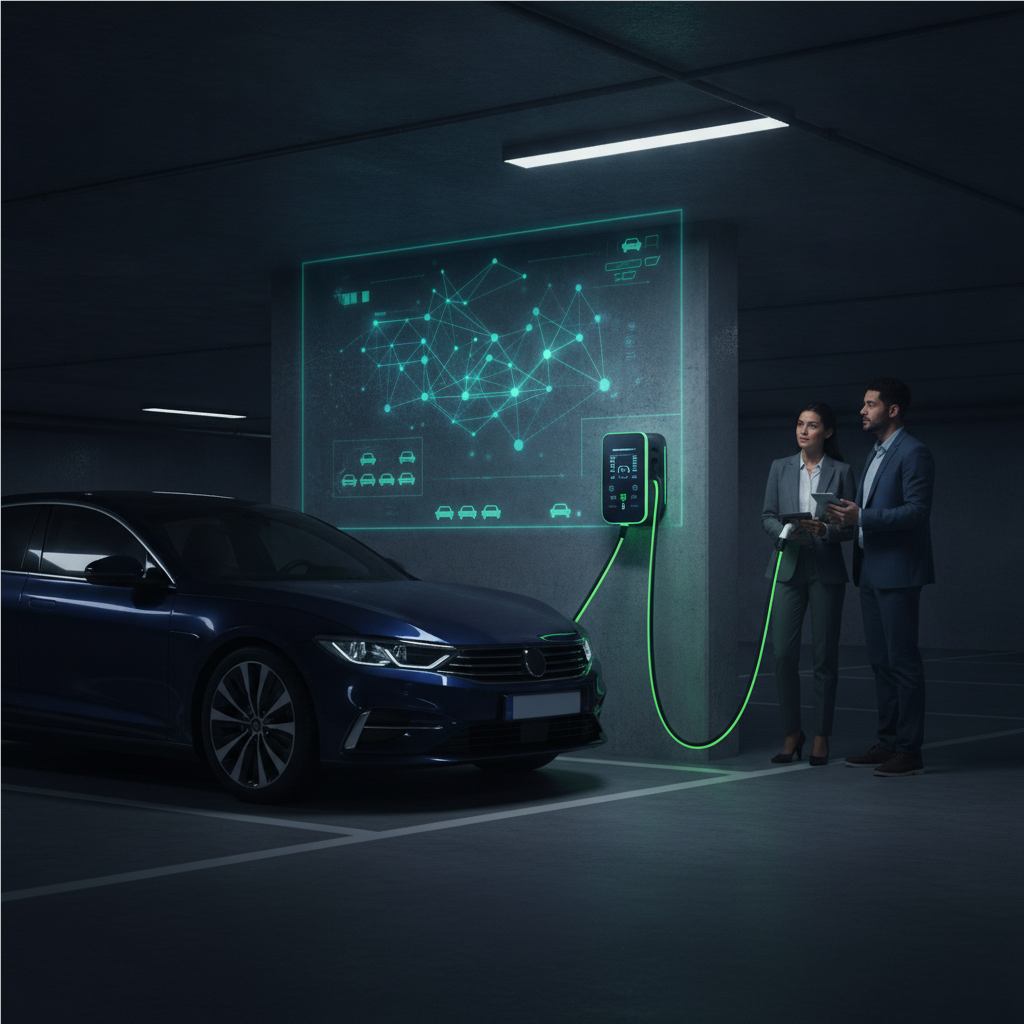
Your neighbor bought an electric car? How to turn one request into an opportunity for the whole building

When the first resident asks for an EV charging station, it is not just a private request but a decision that can affect the entire building. This article explains why one-off installations create a mess and overload, how to properly prepare organized charging infrastructure for all residents, and what the building committee needs to check before starting the process.

Your neighbor bought an electric car? How to turn one request into an opportunity for the whole building

It usually starts very simply: one resident announces in the building's WhatsApp group that he bought an electric vehicle and needs a charging station. Half the neighbors respond with ”congrats”, someone asks whether it's even legal, another already warns about the power collapsing in the parking garage, and within a few minutes a conversation opens up that is no longer about one vehicle — but about the future of the entire building.

And that is exactly the point that is important to understand early: in an apartment building, one charging request is almost never a matter for just one resident. It touches the shared electrical infrastructure, the parking spaces, cost allocation, safety, equality between residents and above all the question of whether you intend to manage this transition in an orderly way — or wait for the mess to pile up.

Preparing charging infrastructure for a building is not meant only to serve those who already drive an Electric car. It is meant to prevent a situation where each resident installs a one-off solution for himself, runs a line a different way, and in the end you get a structure that is not really ready for a growing number of vehicles. When you look at it the right way, the first request is not a headache. It is an opportunity to plan ahead.

The problem is not the first resident. It starts with the fifth

Many building committees tend to view the first request as a private case. “There's only one vehicle now, so we'll deal only with it”. On paper this sounds efficient, but in practice it is an approach that creates complex problems later on.

because EV charging station in an apartment building is not a kettle you plug into a socket. Every installation, even the most individual one, affects the existing infrastructure. The real problem begins when each installation is done as ”firefighting”: one time a line is run from one resident's panel, another time a trench is opened somewhere else, and the third time you discover that there is no more free space in the main electrical panel.

After several such installations, the parking garage starts to look like a patchwork: different cable routes, lack of uniformity, and a feeling that everyone “sorted things out for themselves”. But this is not just an aesthetic matter – it is mainly a management and technical one:

  • Load on the system: Not every building's electrical infrastructure was designed for a world in which several vehicles charge simultaneously. Without central planning and a solution forLoad management, you may discover that the system is working at its limit, leading to power trips or the need for an expensive, unplanned upgrade.
  • Inequality between residents: Once the first resident takes the easiest cable route or the most convenient connection to the panel, those who come after him may find that the solution for them is significantly more complex and expensive. This is a sure recipe for tension between neighbors.
  • Infrastructure mess: “Spaghetti” cables, exposed trenches, drilling and local repairs. Uncoordinated installations not only spoil the look of the parking garage but also make future maintenance harder.

So the right question is not “How do we connect one resident now?”, but “How do we build an orderly path that will allow more residents to join in the future, without taking apart what has already been done each time?”.

The right approach: one orderly infrastructure, even if you start small

Preparing charging infrastructure for a building does not mean you have to install ten Charging stationstomorrow. On the contrary. In most buildings it is right to start with a limited number of users, but to do so on the basis of central planning that can grow along with demand.

Instead of treating each resident as a separate project, you build orderly main infrastructure for the parking garage, define uniform connection principles, examine the capacity of the electrical system, and prepare “busbars” or future connection points. This is the difference between a building that reacts late each time anew and a building that manages the issue proactively.

What is important to check at the planning stage?

  • Condition of the electrical infrastructure: What the building's total capacity is, where the electrical panels are located, and the average distance from them to the parking spaces.
  • Planning a uniform route: How to run cables and trenches in a uniform, safe and aesthetic way that will serve all the relevant parking spaces.
  • Need for load management: Whether a smart charging solution is needed that can divide the available power among several vehicles charging simultaneously, to prevent overload.
  • Metering and billing: How each resident's consumption will be metered and how the costs will be allocated, especially if the connection is made from the common electricity supply.
  • Preparing for the future: Will the planned infrastructure allow stations to be added easily, or will each new resident require additional infrastructure work?

This is not a “do-it-yourself” list, but a framework for thinking. In practice, every such decision must be checked on site by a qualified professional. At DSGCharge, we don't just sell a station – we build a complete charging solution that starts with checking the existing infrastructure and ends with a system tailored exactly to the structure, budget and growth rate of your building.

What the building committee should ask before saying “yes” or “no”

In practice, many building committees don't need more technical information. They need order in the decision-making process. The real difficulty is not understanding what AC or DC is, but knowing which questions to ask before approving a move that will accompany the building for years to come.

Here are some key questions every building committee or management company should raise:

  1. Are we approving a solution for one resident, or building a policy for the whole building? If there is no clear policy, the first decision becomes a precedent, and it is not always the right one.
  2. Will the route chosen today allow more residents to be added without “breaking things” again? This is a question of infrastructure planning, not just momentary convenience.
  3. How will we manage the allocation of consumption and costs? In some buildings this is critical. A managed charging system resolves future arguments about “who consumed how much”.
  4. Is the proposed solution built for expansion? Even if today there are only two electric vehicles, it is important to understand what will happen when there are seven or fifteen.
  5. Who is the professional accompanying us? It is important to choose a company that knows how to plan a systemic solution for buildings, and not just carry out a Charging station installation single.

At this stage, most buildings realize that they don't really need just another Home charging station, but an orderly master plan. That is why it makes sense to turn to a provider familiar with both private homes and managed charging systems for buildings, parking facilities and complex projects.

Turning a private request into a smart decision for the whole building

In the end, this is the choice facing the building committee: handle each request separately, under the pressure of the moment, or use the first request to create long-term order. In most cases, it is precisely when the issue is just beginning that it is easiest to plan correctly. There are fewer constraints, fewer existing installations to take into account, and less of a sense of “facts on the ground”.

A charging solution for an apartment building doesn't have to be complicated, but it does have to be well thought out. That means understanding that the question is not only where one charging station will stand, but what the whole building will look like when the switch to electric vehicles becomes routine. It means preventing overloads, avoiding improvised installations, and choosing a path that respects both the needs of the first resident and those who will come after him.

If you are on a building committee, at a management company or residents of a building where the issue has come up, this is exactly the time to stop and plan. We at DSG Charging Solutions will be happy to build an orderly plan together with you that suits your building's infrastructure, parking garage and needs – not just for now, but for the years ahead.

Talk to us for advice and charging infrastructure planning for your building.

Frequently asked questions

Can you start with just one resident and still plan correctly for the building?

Absolutely. In most cases this is even the recommended move. The idea is not to install stations for everyone in one day, but to prepare central main infrastructure (such as a “busbar”) that will allow every future resident to connect to it easily and uniformly, without the need for complex infrastructure work each time.

Does every building need an expensive load management system?

Not necessarily. The need for load management depends on the size of the building's electrical connection, the expected number of electric vehicles and the type of use. In buildings with strong infrastructure and few vehicles, there may be no immediate need. However, proper planning will prepare the option to integrate such a system in the future, as demand grows. A professional on-site check will give the exact answer for your building.

Which is better: each resident funding their own, or the building setting up shared infrastructure?

There is no one answer that fits everyone, but the most efficient model is usually a hybrid: the building committee or management company leads the setup of central infrastructure with shared funding (or from other sources), and each resident who wants to connect pays for their private station and the cost of connecting to the prepared infrastructure. This approach ensures order, equality and readiness for the future.

Share the article:

Already more than

0 +

stations installed

Let us help you

We promise to get back to you in record time with a winning offer!

Which product are you interested in?
  • The cost of a home charging station varies by brand and the station's charging power. There are three charging station power levels: 7kW, 11kW, 22kW (single-phase).

    7kW charging stations are recommended for charging plug-in hybrids (gasoline/diesel-electric) and/or cars that can't charge on three-phase. They aren't recommended for charging an EV, since the time needed to charge an EV will be long. 

    The price of charging stations is affected not only by the station's power but also by whether it has a display and whether it's a smart station managed through a mobile app.

    The price of a simple charging station starts at about ₪1,690 (a promotion at our company for a smart three-phase charging station. The lowest price in Israel!) for 11kW and can reach about ₪4,200 for a 22kW smart station. 

    The price of public charging stations is completely different and is affected by the charging rate, the ability to communicate with computer systems and billing systems. 

    The price of a fast (DC) station runs from tens to hundreds of thousands of shekels.

    The prices above refer to the charging station only and do not include installation. 

  • The cost of charging an EV is significantly lower than fueling a car with a combustion engine (gasoline/diesel). The price per kWh on the residential tariff is 62 agorot (06/2024).

    The cost of driving an EV is around 10% of the cost of driving a combustion-engine car, and that's before accounting for routine servicing, which an EV doesn't need.

    The price of public charging is higher than home charging and is around ₪2.5 per kWh. Despite the higher price at a public station, charging at a public station is still about 60 percent cheaper than fueling a combustion-engine car.  

    There's no doubt that electric charging costs allow cheap driving and may save about ₪15,000 a year, based on driving 20,000 km a year.

    In addition to the savings on driving costs, it's important to emphasize that the annual license fee for an EV is ₪537, while the annual license fee for a combustion-engine and/or plug-in car can reach ₪4,700.

    Bear in mind that the state has already announced that in 2025 a mileage tax (15-25 agorot) will be imposed on EVs. The tax will probably be paid according to the car's odometer at the annual inspection. Even after the mileage tax is imposed, there will be large gaps in driving costs.

  • The cost of installing a home charging station varies by installation location, existing infrastructure, the distance between the electrical panel and the charging station, and the construction work required.

    A distinction should be made between installation in a private house (ground level) and installation in an apartment building. 

    Installation in a private house is simpler, but it too may require laying infrastructure, construction work, chiseling and adjustments.

    Installation in an apartment building is different: it requires a survey of the installation site (virtual/physical) and a signed confirmation that the building committee does not object to the installation. Installation costs in an apartment building are higher than in a private house, and in most cases installation requires construction work, chiseling and adjustments.

    A basic installation starts at ₪2,990 and can reach higher amounts depending on the installation requirements.

    The basic installation price includes laying up to 30 meters of cable. Each additional meter requires an extra charge depending on the station type. In every installation the company installs components in the electrical panel, a circuit breaker and an RCD (Type A), and near the charging station we install an isolating switch. All the company's charging stations are protected against DC leakage current. 

    According to the customer's needs, a meter (kW) can also be installed. A meter is needed when the electricity feeding the station comes from the building's general electrical panel and the building committee must be paid for the electricity consumed. It's important to emphasize that the building committee is not obligated to agree to powering the charging station from the common panel. 

    Each customer can decide whether they want installation by the company and/or prefer to install independently through a certified electrician.

    Installation by the company extends the station's warranty by another year, i.e. 12 additional months.

  • We've encountered quite a few cases where customers living in older houses have a single-phase home electricity network.


    The question is whether an EV can be charged from a single-phase home network. The answer is yes, but charging will be slower.


    A separate line from the panel must be laid to the charging station. A 16A line allows charging at 3.68kW per hour. A 25A line allows charging at 5.75kW per hour and a 32A line allows charging at 7.4kW.

    EV batteries are typically between 50-80 kWh. 

    This means that if the home had three-phase electricity the car would charge in 5-7 hours, while on a single-phase home network the car can be charged

    16 – 21 hours on a 16A line

    10 – 14 hours on a 32A line.

    Needless to say, the car is usually charged when the battery is around 50%, so the car can also be charged on a home network within one night. 

  • The charging time of the car battery varies by the charging infrastructure and the size of the car's battery.  

    Plug-in hybrid batteries are small batteries that charge on 3.7kW single-phase charging stations within up to three hours. 

    EVs are equipped with larger batteries that can exceed 80kW in cars with a driving range of about 450 km. 

    95% of cars on the market today support a charging rate of 11kW. 

    For a car to charge at a faster rate, two conditions must be met together: 

    A. The car can charge at a rate of 22kW.

    B. The electricity network supports charging at 32A and above, i.e. three-phase 40A and above. 

    However, you can ask the IEC to upgrade the infrastructure, allowing the use of more powerful charging stations: 22kW. 

    Even if the electricity feed currently supports three-phase 25A, it can be expanded through the IEC. The estimated cost of expanding from 25A to 40A is about ₪3,000. 

    All of the above isn't relevant to fast (DC) charging stations, which operate at high charging power of 30-350kW. These stations allow charging about 80 percent of battery capacity within minutes.

  • Deciding the charging station location is an important decision that should be guided by where the car parks and the existing infrastructure.

    The distance of the charging station from the electrical panel matters, as do the car's parking spot and the length of the station's cable, which is usually limited to five meters. 

    If you don't park the car in covered parking, the station needs a high level of water and dust sealing: IP54 and above. At our company all stations are resistant to rain and weather conditions. 

    If the station is installed outside the house, it's important to know that a charging pedestal will usually be needed, and its installation involves an extra charge. 

  • A three-phase connection at home isn't mandatory. There are single-phase charging stations that will charge the car, but charging with them will be slow. Single-phase charging stations are mainly suited to plug-in hybrids.

    If you have the option and the home's infrastructure allows a three-phase connection, it's better to install a three-phase charging station. Such a station allows fast charging of the car. 

    If your car requires a single-phase charging station, chances are that your next car will already need a three-phase charging station, so we recommend saving a future installation and station replacement by installing a three-phase charging station today.

  • When choosing a station, you must take into account:

    1. Is it a fully electric car or a plug-in hybrid: If the car is fully electric, a three-phase station should be installed. If the car is a plug-in hybrid, a single-phase station is enough. 
    2. Does the station include a holder for the charging cable: Stations that provide space for coiling and storing the cable protect it from wear and damage. 
    3. Locking mechanism: If the station will be located outside the house, it's important that it can be locked.
    4. Size and appearance: This is of course a matter of personal taste, but since there's a wide range of charging stations there's no reason to compromise on appearance. 
  • The IP rating is a classification of the degree of protection and sealing of the station against dust and water. The rating consists of the letters IP and two digits, defined by the IEC 60529 standard of the International Electrotechnical Commission. The first digit rates sealing against dust and the second digit rates sealing against water.

    IP54: dust can enter but doesn't interfere with the station. The station is sealed against water at 10 liters/minute at a pressure of 80-100 kilopascals. 

    IP55: dust doesn't enter the station. The station is resistant to water at 12.5 liters/minute at a pressure of 30 kilopascals from a distance of 3 meters.

    IP65: dust doesn't enter the station. The station is resistant to water at 12.5 liters/minute at a pressure of 30 kilopascals from a distance of 3 meters.

    IP67: dust doesn't enter the station. The station is resistant to immersion in water at a depth of 1 meter for 30 minutes.

    Stations installed in an uncovered location should have a sealing level of IP55-67.

  • All the company's products are sold with a 24-month warranty, with the option to extend the warranty up to 60 months.

    If the station is installed by the company's installation team, the customer receives a gift of 12 additional warranty months, for a total of 36 months of warranty. 

    The company allows extending the warranty on stations up to 60 months.

    Because the company is confident in the quality of its products, which have been sold in Europe for many years (France, Germany and more), it offers a warranty extension at a nominal price of ₪499  for an additional 24 months. The warranty extension is possible up to 7 days from the station installation date. 

Accessibility Toolbar