
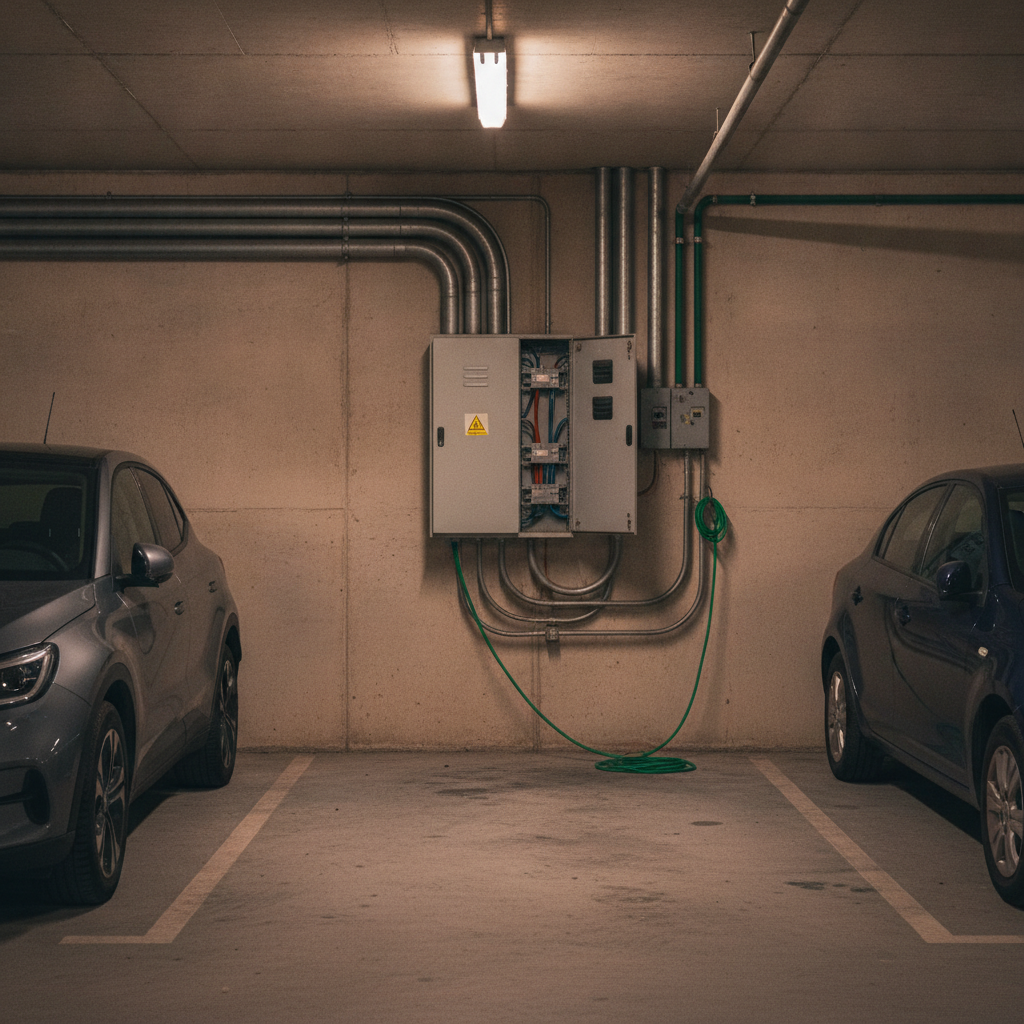
You've got your electric car, and your parking spot has become your own charging point – there's just one step left: getting approval from the building committee. In most cases this is exactly the stage where residents get stuck, not because the committee is opposed in principle, but because the request it receives is too general, lacks details and doesn't give the committee anything concrete to work with.
A building committee, like any body that has to make a decision affecting the whole building, doesn't like uncertainty. “I want to install a charging station” is a request. “I'd like to look into installing a single-phase charging station in my parking space, and I'm willing to fund a professional infrastructure check” is the start of a process. The difference between these two phrasings is exactly what decides whether your request moves forward at the first meeting or gets pushed to the next one – and the one after that.
This article doesn't deal with legal rights or the formal procedure with the committee – those are matters to look into separately with an appropriate professional. It deals with the stage before: what to prepare, check and understand before you even sit down to write the request.
What makes a request to the committee something that can actually be discussed
In most cases, a building committee doesn't oppose a charging station because it's against electric cars. It opposes – or avoids deciding – because the request arrives without answers to questions it's sure to ask itself, or that another resident will ask. Questions like: where exactly will the station be, is there already electricity near this parking space, who will be responsible for the electricity consumed, and what happens if another resident wants a station in a year.
When your request comes with initial answers to these questions – even if they're not final – you move the discussion from “is it even possible” to “how do we do it right”. That's a significant change in the dynamics of any committee meeting.
What basic information to gather before you approach the committee
Before you write even one word to the committee, it's worth going over a few basic points that will help you phrase a request in language the committee understands:
- The location of your parking space in the parking garage – next to an exterior wall, inside a parking structure, close to or far from the main electrical panel. This directly affects the complexity of the installation and the length of cable needed.
- Your household connection type – whether the electricity in your apartment is single-phase or three-phase. This detail will affect which type of station is relevant for you and how the possible power ratings are presented.
- The condition of the building's main electrical panel – if you know the building has had infrastructure renovations in the past, or that the panel is old, this is information worth sharing right from the initial stage.
- Whether other residents have already looked into something similar – if so, you already have natural partners for the process.
You don't need to know the exact answer to each of these details – some of them actually require a professional on-site check. But simply coming with awareness of these questions, and not just a general wish “to install a charging station”, changes how the committee perceives the request.
How to involve other residents in the process without complications
In apartment buildings, one of the common mistakes is approaching the committee on your own behalf only, thinking it's “my issue, not everyone's”. In practice, a building committee usually prefers to know whether other residents may request something similar in the near future – because that changes the picture from a single request to overall infrastructure planning.
You don't have to open with a public outreach campaign. A short conversation with a neighbor or two who you know are also considering an electric car is enough, just to check whether it makes sense to present a broader picture to the committee. If it turns out several residents are interested, you can ask the committee to consider, in advance, planning that takes into account that more stations will be added in the future – even if at this stage only you are really moving forward.
Why a preliminary infrastructure check can change the whole conversation
One of the most direct ways to steer the discussion with the committee toward something practical is to come not just with a wish, but with a professional snapshot of the existing infrastructure. A preliminary infrastructure check – which examines the condition of the electrical panel, the distance from the parking space and the existing load in the building – is what allows the committee to understand what the request actually involves, rather than just discussing it in principle.
This is exactly the role DSGCharge plays for residents starting this process. DSGCharge installs EV charging stations in private homes and apartment buildings, and one of the central parts of the work is a professional infrastructure check before every installation – that is, an inspection carried out on site, not based on general estimates. For a resident who wants to approach the committee with something concrete in hand, such a check can turn the request from a wish into a working document the committee can actually discuss.
It's important to emphasize: the infrastructure check and the charging station design must be carried out by a qualified professional, in accordance with the relevant legal and standards requirements. This isn't a check you can do “by eye” or settle for a general estimate – the condition of the electrical panel, the distance from the parking space, single-phase or three-phase, and a possible need for load management when there are several stations in the building are all variables that need to be examined in practice.
The actual installation cost, when you get to that stage, depends on several factors: the type of station and the power chosen, the distance from the electrical panel, the connection type, whether conduits, digging or drilling are needed, and whether a load management solution is required when the building plans several stations. These are exactly the data an infrastructure check provides – which is why it's an important step before any budget discussion with the committee.
Planning to approach the building committee with a request to install a charging station and want to come with professional information, not just a general wish? You can contact DSGCharge for an initial feasibility check and a solution tailored both to your apartment and to the character of the building.
To understand what DSGCharge offers at the next stage, you can take a look at theEV charging stations available in the store, and also check which charging cables and accessories may be relevant depending on the distance of the parking space from the electrical panel – a detail any serious building committee will ask you about.
If you'd first like to understand who's behind the solution before presenting it to the committee, the About DSGCharge page gives a picture of the areas of work: home AC charging stations, DC fast charging stations, professional installation and charging management systems for buildings with several residents.
What to bring with you to the meeting with the committee
Before you walk into the meeting, or send the request in writing, it's worth going over a short list:
- A short description of the parking space location and the estimated distance from the building's main electrical panel.
- A detail about your household connection type – single-phase or three-phase, if you know it.
- A note on whether other residents have expressed similar interest, even informally.
- An open question to the committee about the condition of the main electrical panel – you don't have to know the answer, but it's worth asking in advance.
- A proposal to carry out a preliminary professional infrastructure check, so the committee's discussion is based on data rather than estimates.
A request that comes with this list, even partially, looks different to any building committee – it shows the resident has already thought about the impact on the building as a whole, not just about their personal need.
The process from the building committee to a working charging station takes time and involves several stages. But the right preparation at the first stage – before the first word is spoken at the meeting – is what usually decides whether the request becomes a real project or remains a topic that comes up at every meeting without moving forward.
📊 In brief: key points of the article
What makes a request to the committee something that can actually be discussed
In most cases, a building committee doesn't oppose a charging station because it's against electric cars. It opposes – or avoids deciding – because the request arrives without answers to questions it's sure to…
What basic information to gather before you approach the committee
Before you write even one word to the committee, it's worth going over a few basic points that will help you phrase a request in language the committee understands:
How to involve other residents in the process without complications
In apartment buildings, one of the common mistakes is approaching the committee on your own behalf only, thinking it's "my issue, not everyone's". In practice, a building committee usually prefers to know w…
Frequently asked questions
Can you approach the building committee before you have a final quote?
Yes, and it's even advisable. Most committees prefer to know in advance that there's an intention to look into the matter, and to be involved from the planning stage. An accurate quote depends on an infrastructure check that's only carried out at a later stage.
What happens if the committee asks how this will affect other residents?
That's a legitimate and reasonable question. The more information you bring about the condition of the infrastructure and the possibility of planning that takes future expansion into account, the easier it will be for the committee to discuss it calmly rather than out of concern.
Do you have to involve other residents in the process before approaching the committee?
Not necessarily, but it's recommended to check whether other residents are interested in something similar. This can change the way you approach the committee and turn it from an individual request into a broader infrastructure discussion, which committees tend to take seriously.
Who should check the infrastructure before you submit the request to the committee?
An infrastructure check should be carried out by a qualified professional, in accordance with legal and standards requirements. It isn't something you can self-assess – it requires an actual examination of the electrical panel, the connection type and the distance from the parking space.
How long does it take from approaching the committee until the charging station is actually working?
The time frame varies depending on the complexity of the committee's decision, the results of the infrastructure check and the scope of installation required. An exact timeline can't be guaranteed without examining the specific case.